
The manager at my local branch of the brick-and-mortar retail store GameStop went so over-the-top with his “customer service” delivery today that I left the store feeling suspicious and uneasy. What I found out about the motives behind the manager’s overzealous push will keep me from returning to GameStop.
My newly six-year-old son received a GameStop gift card as a birthday present. GameStop gift cards are popular in this area, as many of the children have gaming platforms (e.g. Wii, Xbox) as well as personal systems (e.g. Nintendo DS). My son couldn’t wait to spend his card, so we went today after school.
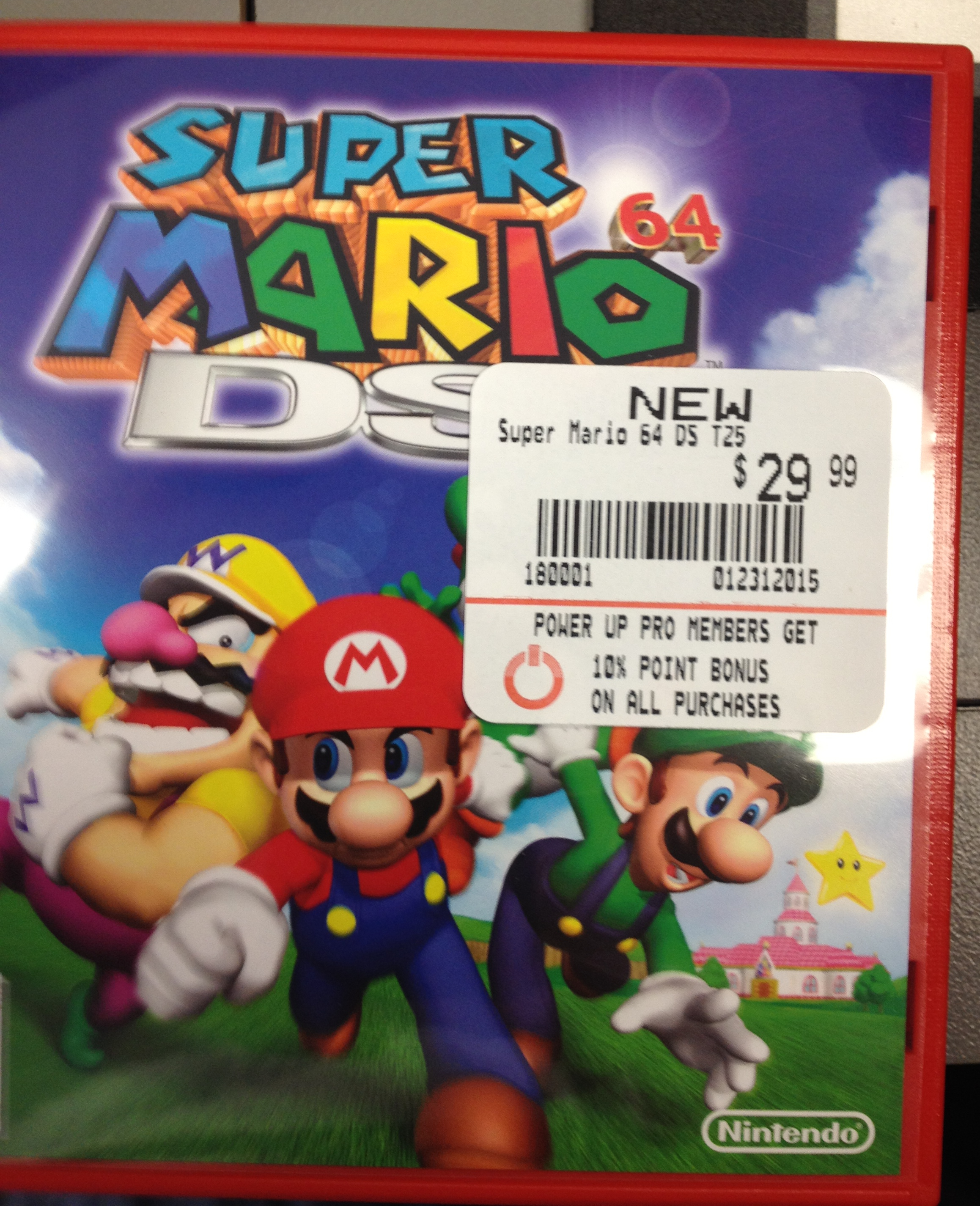
The game I wanted to buy
He browsed a bit and settled on a Mario Bros. game for the DS. I took the new box up to the counter (all the games inside all the boxes in the store have been removed to avert theft. I don’t like this idea, because I prefer untampered products, but I understand). I put the box down on the counter and took a picture of the game cover to text to my husband; I wanted to make sure we didn’t already own the game.
The manager, or, the man I know as the manager (generally a nice guy) was the only employee in the store. I didn’t hear back from my husband, but I felt pretty sure the game wasn’t one we owned. I presented the box to the manager.
Without being asked, he said, “I think I have this used” and proceeds to look up the game in his “used game” file.
I paused. I have a general aversion to used games.
The manager said, “Yup, I have it,” and puts the used game cartidge only (no box) on the counter and rings it up before I could say anything. He answers the phone during the transaction (understandable, as he was the only one in the store, but honestly? What kind of policy is that?).
I handed him the gift card for $25.00 and an extra dollar for the .75 cents left on the bill.
When the transaction was completed, I stood in wait; I expected a case and a cover as well as a book. I’ve bought used games once or twice before and they’ve come with these packaging materials. I had no idea GameStop sold only the cartridges mostly, that I must’ve had rare “full box” experiences with my used game purchases in the past.
I said, “Where’s the box?”
The manager said, “This is how it comes.”
“What?”
“That’s how most people trade them in. I can give you a case, if I have one. You can get all the other stuff online.”
I thought, I have to print out the cover? Then he hands me a case with a big rip in the plastic.
I said, “I’d rather have the new game. Take this all back.” I gave him the lonely little game cartridge back and the receipt.
“You’ll pay 9 dollars just for the case?” he asked. At this point, he should have just apologized for the misunderstanding and taken the return. Instead, (I think) he went to answer the phone again. (He was the only one in the store, so this is kind of OK).
I paused again and looked at the new game price. When he was present again, I said, “This isn’t 9 dollars more.”
“You just paid 25 and for that with taxes you’d pay 31.” he said. (I paid $25.75 and the new game would be $31 and some odd cents. It wasn’t more than 6 dollars difference).
“Yes, but I hate looking at this,” I said, as I held up the crappy black cover.
“Who looks at the stuff anyway? All the instructions are in the game. All the information in the book is online. It’s not worth 9 dollars.” (again with the fuzzy math).

This is the case I got
“I’d rather just have the new game.”
Then he answers the phone or otherwise goes away. I was left standing there, mumbling about the cover missing and how I hated looking at black covers (not white) without an insert (no official cover), the manager said, “Well, have him try the used game and if he doesn’t like it, you can exchange it and you haven’t bought the new one.”
This last point is a good point. I get it. But my son is 6, and he doesn’t like much for long. He does revisit games as he grows, though. He also has our 11-year-old daughter with whom to share games. I’d rather have a new game that I can put on my shelf along with the others, lined up like books so I can read their spines. I’m an organized person who likes to keep things neat. Also, we sell games back occasionally and I take pride in treating people and things with respect, and teach my children to do the same. It’s worth 6 bucks to have an in-tact product. AND I actually do read the inserts & use the online codes. (By the way, I don’t need to justify my desire to pay GameStop an extra six bucks for a new game.)
At this point the manager, with his tone and his body language, basically communicated to me that I’d have to argue with him to get the new game. This, I decided, wasn’t worth it, especially since my son and I were both well overdue to eat lunch.
On the short drive home, I began to wonder why the manager “helped” me so much. His insistence on the used game bordered on weird. The fact that I left the store feeling bamboozled into buying an inferior product started to anger me.
As lunch was cooking, I remembered my basic capitalism education: there is a reason behind every sell. What could the reason be here? Why sell these used games so strongly? It must be profit margin. That was the only logical choice.
I took my suspicions to Twitter. More than a few savvy users confirmed it: The profit GameStop makes on used games is far, far higher than the profit on new games, even though new games are at a higher price point. GameStop buys back games at a low price and then sells them for the majority of the new sticker price (of course, this is without the cover, the box, the original instruction booklet or any of the inserts, as well as unused online access codes unique to the game). They sold me a game at $25.75 out of a possible $31.17 (I’m guessing on the cents, but it’s around there), so at about 80% of the new price. GameStop most definitely paid much less than $25.75 for this used game

Notice the custom-sized shelf for DS games.
(impossible to know how many users the game had, by the way).
New games on wholesale probably are at least 80% of the price. So say GameStop makes 6 bucks on every sale of new games. So if the store pays less than $19.75 ($25.75-$6.00=$19.75) for used games, which, they do (and as I said, this game may be used and used and used), then their motivation to re-sell the used game is much stronger than their motivation to sell the new one. They’ve already paid the wholesale price for the game, so pretty much anything they make on it afterwards, even with the buy-back money they put out (which they usually give in store credit, of course – even more money saved for GameStop), is pure gravy.
So the manager (who, as I do want to stress, is a knowledgeable and nice guy. Usually) was not just “being helpful.” He was pushing his profit margin instead of listening to me. I didn’t want the used game. I also didn’t want to justify my purchasing decisions. I just wanted the new game. He should have taken the new game and asked me, “Would you like to save a few dollars on a used game? They don’t come with the box but they are much less expensive.” I would have said, “Thanks but no, I want the new box. Call me crazy” and my whole dust-up on Twitter and this blog post wouldn’t have happened. Plus I may still be considering shopping there. Not any more. Now I know he wasn’t trying to be helpful to me at all.
Some friends on Twitter told me to complain to the GameStop district manager, but honestly I don’t see the point. The store’s model, their whole business theory, is based on re-selling games. They aren’t going to tell a store manager to stop pushing them. That’s the majority of their profit margin. My little complaint will do no good, except for the manager being trained to be more subtle (and evil) with his push.
My friends tell me Amazon is a decent alternative to GameStop. We are GameStop members (pay $16 bucks a year for discounts, but guess what, only on USED GAMES) but I’m going to pursue the Amazon option. I predict GameStop will go out of business if they don’t insist on selling decent-looking used games for a better value than 80% of the new game price (and that was with my discount!). More and more women are buying games for kids and themselves. Daughters have personal gaming systems of their own (my daughter games a lot. GameStop ignores her as a gamer.) DS ownership in adult women is rising (my own mother has one) and women don’t, in general, buy crappy-looking stuff. We are also smart shoppers who know the value of products. A game without a case isn’t worth 80% of the new price. If GameStop doesn’t have the women going forward, they won’t survive. (Their email and print flyers are so male-oriented that I don’t even read them. I unsubbed today). If GameStop doesn’t figure out how to market to and treat girls and women as customers, and if they don’t construct a better business model than “used games profit margin” they will be dead within 5 years. If you have stock or work there, strongly consider something new now if possible.
Any thoughts, gamers?
-Christine Cavalier
Comments on this entry are closed.
He should have listened and it sounds like he was being the typical awkwardly over assertive type that you see in a lot of tech retail types. I can also see where he’s coming from. During my brief tenure as a DS user, I carried all my games (cartridge only) in my DS case. I just threw the boxes aside.
The used factor isn’t too big of a deal either. Generally, those nice, smartly closed up plastic cases hold up pretty well. All my old Nintendo NES games (the original) still play fine, and they are — what — twenty years old? So why spend more?
But he was pushing his own margins and not really helping you. On the other hand, he’d already made most of the money you spent, anyway. He would have made more if you’d never redeemed it, so what did it matter either way to him?
I think probably 99% of his customers would rather buy used, so that’s probably where he was operating from.
99% of his customers aren’t enough to keep the business afloat. They’re sinking. They need me and my daughter, and the next generation of girls after her. I doubt that women gamers are going to get assimilated into the culture; Women are the Borg and All Your Base Are Belong To Us. GameStop accommodates us or dies.
-Christine
Now you’re scaring me. You sound just like my wife. 😉
I thought you looked familiar. 🙂
Yep, they pay much, much less. My daughter just traded in ALL of her DS games, as well as her DSi. She had a ton of games, and they gave her anywhere from 2-5 bucks apiece, as I recall. Now, she was actually in the market for a Wii, so when she traded them in she took store credit instead of cash, which is higher (they tack on a couple of extra bucks per game.) As I understand it they base the price they pay for each game on its current demand. In the end, my o-spring came up with enough store credit to walk out with a brand new Wii (they didn’t have any used units to push) and a used game she wanted.
Whether or not she got the best deal she could have, I can’t say. Our other option was e-bay, and we may have been able to get her more money, but being a tween she was on the impatient side, as I’m sure you understand. So, as it was, it came out a wash for her – she gave up all of the games and the DSi she was no longer using, and walked out with the Wii she wanted.
I guess it largely depends on what you want to get out of the deal – However, they DEFINITELY push the used games and equipment because that is where the dollars are for them.
MR,
Yes tween girls don’t wait much. Would your daughter have bought a used Wii? What if it came in a crappy box? Would she have still bought it? Good for you for making her work for what she wants, though. I commend you.
I wonder what your daughter would think of the GameStop flyers/emails. Oh wait, she’s a tween. She think emails are for old people.
-Christine
Pretty much… Now, if they sent her texts…
On the used thing, probably. She doesn’t care much about the boxes – in fact, she wasn’t even able to find all of the cases for her used games she traded in. Fortunately for her, that didn’t adversely affect the trade in value – as you have discovered…
That’s a bit odd for him to not ask you if you wanted it new and to just offer the used, but as an employee for GameStop, I find myself pushing used, not to increase profit margin, but to decrease the number of angry customers that come in trying to return opened, new product. To be honest, the manager probably wasn’t pushing used for the reason you thought he was. He was probably pushing it so hard because EVERY DAY, most of us get an angry customer who yells at us for our return policy, even if it is printed on the back of the receipt. Also, take into consideration that all prices for new product are set by the manufacturer. That’s why you’ll find a game like CoD:MW3 for 59.99 everywhere brand new (at least when it first came out). So, unless GameStop increased prices for those games, or brand new accessories/systems, then GameStop doesn’t make much of a profit off new items.
Consider that Walmart/Target/Everywhere else that sells just about everything sells, well, just about everything, so they make plenty of money off of other stuff and don’t need to worry about selling used games and such.
As for ds games and their cases… I’m in the same boat. I prefer my games with their cases… But if we turned away every trade in that people brought us that didn’t have their original casing, then you wouldn’t see games like New Super Mario Bros. used… Ever. Little kids typically aren’t meticulous, and they typically lose cases and instruction manuals.
Overall, the manager wasn’t trying to cut you a bad deal or anything. Sure, his customer service left much to be desired (to me, people in the store take priority. People on the phone can be put on hold). To me, it seems like he was trying to make it easier on you (and him), since little kids are well known to us GameStop employees as the number one criminals of trying to return opened new product. He was trying to save you (and him) a headache. 🙂
As for complaints about trade-in values and such… That’s not the manager’s fault. That’s all set by corporate. So for other commenters complaining about how much we gave you for your games, stop being so lazy. If you want more, then you actually have to put in the effort and try to resell them online. It is your own fault for that. Don’t blame GameStop for that >.>
But don’t feel too important about yourself. GameStop makes enough money off of used stuff that (at least on the West Coast), pushing used isn’t really a primary objective. So, again, it wasn’t really about profit margin for his store.
-And to the commentor about the Wii… Buying used is sometimes a good deal, but unless it is, we generally don’t push it. For example, I never really push used PS3’s, since you’ll probably want a warranty on top of the $230, putting you at $260… When a brand new 160 GB is only $250 and comes with a year manufacturer’s warranty through Sony. Yep…
*And on another note, PowerUPRewards (which may have been Edge the time you were in there… Can’t remember) saves you money off of used games/accessories. I know I push used when someone could save a ton of money off of used. Especially since my store is located in one of the less classy areas.
Don’t get me wrong… I have my reservations about GameStop… and certain bad practices… But that’s not one of them.
Sorry, I’ll have to disagree though… GameStop will survive… And flourish. It has close to a monopoly on used games.
Thanks for weighing in. This adds perspective to the conversation somewhat. Profit margin still seems to be the key, though.
Perhaps the return policy should be revised. If the policy is too restrictive to customers and a pain in the neck for employees, then re-write it. There could be a level of return of a new item that is above the used-game-no-case-no-book trade in. The extreme nature of the return policy is what is the problem here, it seems.
Also, I have no idea why a used game with no case, no book, is sold at the same price as one with the case and book. That makes no sense.
As for selling online, I think that’s what we’ll do. First you say that people are lazy for not selling online. Next you say that gamestop will survive. It doesn’t seem like gamestop will survive if users get familiar with selling online.
Donating them to the public library in your township also is an option, and one I’m going to look into.
Thanks again for coming.
-PC
Funny, I asked today about a used game in the little glass cases they have and they said “Oh, we have it for $20.”
“$20 for that thing?”
“Yeah, new…. Wait, did you want it used? That’s $10.”
I almost bought it, but I had the mind to ask if it came with its original packaging.
The answer? Nope. I walked out.
Lute,
Glad to hear someone else likes to have the original packaging. I don’t mind used, but I’d like it to be still decent looking.
-PC
Woah,can you help me? I want to buy a used game,it costs 28.?? With the box thing(its kind of new looking though.) but I saw another game that has no box,more expensive,but with more features. Its pokemon explorers of darkness(box) and explorers of sky(no box) which should I choose?
I would suggest you look for reviews of the games online. Also, look for Internet downloadable features. These are often disabled after the first download and do not work on used games. As for the box, the completeness of the set (instruction books, etc), you can make your own decisions. I personally think Gamestop’s used games look like crap. If Gamestop knew anything about psychology of buying, they’d remedy this. But you can decide on your own if you think the games are crap. I know based on research that I will inevitably devalue the games because of what they look like.
Good luck.
PurpleCar
Thank you, I decided to buy explorers of sky instead of explorers of darkness. My friend let me try out her darkness one,and I noticed the difference between both. I think the box doesn’t matter,its the game that counts.I don’t mind paying a bit more for it.
Thanks for helping. =D
After twenty years of buying and trading games, I can saefly say Gamestop is one of the worst places to shop for games. If all you intend to do is purchase a game, then go to Amazon, or eBay. I prefer Amazon. The prices are more often than not, better than Gamestop.
Gamestop is only good for trading in games, or specific pre-order bonuses. Even then, trade ins only when they have “deals” like added +50% bonus to the credit. Even still, Amazon and eBay are better for outright selling games.
Gamestop is only a better choice if you’re in a hurry, and don’t want to deal with the hassle of selling directly.
I went in recently due to a combination of 50% bonus for all trade ins and Lollipop Chainsaw being on sale for forty dollars. Otherwise I would have shopped online.
The guys were really nice, but boy did they push a used copy hard. They even began preparing the one used copy they had even before I was able to insist on a new copy (I want the money going to the developer/publisher to show my support for their game). They even tried to tell me that the new copy was ten dollars more. (it was around three).
I looked all of this stuff up online first, and knew the prices.
Ultimately I insisted and got a new copy. They were cool about it, but a less assertive person would have felt bullied. I know I have in the past.
Also, they allow employees to take opened (display) games home, and play them over the weekend, and if they are still is perfect shape, they’ll sell them as new.
Fiachsidhe,
Thanks for sharing your story. I see I’m not the only one who feels the ridiculous push of the used games. Does Gamestop hold employees’ secrets over their heads or something to get them to push the used games with such fervor? It’s bordering on a Stephen King plot.
I agree with you about wanting the game makers to get the bulk of my sale, as a sign of appreciation. I want them to keep making the games I like. It’s a no-brainer. I’ll avoid Gamestop and move over to buying my stuff online from now on (because, don’t get me started on Best Buy…).
-PC
Well from what I heard, job security isn’t exactly solid at Gamestop. Employees are treated like garbage and hours usually suck. So I have a feeling each location needs to fight tooth and claw to impress their regional managers with higher profits.
Gamestop has a long history of shady business practices, and crappy employee care.
Great. Yet another place that disrespects employees, just because they can. I’ll bet you are correct about the competition between stores. It’s a shame! As I said, the employees at the store I mentioned are great guys, but I won’t shop there anymore, due to their hard sell of the used and battered games.
I stopped reading about half way through, but I just wanted to mention that I feel the exact same way about wanting a cover and the papers and stuff, it just looks nicer, i don’t want to disrespect my property by just throwing all the games in a box or something.
I agree, it is disrespectful. I treat my belongings with care.
Christine Cavalier
I am an employee of Gamestop so I can confirm this. To answer your question when the next wave of consoles comes out there is going to be a push to move things towards the digital business model. This will mean, almost assuredly, that Gamestop will be going out of business because they make all their money on reselling physical copies of games which the game companies receive no share of. Going digital lowers the price of games and allows the companies to receive all the profits. Kiss Gamestop goodbye and get ready to embrace digital.
Thanks for weighing in. If Gamestop wants to survive, then, they need to have their own distribution models or their own proprietary gaming console and digital titles. I don’t see them doing this. Will EA or some other chain buy them, then in essence making a showroom facility for their titles and console? That’s how I’d do it. I’d also include space for renting out for game parties and such, especially in cities. They could set up multi-player games for the party, run tournaments, perhaps even have club memberships where you can hang out there after school or during the summers. I’d either expand Gamestop incredibly, perhaps even partnering with an established game room brand like Dave & Busters, or I’d shut it down.
I think a lot of businesses will have rough transitions once digital takes over.
-PC
Lol 3 years later and Gamestop still hasn’t shut down. This is a hilarious failure of you Christine Cavalier, you should be embarrassed for the stuff you are saying!!!!LOLOLOLOL
I am 13 and I bought super mario 64 just like you but NEW super mario bros was in the case i am so made because i got it 4 years ago and since then have been trying to figuer out what was wrong with it i only found out 2 days ago
That sucks! We all have had these kinds of things happen to us. Someone told me when I was younger to “chalk it up to experience” or “you just paid some School of Hard Knocks tuition.” We all have to pay our tuition for street smarts, because education is never free.
Now you’ve learned the lesson: try out purchases right away. If they do not work correctly, take them back to the site of purchase immediately. Also: GameStop sucks.
It’s all OK if you’ve learned something from it, ya know?