≡ Menu

Make Facebook’s Feed Nice-Nice

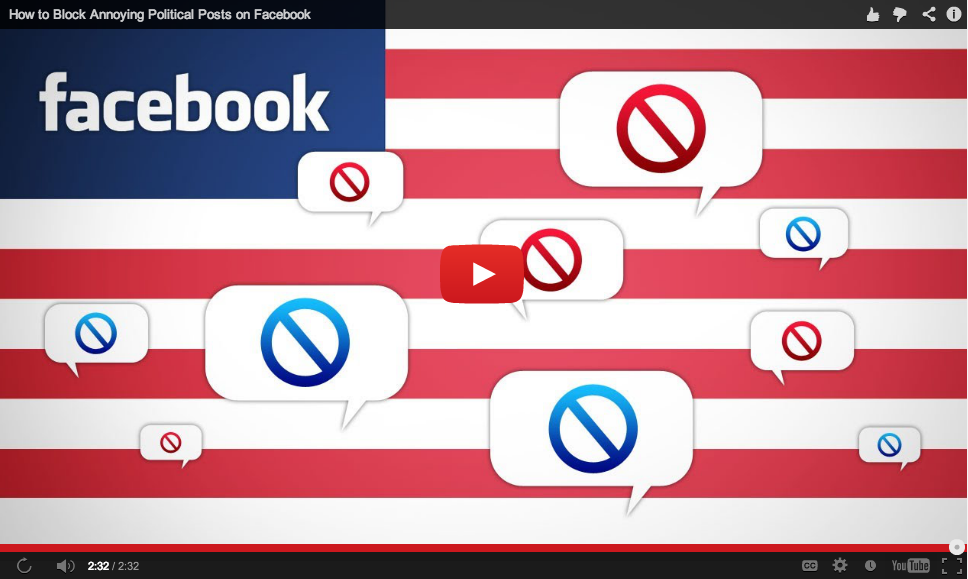
screen shot of lifehacker videoHow to Block Annoying Political Posts on Facebook is a Lifehacker video that will show you a third party app that will allow you to filter out “Trayvon Martin” or  “Zimmerman” from your FB news feed. No need to block friends or unfollow people or pages you like. Just take some time to set up an auto-filter.

Setting up privacy levels, auto-filters, etc., is a 21st century basic skill we all need.

0 comments

Krrb Getting Crushed by Craigslist

Krrb logo and front page that says "buy local" with a search bar

What, no Philly listed? pfft.

As an early adopter, I end up being one of the first members of new apps. Krrb is one of those apps.

I haven’t participated in Krrb much, as I am not in the buying/selling stuff game lately. But I did find this email from Krrb Founder George Eid to be enlightening. Read on to find out what big guy Craigslist is trying to do to little guy Krrb.

Hello PurpleCar,

Happy Independence Day! I hope this email finds you well. We haven’t seen you around Krrb lately, but there is some important news we’d like to share that affects you and all who use the Internet.

You might have heard Krrb is now the latest in a series of startups that Craigslist has threatened with legal action. We finally caved to their litigious ways and disabled our Krrb It button with respect to Craigslist. But not without calling attention to their questionable methods.

How does this affect you? In order to threaten us, Craigslist has accused Krrb of inducing their members to violate their terms of use. They claim that their users do not have the right to copy a post from their website. In doing so, the user may be subject of up to a $25,000 fine. This type of provision explores the attempt by large corporations to own you and what you own. And as the 9th largest website in the United States, if they get their way, it will have potential adverse consequences to Internet law as a whole.

Tuesday I published an Open Letter to Craig Newmark, which is starting to get a bunch of attention and ignite heated debate. I would be super happy if you took a moment to read it, signed our petition and spread the word.

Other than that, things are hopping at Krrbieland, we just hit 40K members! Wahoo!!! I do hope to see you around Krrb again, but more importantly I hope that you will support us in this effort to urge Craigslist to change their policies, but also to support Krrb and many other fledgling startups trying to innovate and build an honest business without threat of litigation.

If you have any questions, don’t hesitate to respond. I’d love to hear from you!

Best, George

I couldn’t determine from this note alone what the issue was. Were Krrb users copying craigslist posts of other users? In his open letter, George Eid writes a very good case against the once-loved Craigslist. Love to see how this works out. It seems like it’s just a case of the bookmarklet right now. Craigslist didn’t like any bookmarklet working on its site, especially if that information gets “pinned” (verb a la Pinterest) to a competitor’s site (I use “competitor” in reference to Krrb very loosely here).

The ship’s sailed on bookmarklets, though… That’s going to happen. They are just too dang convenient. I like my Scoop.it, Pinterest and Press This bookmarklets. I doubt I’d give them up easily. And what’s the difference between a bookmarklet and going through the copy & paste motions? Craigslist can’t stop that. Threatening users with a $25,000 fine? What is this? The music industry?

 

0 comments

What the NSA Sees in Our Gmail

Some brave people at MIT have put out a little web app that will generate a picture of your gmail use.

Here’s mine:

dots and connections of different sizes and colors to graphically illustrate who I email. First names only.

Lots of networks and stand-alone people there. I wish I could run this on my verizon, yahoo, hotmail and other accounts too.

As you can see, according to gmail, I have a few isolated networks and many non-connected-to-each-other people. The incomplete data is because I have several email accounts and I use each one for different parts of my life. Gmail I use as follows: The green network you see is the library trustees and staff, with whom I work in my volunteer capacity as the VP of the Board of Trustees. The orange bunch is my group of neighbors and close mom friends with whom I share childcare and picnics, etc. These people don’t text much, so emails tend to stack up. The red dots are between my graphic designer, Rick Wolff and another friend of mine, Scott, because we are all working on a project together. All the rest are one-to-one conversations.

If I were to analyze this, I’d guess that a person with many one-to-one email conversation has a lot of friends, does some sort of customer support or does customer support for a lot of friends. Actually though, I am usually the one emailing my friends with quick questions (and they are kind enough to answer me).

A fuller picture would be made if one could aggregate all of my email accounts, my texting records and my phone records, which, in fact, the NSA can do. Easily.

Does it seem like faceless, anonymous metadata now? No. The NSA can easily gather from this whom I love, who are my top friends, where I spend most of my time and whether or not I have any relationship at all to other people they may be investigating. All without a warrant. The NSA Newspeak generators want you to believe that metadata is harmless, that if you “have nothing to hide” that you shouldn’t worry.

Private email accounts, private phone records, etc., should be private and require a warrant to search. This is non-negotiable if we want to preserve the civil liberties upon which the USA was founded. It’s just that simple. Data mining without protections is a step toward martial law (<-thems is stong words, I reckon. But I also reckon this is the time fer strong words. Dictators and communists spy on their own people;it never supposed to be for US).

Counteract anyone who is under the “nothing to hide” myth. Write or call your senators. This slippery slope is only just getting started, and we must be active now.

UPDATE: The Verge just caught on to this story. One commenter added this helpful little link: A comprehensive tracking program using cellular and Twitter data, using one politician’s life. The NSA can do this to you, too. Easily.

7 comments

Predicting Suicide via Social Media Status Updates

Can scientists predict a suicide from Facebook statuses? | Ars Technica.

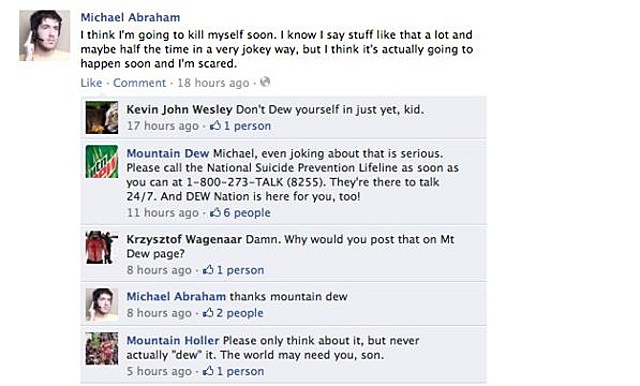
Brand Mountain Dew gives suicide hotline number to a fan who posted a suicidal status

The Mountain Dew marketing machine showing some humanity

This study seeks to identify a recognizable pattern in social network status updates of a potentially suicidal person.

Research-wise, it’s a solid premise. Human behavior is predictable in a lot of ways; For many decades, experts have recognized common “signs” that a person is thinking about self-harm. It turns out that we humans think in similar ways. We probably tweet and post FB updates in similar ways, too.

One of the more interesting points with this article, though, is the comments. Lots of talk there about spying and the observer-expectancy effect (where the results are skewed because the subjects know they are being watched). People seem a bit nervous about their statuses being analyzed, even for the sake of saving lives.

But what if no human saw the data? I can see a scenario where the computer sends a human-written note saying “Your statuses indicate you’ve been struggling. Here are some helplines you may find useful.” No privacy invasion. Just a simple, not-personal algorithm doing its job.

When life insurance companies are on your digital trail, however, that could be a devastating thing. I was interviewed for life insurance when I was in my young 30’s. The agent was so very rude and insistent about assessing my mental health history for suicide risk that I had to ask for a manager. (The manager stopped the questioning and put the policy through immediately. I was a prime, healthy candidate for them and she knew it).

Again, this is the brave(ish), new(ish) world, a place where computers might care for you more than humans do.


0 comments

10 Days. 10 Posts.

Crawlers slide with lessons learned

10 days ago I joined a group of bloggers who agreed to post once a day for 10 days.

Here’s a timeline of my last 10 posts:

I learned a bunch of lessons from this. Here’s a very brief history of PurpleCar.net, so you can have some context for what I learned:


slide of # 2 lesson learned, just text on a chalkboard

2004: PurpleCar Founded

2004-2007: Wrote Personal Essays

2007-Present: Wrote Niche Articles about the Internet and Psych of IT

Last 10 Days: 1st Time I’ve ever Posted 10 Days in a Row


Lessons Learned

  1. Crawlers. Benefits do exist for bloggers who do post daily. For example, when you update your page more frequently, the search engine caches crawl your site more often, which in turn, experts think, gives you better ranking in search.
  2. Expertise. Blogging daily also gives Internetters the impression that you have something to say. Being termed a “blogger” in the online world really only comes from blogging once, twice, maybe 3 times daily. Some argue that the content a blogger offers is also important, i.e., quality tops quantity, but the jury is still out on that one.
  3. Efficiency. I’ve always placed myself solidly in the “quality” camp, letting my blog go for days or even weeks with no posts. I put off posting  until I had time to write a solid article. My posts usually tend to be longer and require at least a little bit of research.  One post can take hours.  Most of them take at least an hour. I need to be quicker if I’m going to post daily. Quality may suffer.
  4. Making Choices. Posting daily means I either don’t have hours to spend on each entry or I don’t do any other work for the day. My other projects took a back seat this week as I worked to produce quality content for this 10-day stint.

One blogger I enjoy reading is Adam Tinworth, a content producer and online journalism dude. Adam posts interesting links with a small paragraph of response. Sometimes these small bits start large and valuable comment streams. I should take a cue from the master, obviously, and incorporate more plain curation into blog posts.  I put curated links within the content but it’s possible that one curated link *is* content.

*Ding*

lesson #3 in the lessons learned

That’s the sound of me leveling up in blogging.


At the end of the day, I think it’s better to post more slightly interesting snippets than post less frequent deep analyses. That’s a whole new skillset for me: quick but interesting Internet bites. I’ll continue to use new apps like Scoop.it, Storify and perhaps Slideshare (what’s with all the S’s? And StumbleUpon for the hell of it), but I will definitely try to keep up with daily posting and see where it takes me.
Making choices slide

What say you, Dear Reader? Any opinion on this, now that blogging has been around for an Internet eon?


6 comments