≡ Menu

A Letter to The World, 11 Sept 2011

Dear People of the World,

We are Americans.

Today is the 10th anniversary of the terrorist attacks of 11 September 2001, and you may be feeling a bit annoyed at the staggering amount of news coverage and online status updates devoted to those moments when we found ourselves a target of vile hatred.

We see your news coverage. We hear your voices. We know that you think Americans can be spoiled, greedy and irresponsible. We know it can look like we don’t care about the rest of the world’s problems, like we don’t mind the wrong moves governments may make in their quests to protect their people and way of life.

It’s easy to assume this about us. But the easy way isn’t always the right way.

We are just like you. We get up early and we go to work. We come home after a long day and feed our families. We do chores, keep up with the kids’ homework, try to relax, go to bed. We do this, day in and day out, and we consider ourselves lucky. There are many people who don’t have the privilege of being exhausted after a full day’s work, nor a home to come back to. We thank God daily. Sometimes hourly. Sometimes by the minute.

We know that you have lived with terrorist threats and war on your home soil for generations, that in your country there is still violence like none we have seen recently in the United States. We remember you today, too. Every September 11th, we remind ourselves what it feels like to be a target, what it feels like, individually and a nation, to live in danger. We are not equating our suffering to yours; we want to end suffering.

We are asking you on this day, in any way you are able, to celebrate peace with us. The mothers, the fathers, the sons and daughters, the families that make up what you call America, want to see the end of terrorism. We wish safety for the world’s children, not for just our own.

We are individuals with families, just like you. We are also a proud nation. We don’t only mourn for ourselves on this day, we mourn for the world.

On September 11th, we are all Americans.

With Love,

The People of the United States of America

0 comments

More Travel Scam Email

I just received this in my email today from one of my social media contacts. I know it’s spam because 1. This is a common travel scam. 2. This friend and I are not at a level of friendship that would allow for a request for money. 3. The request is outrageous to receive via email. If someone needs money quickly, they would call their family members, on a phone, that the local police would provide. 4. Hotel bills? Please. One call to my credit card company would fix that, pronto. I don’t know very many people who travel abroad without a credit card.

You all know this. I’m just putting the text up here so the search engines can catch it. If you are finding this post from a Google search or other search engine, yes, it is a scam and don’t reply to the email. Contact the sender through other means immediately and tell them their email has been hacked.

Here is the text:

How you doing?i am so sorry about me not informing you about my trip to London, United Kingdom some days back, Unfortunately for me i was mugged at gun point last night and here i am totally freaked out! All cash, Credit cards and phone were stolen,i got messed up in another country, stranded in London,United Kingdom, fortunately my passport was in my hotel room. It was a Brutal experience and i was hurt a little bit on my right hand, but would be fine.

My return fight leaves in a few hours but i am having Problem sorting out the hotel bills, wondering if you could loan me some money to sort out the hotel bills and also take a cab to the airport i will refund it back as soon as i get back home. I have been to the police and embassy here, but they aren't helping issues,i have limited access to mails now,i have canceled my cards already and made a police report, I won’t get a new card number till I get back home! So I really need your help.would def refund it to you once i get back home...Hope to read from you soon
I await your reply soon.
Thanks
(first name of sender)

UPDATE: TUESDAY SEPT 6 2011
Sent Clarence Westberg a head’s up on Google Plus. (notice I did not reply to this email. Never reply to a travel scam email. Never use email to reply to any request for money. The return addresses are fake and redirect you to scammers. Also, there is a chance that the whole account is fake, as it is in this case.)

Here’s what the real Clarence Westberg said:

 It's not my yahoo account, they created it using my name, probably using the create account from FB [Facebook] feature. I don't even have many of the email addresses, so they must be getting them from FB.

So now accounts can be spoofed. I do not own the christine.cavalier -@- yahoo.com account. If you see an email from that account, know it is fake.

But, that being said, another, easier rule to remember is this: No voice, no money. Never wire any money to anyone unless you’ve talked with them on the phone. The local authorities will help victims place a phone call. Don’t be fooled. No voice, no money. Spread the word.

2 comments

“There is no private life which has not been determined by a wider public life.”
-George Eliot, Felix Holt, The Radical 1866


The Internet is changing the way we view our private lives. Keeping secrets online isn’t all that relevant anymore, as clandestine facts no longer deemed worthy of concealment are posted for everyone to see. Disregarding the shock and awe visited upon us by any number of exhibitionist young Facebookers, we must agree that our own adult sensitivity to what is considered private is narrowing. Our love of miniature bonsai rose gardening or our pet peeve of all things yellow are now innocuous enough to post. “What’s the harm?” we think. “I may benefit from finding community,” we hope.

“You’re not crazy.  There are like-minded people out there.   You just have to find them.    For me … I found my people online.” –Sarah Glassmeyer


We post our best pics, our library book check-outs and our wandering check-ins in hopes one of “our people” will find us. We post for validation. We post to make our friends laugh. We post exercise our self-esteem muscles: “This is me. Like it or not.”

But this seemingly harmless sharing of our less-intimate secrets in hopes we will find these boosts and connections isn’t so harmless.

I’m in the process of collecting images for an inspiration board project. There are many sites like Pinterest and Tumblr where I could collect these images online, but I’m choosing to keep the images in a folder on my machine. I know this is “risky”, i.e., no online back-up. But curating the images in a semi-private place doesn’t appeal to me. (Side note: don’t think any place on-line is private. Even pay-to-use site dropbox has been accused of reading and selling their users’ secrets).  If I did post the images online, comments would surely come, and I’m not looking for love. And I’m sure as hell not looking for hate.

This board project is to chronicle my inspiration; it is not for markers to chronicle my hopes and desires. Enough of my “secrets” are online that any marketer with half a brain could construct my complete stereotyped profile to sell to brands interested in my business. It’s already happened. A lot. It’s as if there is a pack of wild marketing dogs constantly nipping at my heels. What does this mean, practically, for me? It means I get more fleas, i.e., more spam and junk mail, more Twitter direct messages, more offensive Facebook ads, more ridiculous type-ahead suggestions on search, more pop-ups, more people coming up to me at events and making some obscure reference to a personal fact about me. Sharing on the Internet’s worst case scenario would be a stranger showing up at my door uninvited and unforewarned expecting to spend time together (this actually happened to me via IRC in 1989).

With every piece of information I share online, I get more eyes on my life. More dogs sniffing my trail. As I said to the pushy liquor store owner in a vacation town who wanted me to sign up for his frequent buyer list: “I like to keep things simple.” I don’t sign up for frequent buyer lists to stores where I will visit once a year (or once in a lifetime for that particular one). Adding details online is akin to signing up for store club cards. A Yellow-Hater store, a mini-rose bush shop, a Star Trek Conventioneer newsletter. We can refuse these lists easily, yet we can’t see the connection between posting a tiny little secret and the increase in subject-related ads or other invasions of our privacy.

Alarmism about our new lives online isn’t my goal for this post. It’s OK that little tidbits of information once kept secret are not thought as precious as they once were. The pundits yammer on about the assaults on our privacy, but the fact of the matter is that plenty o’ people are giving up smidgens of their privacy each day, considering tiny tidbits a small price to pay to be able to connect with like-minded souls online. I do, however, want to point out that we have yet to fully rub the dark,rabid underbelly of sharing online. Today it is spam based on your general personality profile. Tomorrow it is a specifically-targeted pop-up ad that loudly announces your healthcare issues to your co-workers.

If one follows this argument through, one will end up at a socio-economic class issue. But it’s the same class issue of the ages: rich people can afford to keep things private. In the past, the rich paid for custom services and hired only the most discrete of white and blue collar laborers, who acted as guard dogs for their wealth, health and privacy. Those custom services come now in the form private server administrators and premium software engineers. Just as the rich shop at elite stores and eat at expensive restaurants, they will demand “above the cloud” computing that keeps their information under exclusive lock and key. I’m not endorsing or rejecting this attitude (because, of course, I don’t want to give the marketers any clues 🙂 ), I’m merely noting it. If you are looking for a start-up idea, you should start building out server racks and hire an electronic security ace (or 2 — dozen). A wealthy cohort who will pay handsomely for you to safeguard their secrets and give their spoiled teenage sons a place to host naked pics of the townie girls online is out there and waiting for you.

The capitalist system has not changed. The “freedom” of the Internet is not a freedom at all. Personally, I’m keeping my secret inspirations secret; these images are not portraying seemingly useless facts about me, like where I ate dinner or if I liked jumprope as a kid; these images are portraying my very deep and distinct desires. My dreams. The Internet is the bed of the market; I need not lie down with dogs.

-Christine Cavalier

2 comments

For Emergency Use Only

Please Delete

Ever hear your mom mention her sex life? A cringe-worthy moment for the ages. You wish Hermione could wave her wand and extract the very words from your ear. If you were one of the unfortunate children to actually witness parental “involvement,” then I’m sure you’ve wished Hermione had immediately applied her latest forget-it potion to your irritated eyes.

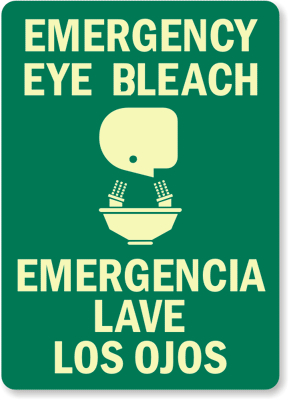
“Eye Bleach” is a term for the mythical mind-cleaner that erases offensive sights from one’s experience. Eye Bleach is a popular phrase among the early adopters and geeks, as we are the first to see many a grim meme. We fantasize about the day we can stumble upon the magic formula that would bring riches beyond those Bill Gates.

Living in today’s übermedia world poses constant challenges. More than ever, we need to control where, and at what, we look. Many of the older generations grew up in days where national newspapers didn’t dare print sensationalistic or gruesome photos “above the fold.” Playboy Magazine covers were wrapped in brown paper. Efforts were made to conceal the rank and the odious from the sensibilities of children and the genteel.

Today, all efforts are lost. The Vietnam War changed photojournalism, newspapers, and television news. Shocking images of war casualties fueled student protests and changed our expectations of news reporting. The seal on the careful distribution of images was broken. When the Internet went viral years later, that seal had all but disappeared. The desperate need for Eye Bleach grew along with the Internet’s fast and furious distribution of images and information.

The Memory Rat Race

Our culture felt this shift. Various forms of art reflected the concerns. Google’s ngram viewer scans a large sample of books and rates the frequency of occurrence of each word. Here’s the ngram chart of the frequency of “memory,” “remember” and “learn” in the Google Books sample from 1900-2000 (Google’s sample does not yet go past the year 2000).

memory, remember, learn, from 1900-2000

We can see the blue line (the one at the bottom at 1940), representing the word “memory” had a significant increase in appearance after 1970, a slight dip at around 1992 but no significant loss, with increases beginning in 1999 or so. The word “remember” (shown in red, at the top in 1940) slopes downward from about 1943 until about 1980 when there was a steady increase. “Learn” (in green, in the middle at 1940) remained pretty steady until about 1990, when we see an increase.

Two popular movies from the 2000’s took particularly interesting approaches in order to address the problem of experience and memory:

In the 2004 movie Eternal Sunshine of The Spotless Mind, main character Joel’s ex-girlfriend Clementine underwent an experimental procedure to have her memories of Joel erased entirely from her mind. When Joel learns of this, he also seeks out the doctor and undergoes the procedure. The rest of the movie explores many concepts around memory and experience, as Joel realizes how much he loves Clementine and doesn’t want to lose her or the memories of their times together, good and bad.

In the 2000 movie Memento, main character Leonard sustains a brain injury while fighting off attackers who kill his wife. Determined to avenge his wife’s murder but unable to remember anything until after he sleeps, Leonard resorts to writing himself notes all over his body so, upon awakening, he can be reminded of the information he gathered the previous day. The movie has two story lines, the forward timeline scenes shot in black and white and the backward timeline (flashbacks) shot in color.

These snapshots of Western culture’s artistic take on the prescient problem of memory are just a tiny few of the many works, both in art and in science, that address memory. Governments want to know memory’s secrets, scientists seek where memories lie, poets lament memory’s loss. Memory eludes. But we know it works. In fact, at times, it haunts.

New Lessons for a New World

When I lecture to parent groups, I outline the importance of teaching our kids new lessons to help them survive the übermedia. I give them this mantra to repeat to their children: “There is no such thing as Eye Bleach.” Parents usually chuckle when they first hear the term, as it’s so poignant it’s funny, but I go on to explain that images can haunt us. We all know how difficult, if not impossible, it is to erase disturbing pictures from our minds. It’s a hard enough concept for adults to grasp, let alone children. I’m actually working on a children’s book that illustrates the idea that we need to decide what media we consume. I’m not so hopeful in finding an agent or publisher, though. It’s too futuristic of a concept for mainstream buyers. It’s hard to be conscious of controlling the information that flows into one’s brain. How do you not see something before you know what it is that you’re not seeing? You can’t, of course. But you can learn to spot the warning signs that something repugnant is waiting. For example, an email from a particularly disgusting colleague that contains a link and the subject line “OMG YOU HAVE TO WATCH THIS” is a good candidate for the “Trash” folder.

The curiosity, though, that compels us to click on the link is the toughest to fight. Also, it’s hard to break the underlying etiquette rules that dictate we click on every link, read emails, listen to voice messages, or even peruse blog posts that are sent to us by people we know. We need to fight the curiosity, and we need to change the unwritten etiquette rules to include the right to ignore. These changes pose the real challenge.

If we can be aware of the warning signs, learn to control our automatic clicking, and negotiate with friends and family that we love them but can’t always absorb all their output, then we can move past the daily need of Eye Bleach and on to something memory is meant to do.

NEW IDEA: Lessons Learned App

Here’s a funny exchange I had on Twitter today:

Who wants to write me the app?

Memory is key to our survival. It retains information like which berries killed our slow Uncle Ted. In Eternal Sunshine of the Spotless Mind when Joel starts to lose the memory of Clementine, he realizes that those memories made up his very worthy love for her; he feels something akin to a slow death as each memory of her fades away.

Memory, as a muscle, needs flexing and care. Unfortunately, as more media comes at us on every flat surface in our lives, our memory gets fractured and frazzled. Instead of being exercised, our memory is being pulled thin. It’s becoming harder and harder to remember simple strings of data, like phone numbers or birth dates.

Like Leonard of Memento, we take to writing things down. We pay the memory industry billions each year in the forms of personal organizers, photographers, calendar software, therapists, event planners, and more. As Leonard and Joel finally each come to the realization that memory is the key to not only survival but happiness, it’s almost too late.

It’s not too late for us. Respect your memory. Don’t fill it with useless facts and data; don’t let it get drawn into a vacuum of endless posts and links. Try to stay aware that when you are caught in the Internet Procrastination Vortex, that you are actually depleting your memory’s ability to remember important things, to stay focused on and be able to recall the good, helpful information that you already know. The more you lose yourself in the vortex, the more likely you are to deplete your abilities to do anything else. Habits form. Your memory will get out the habit of being useful and get into the habit of wanting tiny bits of useless dreck that it will never have to recall in the morning.

Let me know what you’ve forgotten and what you’ve remembered in the comments.

_________________

“Eye Bleach” poster was photoshopped. Original sign here.

5 comments

Checking Stuff

Great post about “just checking stuff” (and we don’t mean airline baggage) over at ByJohnChandler

It’s only a few paragraphs, super short, but worth your time: http://www.byjohnchandler.com/2011/06/09/checking-stuff/

1 comment