Pigeons, Checking In
My Pigeon
The late August day in Pittsburgh was sunny and warm. I walked across the University campus to the psych building, where I settled into a seat in the big lecture hall. “Advanced Human Behavior” was a seminar course for the Bachelor of Science in Psychology I was earning. After a few minutes, a tall but elderly gentleman with a shock of frizzy snow white hair took to the podium. He carted a large, worn tome, obviously an academic book. “This is B.F. Skinner’s book.” The book made a large thud on the wood. The elderly professor hurriedly flipped through the pages. He then picked up the book and displayed a page with a simple graph on it, with an X axis, a Y axis, and a single, crooked line. “This is my pigeon,” he said proudly.
It was altogether adorable and fascinating. My professor had been a graduate student under famed (and famously a bit strange) Behaviorist B.F. Skinner, and he was going to spend the rest of the semester not only telling us amusing anecdotes about Skinner, but how the system of stimulus->reward and all its variants can induce the most predictable and powerful responses in all organisms, including humans. (My most-remembered anecdote was how he watched Skinner try and fail at sleeping 15 minutes of every hour around the clock, instead of a solid 7-8 hours like normal. This is before the discovery and understanding of how the absence of rapid eye movement sleep induces psychosis after a 48 hours).
Behaviorism, of course, doesn’t cover all the bases. As a theory, it falls short in many areas. The discipline of Cognition was combined with Behaviorism to make a more complete theory. But this doesn’t mean that Behaviorism’s stimulus-response theory is worthless; it isn’t. In fact, simple Behaviorist theory is alive and well in online application design. Unfortunately, many designers lack the Psych background or behavior insights that lead to successful online games. Foursquare is one of them. Foursquare should really look into buying some pigeons.
That first day in lecture, my distinguished Professor Emeritus was kind enough to explain how he trained his pigeon to hit a bar to deliver an edible treat. He also went on to do a bunch of other experiments with pigeons, all under the guidance of BF Skinner. My classmates and I spent the semester learning all the proven combinations of reward schedules, variable stimuli, operant conditioning, that are designed into systems and spaces that make people behave the way they do. We studied a lot of pigeons. Pigeons are particularly intelligence-free animals. They are easily distracted and easily trained. They are almost pure stimulus-response organisms. Because of this, they can give us insight into what stimuli work and what don’t, because we can safely assume that the pigeon isn’t influenced by any cognition whatsoever.
If the Foursquare (4sq) people got a bunch of pigeons in the office and trained them to hit a button for food, then perhaps they’d understand why their app is failing. Sometimes humans aren’t influenced by any cognition whatsoever either. We know certain things about our environments, about rewards, about which pursuits are worthy of our effort. We have this enormous base of knowledge in our subconscious, and we tap it all the time as we make split-second decisions. 4sq is making us tap all the “Don’t do this” advice in our knowledge base.
Let me explain.
Yummy Food Button
Let’s take a look at Twitter. New users tend to drop Twitter quickly. They don’t receive enough reward from it: They don’t get any replies; They don’t have enough friends; They don’t have any conversations or join any chats; The coveted “retweet” is totally out of their grasp. These Twitter Quitters aren’t conscious why they quit using the application, they just quit. Their knowledge base has told them the Twitter reward system doesn’t deliver.
Whenever a reward system doesn’t deliver, people quit. When pigeons don’t get any more food from the button, they quit pecking at it. This is the logical and natural consequence that is seen over and over again in countless lab and real-life experiments.
The strongest reward systems, where the reward is delivered on an intermittent and somewhat unpredictable schedule, are the most “addictive.” Twitter, once you set up your account and start joining in, is one of the best intermittent reward systems applications I’ve seen in my 20+ years online. The beauty of it is that the intermittent rewards aren’t programmed or delivered by the Twitter code; they are delivered by other users. Twitter provides the platform and doesn’t need to do much else. Facebook works along the same lines; other users deliver the comments, the links, the Likes. These little human interactions aren’t simple chatter; they speak to our very survival as human animals. The more people we “have on our side” in life, the more secure we feel.
When we walk about our neighborhoods, go to work, live our physical lives, we take every instance of eye contact, idle chit-chat, handshake, or smile as a cue that we are connected to the community, that we are safe, that we belong. We grow up knowing how to read the validation in these human social messages. Online it’s not so clear cut. We’re learning that these Likes, comments, retweets, etc, are the messages we need in order to judge our place in the virtual community. If we don’t get enough of these positive messages, it feels the same as when we smile at the local librarian and she acts as if we aren’t standing there in front of her with a heavy stack of books in our hands. Certainly we’d stop going to the library if we got type of treatment on a regular basis.

A Twitter reply to one of my application-design rants.
So: intermittent rewards on a variable schedule is the best way to go if you are designing an application and you want users. Twitter should do something to address the lack of rewards for new users; they’d
see their success percentage go up and their Twitter Quitter numbers go down if they delivered some replies, retweets, chat suggestions, whatever, to new users. Facebook already addresses the new user quitting problem by immediately delivering “friends” by offering to sort through a new user’s address book to see whom they may already know and can be immediately connected to on the application. Boom. Intermittent reward schedule in place and running.
This brings me to Foursquare and why I think they need some major design changes in order to survive.
Pigeon Territory
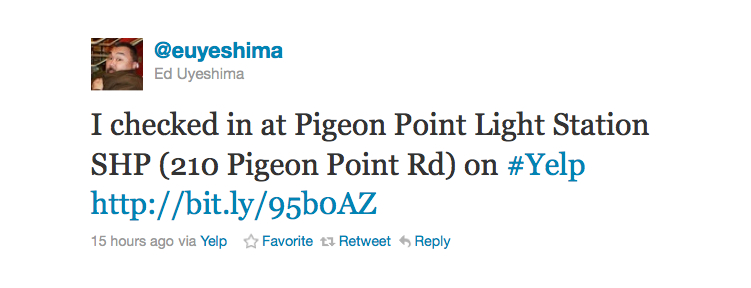
Location-based applications are all the rage. Even Facebook, Twitter and other not-related-to-location applications are jumping on the “Come Find Me” bandwagon. Foursquare, Gowalla and other dedicated location-based apps are facing stiff competition from Facebook. Why start up Foursquare or Gowalla on your phone when you can just log in to Facebook and broadcast to all your lovely stalkers that you’ve set up camp in the local Baskin-Robbins?
 4sq has a pseudo-intermittent reward system called Mayorships. If you check in to a venue a certain number of times, you become Mayor. This sounds like it would work and people would get to a permanently engaged state, but it turns out that it doesn’t. Here’s the skinny:
*Most of the time, “Mayor” is just a bragging-rights opportunity. Bragging rights are only worth the amount of friends you have who value Mayorships. If you don’t have a lot of friends in 4sq that also frequent your same favorite venues, the bragging rights are meaningless. Because 4sq is a time-dependent, physical-location-broadcast app, people will not invite a lot of their friends to connect with them in the app. Their circle will be made up of friends they’d like to see and/or compete with. Not a lot of friends=meaningless Mayorships.
*4sq gives you too much clue as to when you will earn the Mayorship. “You are now 1 day away from being Mayor!” is the worst thing an intermittent reward system can do. “You will probably be Mayor soon!” would be a much more powerful approach.
*”Mayor” has been gamed and is no longer relevant. Adding to the meaninglessness of the rewards in the 4sq system, the Mayorships have been taken over by users who are collectors. Many businesses have been reporting that they have never seen their Mayor and suspect that she/he just checks in when they pass the venue on their commute. Collectors find reward in these Mayorships, but the general community becomes disenfranchised because the collectors have hoarded the rewards for very different reasons than their own.
*No efforts are made by businesses to welcome their Mayor. I’ve held the title of Mayor of many venues, but not once did I see a sign at the venue that said, “Are you our Mayor? Say Hi!” I’d have to see some sort of anonymous invitation like that before I’d volunteer my Mayoral status to some unsuspecting barista. It’s too embarrassing when said barista delivers his most-alarmed “Oh, no, another crazy person!” look. Venues aren’t adopting the community aspect of 4sq.
*Too few venues offer Mayor discounts or coupons. 4sq has addressed this by having venues offer discounts to anyone who checks into the venue, but there still aren’t a lot of valuable offers or coupons in the app. Nothing but Mayorships are delivered on a somewhat intermittent system; special discounts and coupons, above and beyond the check-in ones, should be delivered to users on an intermittent schedule.
4sq’s rewards have been rendered meaningless by gamers (collectors), the transparency in the reward schedule, and lack of venue cultural (welcome your Mayor) and financial (discounts) participation. 4sq will fail if they don’t address this situation.
Who Are The Pigeons In Your Neighbohood?
Have you been using Foursquare? What are the differences you find in Twitter and Foursquare, Facebook and Foursquare? Have you used Gowalla or other location-based apps and find them more satisfactory? Let me know in the comments.
-Christine Cavalier

 I went to BCNIPHILLY11 this weekend. Here are my raves and rants about the event. It’s in newsletter shape in pdf. It’s totally safe to download, I promise. No malware, just ranty goodness (turned to badness)… Enjoy. If you went to BCNI and want to chime in, the comment section is all yours!