≡ Menu

2016: A No “Coffee” Year

Black and white photo of a coffee shop with a "pause" symbol (two red parallel lines) overlaid on it

I’m putting coffee meetings on “Pause” in 2016. What about you?

Back in 2011, Human Resource expert Adrienne Graham published an article on Forbes entitled, “No You Can’t Pick My Brain. It Costs Too Much.” (All links will be at the end of the post). It garnered over 200,00 views and eventually inspired a book of the same title. I caught it because the article spurred a dust-up online amongst consultants and freelance professionals. The popular opinion at the time was that one must give away a ton of value first before being paid for it. Social media promised lucrative contracts for the seasoned pros, if we could only set up a blog and a podcast and free downloads and an info-packed newsletter.

Ms. Graham did all of those things, of course, but she started spreading the message of the virtues of saying no to when you are asked out for coffee by another professional seeking advice or support.

“How would you feel if your boss came to you and said, Hey since we can get this done from information from the Internet, I won’t be paying you today. Go ahead, let it sink in. Got that visual yet? Good. That’s exactly how I feel whenever someone wants to take me to lunch or call me to pick my brain.”

Since reading that article over 4 years ago, I have slowly but surely cut back on the invitations I accept.  To do this, I’ve had to skip attending the type of events where invitations to “pick my brain” were likely to occur. This year, I’m going all in: 2016 will be a “no coffee” year.

When I say coffee, I mean “coffee” – which can also mean “lunch” or “a beer.” I’ll meet with friends, but this year will, to the very best of my ability, contain no coffee with strangers seeking professional advice. As Adrienne says, those types of outings simply cost too much. These meetings, while flattering and sometimes exciting, leak over the time allotted. They usually last much longer than an hour. Even if was just an hour, there is commuting time. I have 6 hours a day during the week when the kids are in school. That isn’t a lot. Protecting those hours is harder than you may think. There are dentist and doctor appointments or half days from school or winter break (forget summers).

I anticipate having a lonely year. As a freelance writer, I don’t have co-workers. I’m alone most of the time. As an extrovert, that doesn’t exactly float my ego’s boat. I get disconnected. Professional tech gatherings combat the solo hours, but the coffee suggestions almost always follow. It’s difficult to turn down an invitation to hang with a new potential friend or business contact. I have to admit, though: not once has “coffee” ever led to a paying gig. Not once.

I’m not even consulting anymore. Meeting business people for coffee doesn’t help me achieve my novel-writing dreams.

So I have to accept a lonely year if I want to finish the novel. In fact, I may have to accept a bit more of a lonely life if I want to make this fiction thing work. Who knows? What I do know is I’ve done my part to help my various communities. I’ve volunteered, written, designed, published, and doled out advice for years, all for nothing more than the satisfaction to my ego and the knowledge I helped my city, an organization, or a business person in need.

A side note: A no coffee year also means a “no advice” year. When I am with friends or family, I’m going to institute the spirit of the “no coffee year”– Letting people figure things out for themselves. This means: More listening, less talking. More nodding, less jumping in. More echoing back, less spewing of advice (maybe even if it is sought!).

How will you be having your coffee in 2016? Alone, pursuing your dreams, or helping someone else pursue theirs?

________________________________

Photo credit: Me (Christine Cavalier)

Adrienne Graham on Forbes: No You Can’t Pick My Brain. It Costs Too Much. Buy the book.

2 comments

Famous Female Knights of Ren

SophiaLo Ren

Actress Sophia Loren's face juxtaposed on top of character Kylo Ren's face


HollyLo Ren

Actress Lauren Holly's face juxtaposed on top of character Kylo Ren's face


Bacallo Ren

Actress Lauren Bacall's face juxtaposed on top of character Kylo Ren's face
0 comments

Self-Evident – a rhyming poem

I wrote this up quickly today, just as an exercise not only in writing but in sanity.

Self-Evident

All the mosques are malls
and all the churches sell churros
The prices are on the walls
and all the altars take Euros

But the doors are often closed
to those not ‘ready inside
yet the priests are not opposed
to those the imams denied:

“As long as they have cash
almost anyone can get in,
and if they clean up our trash
we’ll even forgive their sins!”

Still, people protest and shout
saying “This is against our ways!
We know what we speak about –
our parents came back in the day!”

Then a child ruffles her brow
and whispers “That makes no sense.
We’re all just visitors now.
Why are you all so tense?”

Above the silenced crowd,
“It seems to me,” she said,
“that everyone’s allowed
to go where angels fear to tread.

“But the promised land we stole
is for only the chosen few?
We fence it and fiercely patrol
to keep out people like you.”

The children’s choir agreed
and wrote on the market’s doors:
“To all who seek – Godspeed!
You’re welcome in our stores.”

Not far away upon a shore
a crumbling statue reads
bring me your tired, and your poor
and those who will breathe free.

Commercial Liberty, photo by m01229 on Flickr

Commercial Liberty, photo by m01229 on Flickr

0 comments

Is big data snake oil?

The business world is hypnotized by the big money promises of big data. But is it just another empty trend? To get some real answers, we need to ask the right questions.

_______________________

 wizardofozprofmarvel

Acclaimed by the Crowned Heads of Europe

There’s a scene in The Wizard of Oz where Dorothy, fresh from the farm, comes across Professor Marvel and his wagon-of-wonders. Marvel, obviously a con man, uses common tricks to convince Dorothy she should return home.

Big Data is like Professor Marvel in the Wizard of Oz: a snake oil salesman with a latent sense of conscience. He hawks empty promises, but he also can use his illusion for a higher purpose.

There is some good in Marvel, but you need to present him with the right situation to uncover it.

Like Professor Marvel, big data also promises to predict the future. “Look into the mighty crystal ball of user behavior” big data seems to say, “and you’ll discover a miraculous gold road leading to an Emerald City of profits.” Unfortunately, Professor Marvel faked it and the world of big data is faking it too. Professor Marvel scammed Dorothy by extrapolating information from a photograph and using gimmicks. Big data fakes it by answering the wrong questions.

Bad Structure and Even Worse Philosophy

Here’s the typical scene in board rooms today: CEO tells the CIO to hire some “data people.” Data people, mostly coming from either a marketing or a programming background, set up shop somewhere in the business or IT department. They use Python, R, Hadoop etc., software and languages meant for the job of handling millions, maybe billions of tiny bits of information. “OK, we’re ready,” the data scientists say. “What do you want to know?”

Oops! We’ve already taken a wrong turn on the yellow-brick road. Did you catch it?

Data science is SCIENCE. It is not meant to be housed under sales or IT. A data science team should report to R&D. If your company outsources its research and development, then it should outsource its data science. Without a well-mapped reporting hierarchy and a centralized research structure, any data team is set up to fall into very common error traps, ones the academic world knows all too well. 

Businesses like AT&T and Proctor & Gamble were founded on research principles, and have, by many reports, succeeded in wrangling big data. This isn’t coincidence. In my career, I’ve hopped between academic research and business/IT; I can tell you science has its own culture that needs protection to eke out trustworthy results.

Good science can’t be conducted in the tornado fields of quarterly goals. If a lab’s culture is dominated by the profit-is-king sentiment, the research is more likely to be tainted by common fallacies and decision errors. The very questions asked will be wrongly posed. In journal publishing, we see this often when a study’s funders “magically” come up with supporting results. Human biases are so predictable that transparency in funding is an explicit and strict tenet in academic research. Academics judge a study’s results on many factors, one of the most important being the source of the study’s financial support.

Knowledge for knowledge’s sake, or even a simple search for truth over illusion, is the purpose of any data inquiry.

But when misplaced data scientists are working under business mores, the path to Oz starts to crack. The data scientists don’t feel the fissures forming because their focus is on the data. Middle management doesn’t notice anything amiss because their eyes and ears are awaiting actionable information. Top management doesn’t look at much besides profit margins and quarterly goals. But these cracks grow and what eventually comes out is an expensive wagon-full of reports that have no more predictive power over the future than Professor Marvel’s crystal ball.

Start simply and give it time

The reporting structure and the philosophy are the keys to successfully wield big data into info you can use. Data science is R&D and the pursuit of truth over fantasy are the core values on which to grow any big data endeavor. Once the team is in the right place with the right attitude, start them off with data gathering. Most companies aren’t even capturing half of the data that’s available to them. Run it off a cloud server service and capture as many points of data as possible. You have to make decisions, obviously, because there exists an infinite amount of data in each user transaction. Still, I’m positive your company isn’t anywhere near exhausting its data mining capability. It will take time to hit the sweet spot, and as the world changes, so will your data points. But data is a living thing, constantly changing and fluid. There will be some basics that will always be relevant (e.g., rudimentary demographics), but be prepared to re-map your route on a regular basis.

No place like home

At the end of The Wizard of Oz, the Wizard (aka Professor Marvel) ends up floating away without Dorothy. Dorothy finds another way back to Kansas, one that had been with her all along. We have it in us to find a truthful and honest way to handle big data. Treat it like the science that it is and integrate it carefully into the business structure, and you’ll discover all you ever needed to know was right there with you the whole time.

____________

Photo credit: Wizard of Oz still, by Insomnia Cured Here on Flickr

0 comments

2 cultural shifts I’ve noticed

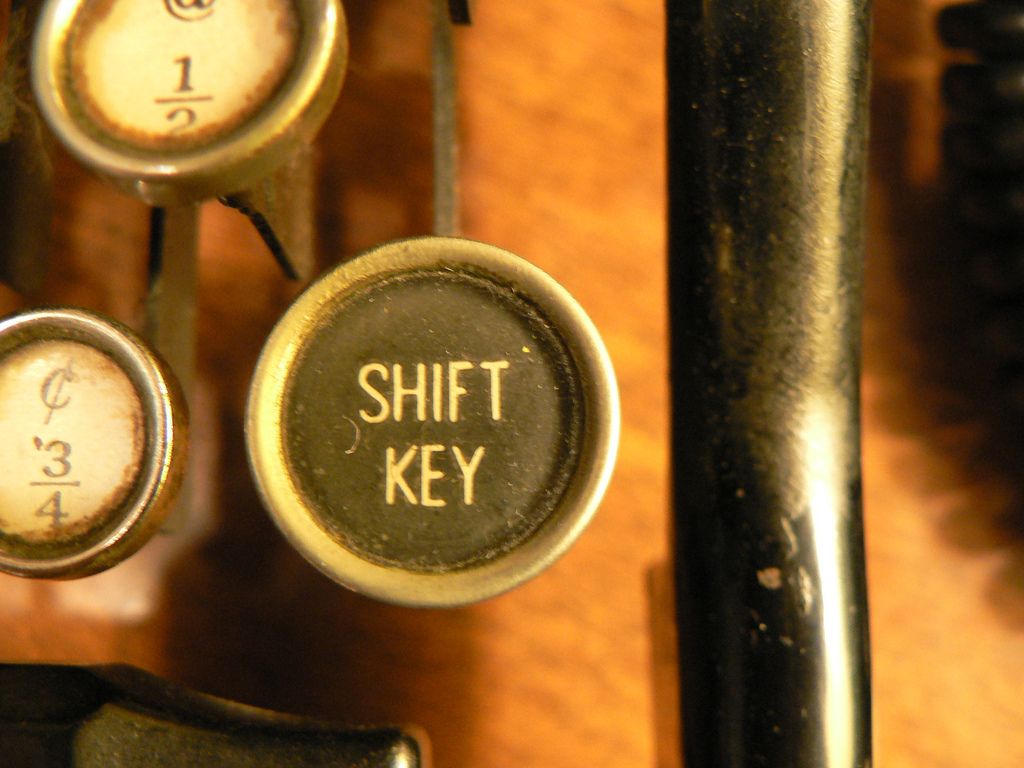
a picture of an old typewriter's shift keyThe web changes everything.

This is a bold statement for me. When it comes to networked electronic communication tools, I’m a “the more things change, the more they stay the same” kind of person. People deal with strange new things in predictable ways. But the web speeds up this process like never before.

Over the last several weeks I’ve felt 2 paradigm shifts in the online ether. One shift is in a particular way people are veering from in-person norms to specific norms for online communities. The other is in using the Internet to learn a foreign language.

Silos are bullshit.

I’ve noticed more and more people are openly admitting to blocking family members or unfollowing friends on Facebook and other platforms. This action used to be equated to shunning someone in person but that association is weakening. Users are customizing the tools more to their own personal needs. This means adopting new societal rules for online communications that veer from in-person communications. Soon it will be a normal thing to exclude family members and close friends from your social platform accounts, and no offense will be taken. The excluded persons won’t see this as a slight and will understand they can contact you via other means.

This is a giant leap away from imprinting established social customs onto new communication tools. This next step, one that usually takes many decades to implement, is taking root now after only about 15 years. For mass adoption of places like Facebook, I’d say it has been really only 5 years.

The media calls this “silo-ing” or building an “echo chamber” but that’s a lot of hooey. Many great apes, including Homo Sapiens, customize tools for personal use. There is no reason to believe humans will stick with a site’s default settings and offline social norms once they get familiar and comfortable with the platform, especially not if the online culture itself is encouraging such behavior. (So go out there and admit you’ve blocked friends on Facebook! Seriously. It helps progress).  

Va bene!

Next shift I see is in the language learning field. I’ve discovered some growing grass-roots theories online about how an adult can learn another language. Instead of the traditional classroom-type book learning, some movers and shakers out there have generated apps around the immersion theory of language learning. Immersion theory is what it sounds like: learning by doing. One of the lessons from this theory is that most people use, on a daily basis, 300-1000 words. Learn the most-used words and phrases in any language and you can quickly rise to a basic proficiency. Next step in immersion theory is to get out there and have basic conversations with native speakers.

This month I’m concentrating on Italian, and in the coming months I’ll be perfecting my Spanish. Two apps have helped me learn some basic Italian: Duolingo and HelloTalk. Duolingo teaches you the most common words and phrases in basic subjects like social greeting, foods, basic body functions and needs, etc. HelloTalk is an app that matches up language learners. Right now I have a few Italian language partners who seek to learn English. We help each other with pronunciation, culture, practice, etc. After only a few days, I feel comfortable with the idea of greeting and briefly chatting with an Italian speaker.

I should add that speaking in person is the challenge. With today’s translation tools, writing in a chat room is super easy if you have a general idea of what you want to say. A few weeks ago I had a long conversation in Italian with a reporter who needed help locating an American for an article he was writing. I did this using Google Translate and my knowledge of Spanish.

The Star Trek communicator is not far off. And with voice-generation software that will be out in public in the next few years, you’ll be able to answer in your own voice in another language.

Photo Credit: C Slack on Flickr
0 comments