≡ Menu

Stacks of Business Cards

I never toss other people’s business cards.

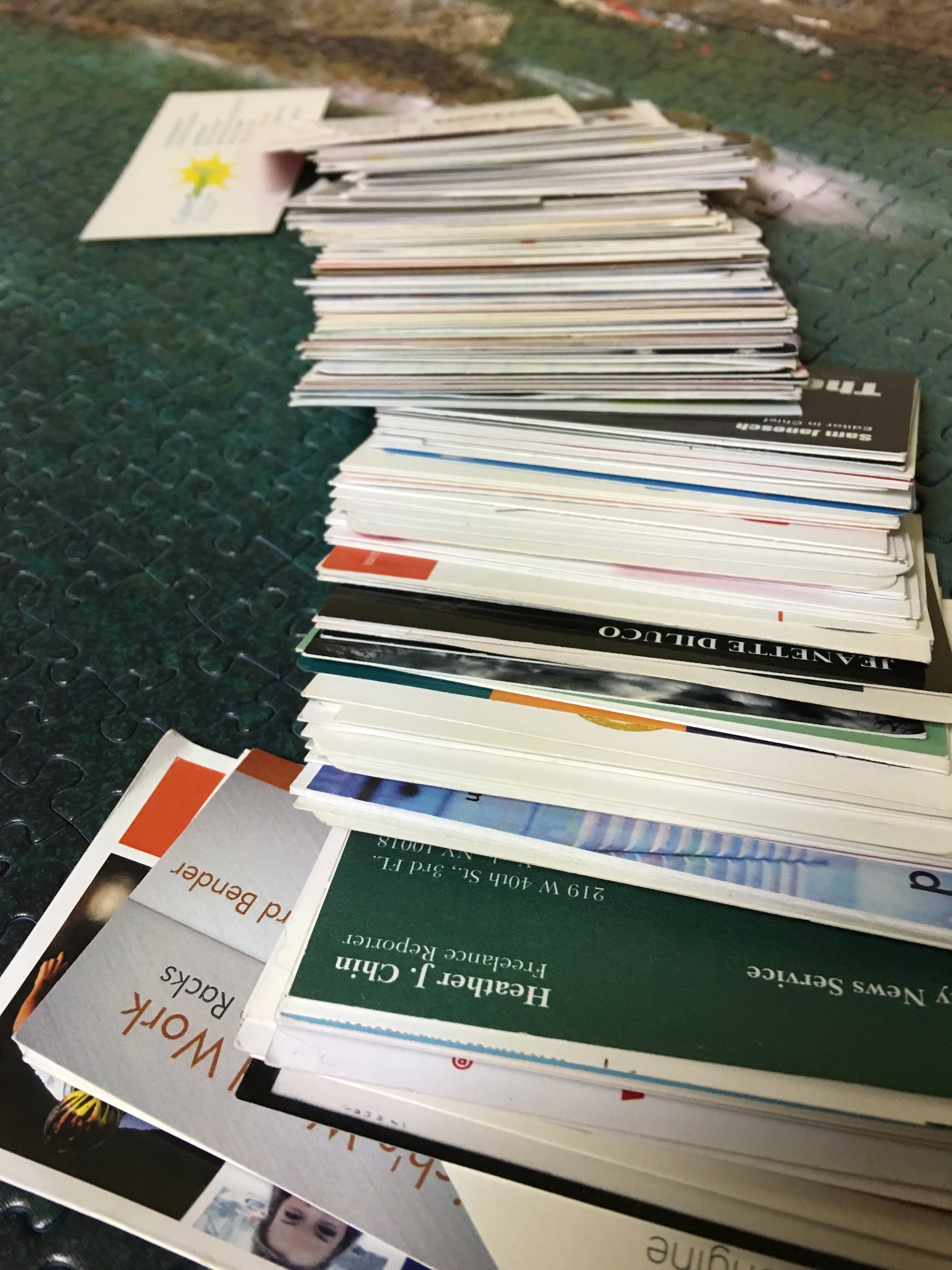
Well, I shouldn’t say never. I shred duplicates. But I have stacks and stacks of them. They look like this:

business cards

That is just 1 stack of the many hundreds of business cards I’ve collected over the years. (You know, I just realized: When someone asks me if I collect things, I shouldn’t answer “No.”)

I feel guilty tossing these little rectangles of cardboard out (I’d shred them first if I did), but I don’t do anything with them either. The cards are usually handed to me at a tech or journalism/writing event with a vague implication on how and when to use it. Hence, I don’t use it at all.

This has led me in my own practice to almost vehemently refuse to give out my own physical paper business card. Instead, I offer to send a vcf (which had some technical difficulties at WordCampUS this year, but I digress) so my information can go straight into someone address book. Guess what, though? They never use the digital info either, just like I don’t use the printed stuff.

Since I’m resolving to write more this year, including blogging, I was thinking it would make a fun project to call every single one of these people and ask them what’s up in life. Once I think about it, though, that would be a major undertaking.

What do you do with business cards?


1 comment

Pee by any other name

As a writer, sometimes you need a very specific word written a million different ways. My fiction project has a character who, for various reasons, is trying to slip the color “yellow” past some algorithms. She’ll be flagged if she types out “yellow,” so she’s looking for alternative names.

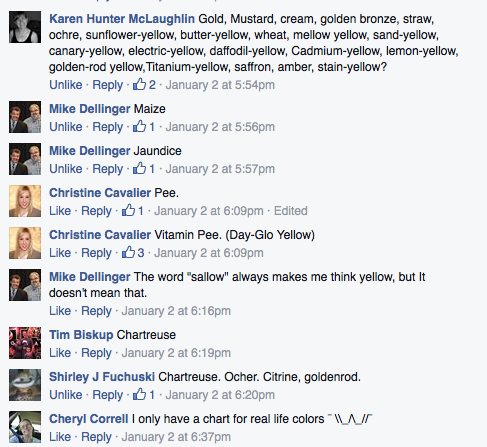
I have a membership to Merriam-Webster online but colors don’t have their own thesaurus listings. Yesterday I turned to my friends on Facebook for alternatives to the word “yellow.” I, of course, quickly degraded the conversation by answering my own question with “Pee.”

Most of my people on FB (which has a mix of pro and personal connections) are a bit more astute and came up with not only the charts below but many useful suggestions in mere seconds. How did authors write before the Internet?

FBConvoYellow

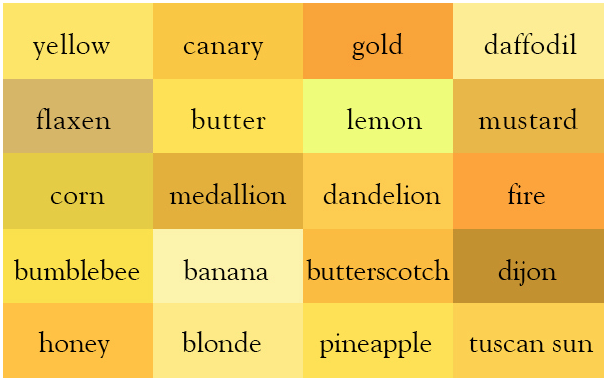
Then I found a chart.

a graphic with a list of colors and corresponding labels
From http://math.ubbcluj.ro/~sberinde/wingraph/main.html

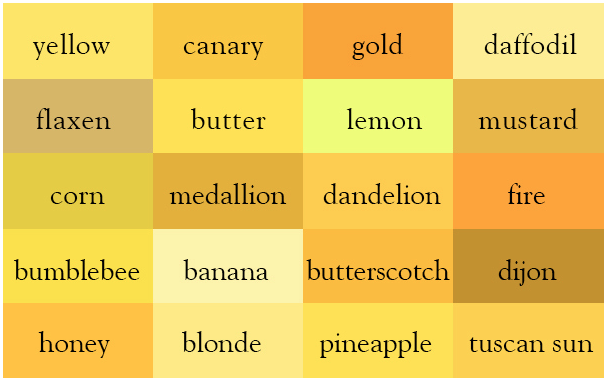
Another FB user sent this:

Yellow names
From http://digitalsynopsis.com/design/color-thesaurus-correct-names-of-shades/

I know a lot more names for “yellow” now. Fictional algorithms, YIELD SIGN to my whims!

(btw: Here I am on Facebook: Christine Cavalier)


0 comments
a line of military personnel

Muscle memory makes no mistakes.

I grew up across the street from an Army Depot. My civilian mother worked for the military and my friends were army brats. My friends and I would sneak around the depot and “spy” on the new recruits as they ran their drills. As an adult, I’ve kept in contact with some of those friends and other military members in various ways via charities and outreach. A lot of wisdom was hidden in those drills. The military has interesting life hacks we can apply to our own lives.

One of the life hacks the US Army knows about is “muscle memory.” A strongly ingrained habit squashes second-guessing. Drills, over and over, creates the muscle memory necessary in combat situations. The more muscle memory a combat officer retains, the more effective she is. It’s a “Do, don’t think” approach and it’s what gets the job done.

Being creative like a writer has to be on a daily basis is not like combat, of course. It is its own type of stress, though, and many people struggle with self-doubt and fear when faced with the task of creating something original. This is where writers can learn a bit from the armed forces. Courage is not the opposite of fear. Habit is."The difference between an amateur and a professional is their habits. All amateurs have amateur habits. A professional has professional habits. We can never free ourselves from habit. But we can replace bad habits with good ones."

When you hear writers speak about “butt-in-chair” they are referring to the habit of sitting down to write every day. No excuses. Just do it. Get used to doing it by repeating the same action over and over. Soon, the habit of writing will suppress the fear of it, and words will appear with much less stress and effort. Your fingers will want to type, basically, if you develop a muscle memory of them doing so. The hint is to start a daily task that turns into a habit. This is why I’m blogging more. It is one of my 8-10 daily tasks I’ve assigned myself this year.

If you want to start a writing practice, especially writing-as-meditation or -mental-health-exercise (i.e. stress reliever), try the Morning Pages practice found in The Artist’s Way book by Julia Cameron. I suggest buying the book and doing 1 exercise a day, including writing out, by hand, 3 stream-of-consciousness pages every morning. That’s it. It’s a little life hack to not only get your stresses out but to trick you into the muscle memory of writing daily. For writers, the most important part of this trick is getting their butts in the writing chair every day at the same time.

Here’s something to pin:

The opposite of fear is not courage. The opposite of fear is habit. -Christine Cavalier

Anyway – HABIT, not courage, is the opposite of FEAR. What do you fear? What’s been in your bucket list for a while now? What 15-30 minute daily task can you life-hack into your routine to get you closer to your goal?

Photo Credits:

Military photo provided by the US Army

Steven Pressfield quote made by Christine Cavalier using Brainy Quote

“The opposite” hang-gliding poster photo by Jordan Fischer on Flickr

0 comments

Slow and steady wins the race. But jogging slowly when you want to sprint is the hard part.

Doing things step-by-step isn’t usually how we think of getting through our “bucket list.” The proverbial list is filled with activities like world travel or skydiving. My bucket holds travel (been around a few times), education (I’ve completed degrees), and a novel and/or writing career (not there yet). 2016 is the year I’d like to finish the novel I’ve been working on. On a not-totally-unrelated note, I’d also like to clean up the flotsam in my house. All of this clutter cuts into my concentration.
picture with an Alexander Graham Bell quote: "The most successful men in the end are those whose success is the result of steady accretion."
These types of tasks can be done, I suppose, in a feverish binge over the course of a month. I’ve tried that approach, but it usually swears me away from the activity for a long time. A daily practice of writing and organizing gives me the best chance of crossing these things off the list.

Plainly put, my 2016 resolutions are to write more and get more organized. Writing more means more blogging on this and a hyperlocal blog I maintain, along with daily work on the novel. To get both of these tasks done means daily exercise, even if it is just a 30 minute walk (you’d be surprised how much physical fitness is tied into creativity).

I’m also taking on 2 365-Day projects (officially 366 for the LEAP Year!): The first daily project is a-craft-a-day, which keeps my creativity going and also is organizing-via-depletion of my craft supplies (which are legion). The second daily project is 15-minute Home Organization projects. I found a calendar online that gives daily tasks that can be performed in one-quarter hour.

Part of the discipline of daily tasks, especially organizing, is to prevent “project creep.” 15 minutes means 15 minutes. For example, the project today was to organize the kitchen utensil drawer. One drawer. Not the junk drawer, not the pantry. Those are for another day. Small wins are key, but they also are addictive. Although we may want to tackle the other kitchen spaces, discipline has to push us toward the day’s next task.

Of course full immersion can be fun occasionally. National Novel Writing Month is 30-day craziness everyone should try once. Writers’ retreats are quite helpful, too. Removing distractions when you’re on deadline is great. But I’m not away; I’m home, trying to balance work and family life. The best way to achieve that balance is to allot each goal some time each day. Slow and steady writes the book, clears the cabinets, and fills buckets.

Links

Some Other 365-Day Projects

I’ve tried the 365 thing once before, of course, and it didn’t stick

2016 15-Minute Daily Declutter Calendar

My Pinterest Board of Finished Crafts

My Pinterest Board of Finished Org Projects (I’ve done 3 so far but just now had the idea to post pics somewhere. I’ll fill it in).

Also posting them on Instagram. Follow me there as @purplecar_cc


picture with an Alexander Graham Bell quote: "The most successful men in the end are those whose success is the result of steady accretion." 2 comments

The Behavioral Economics of Tidying Up

a tidy craft room

This is most definitely not my craft room. Photo by Alison Headley on Flickr

I’m a bit addicted. To what, you may ask? Mostly: craft supplies. Though clothing and accessories come a close second.

But oh, the irony: I love a tidy, well-ordered house. For example, I have a “keys” station right by the door so no-one ever misplaces their keys (it actually works). I have a paperwork station with designated folders for each category of documents. We have a family calendar practice and established routines. My house is far from perfect, but it’s probably better than most. My craft room is, though, a disaster area. But one book is changing everything that’s wrong with it and helping me out of a miserable rut. An article in The Atlantic explains why this particular book isn’t like any other home organization book I’ve ever read (and I’ve read them all!).

Marie Kondo’s book on home organization, The Life-Changing Magic of Tidying Up: The Japanese Art of Decluttering and Organizing is a revolution. You’ve probably heard about it. Originally published in Japan in 2010, the English version of it came out in 2015 and subsequently took the US by storm. I’ve read and tried MANY home organization theories. I’ve even hired a professional come to my house. Even now, I’m attempting a 365-day decluttering project for 2016’s 366 days (yay! Leap Year!).

3 boxes marked "Donate, Sell, Keep"

Jan 1, 2016: Set up an organization station.

As I said, I am constantly working on having a well-ordered house, even if I don’t achieve it often! The KonMari method jumped me ahead at least 5 years in one sitting. Seriously. Until I read this Atlantic article, I didn’t understand why.

According to a study by market analysts Freedonia Group, home organization products alone (excluding services) is a 9Billion US$ industry. Like most home organization experts, Kondo, using her self-named “KonMari” method, encourages not the overuse of storage bins but the virtues of having fewer things and ensuring that each one of those possessions brings you joy. Kondo also teaches a folding and drawer method that is easy to understand and convenient.

The main reason the book is stupendously successful is its use of Behavioral Economics. Behavioral Econ is the study of how and why people make decisions (generally speaking, about time, goods and services). It studies how typical human cognitive biases prevent us from making rational decisions. Behavioral Econ throws original Economics on its head, as the economist of old was working on the theory of  the existence of a “homo-economicus” <- a little rational, money/benefit-focused dude directing your choices at your financial console a la Pixar’s Inside Out.

Psychologists, of course, had known for a while that decisions are emotionally-based and are rarely rational, but the economists just kept sticking with their imaginary homo-econ friend. It’s only been in the last few years that economists have parted ways with the old thinking (see Freakonomics and the work of Dan Ariely for examples).

Kondo, in Tidying Up, addresses each significant cognitive bias that guides us to keep possessions, even after those things have fulfilled their usefulness and outstayed their welcome. Kondo gives readers easy-to-stomach ways to side-step these very strong tendencies. It’s genius, really.

You should read the book. But this article in The Atlantic, written by the former editor of Freakonomics.com, Bourree Lam, outlines some specific cognitive biases and Kondo’s unique advice for overcoming them. For example, Ms. Lam points out how Kondo deals with our inaccurate attempts to “plan for the future:”

Another important point that Kondo protects us from is the folly of prediction: People systematically make terrible guesses about the future. So instead, people should focus on the present, and in tidying, this manifests in the form of using present-day valuations of all of one’s belongings. People are wrong when they think that pair of jeans will ever fit again, Kondo is arguing. They’re also wrong when they think they’ll read that book again. These optimistic predictions keep people from getting rid of things they don’t need.

Sister, can we say “fat and skinny clothes?” Women are notorious for holding on to clothes that are either too big or too small for their bodies, “just in case” some major size shift happens again in the future. (In fact, along with Kondo’s advice, I’m working on a theory about jeans and weight. I’m getting rid of all my pants that are too big now that I’ve lost weight. It’s like Sun-Tzu’s Art of War and burning the boats. I have to stay this size because I don’t have larger size clothes to fall back on).

It’s great stuff. Read the article then read the book. Let me know if you are planning to tidy up this year.


LINKS

___________________

Full text is in the pdf below but you can read “The Economics of Tidying Up” by Bourree Lam while it’s still up at The Atlantic.com.

An Economist’s Guide to Tidying Your Apartment – The Atlantic copy (PDF)

Freedonia Group study abstract

Marie Kondo on Wikipedia

365-Day Decluttering Project

The Life-Changing Magic of Tidying Up: The Japanese Art of Decluttering and Organizing
(Amazon Affiliate link. If you buy through this link, it helps support Purplecar.net and a struggling writer. You’d be a patron of the arts. Thanks!)


4 comments