Scarcity: Why Having Too Little Means So Much
by Sendhil Mullianathan and Eldar Shafir
Times Books 2013
ISBN: 978-0-8050-9264-6
Men of Principle
On a dirty, noisy corner in a sun-seared Indian city, the authors Sendhil and Eldar were sweating away waiting for a bike cab to come along. After about 10 minutes a driver pulled up but immediately added a 50% markup to the regular rate. The driver expected the obvious –and hopefully oblivious– American passenger, Eldar, would gladly pay the inflated price. Sendhil wasn’t so keen. He insisted on waiting yet another 10 minutes on the hot, grimy street to catch a more reasonable driver. What did Sendhil and Eldar save by doing this? Less than 40 cents.
Looking at that negligible amount, Eldar wondered if the added uncomfortable time waiting and sweating was worth it. Sendhil didn’t budge. Despite the driver’s protest that 40 cents is “nothing” for Americans, a 50% markup based on race or nationality just simply wasn’t acceptable to Sendhil. It wasn’t the money; it was the principle of the thing.
We all make these kinds of “principled” moves, especially when it comes to dumping our hard-earned cash into a seemingly unfair venture. As Duke University researcher Dan Ariely points out, ours aren’t the most rational of decisions when it comes to principles or costs of things.
A Little Voice of “Reason”
Historically, economists theorized that we made money choices rationally. A “Homo Economicus” voice in our heads would tell us which is the better economic deal. Unfortunately for economists, humans aren’t all dollars and cents. Behavioral economics research studies show we make decisions based more heavily on context than Homo Economicus would like. In fact, it seems that we humans can only base our decisions on context (including moral belief systems). Refusing the bike cab driver’s blatant exploitation was worth more to Sendhil than getting off that hot street corner.
These findings have upended traditional economics. Ariely contends we may be irrational beings in light of Homo Economicus, but actually we are quite predictable in our irrational ways. We all tend to make the same kinds of decisions in similar situations (especially within cultures). Most Americans tend to make the same type of decision Sendhil made, albeit in different contexts.
Self Help for the Irrational
The book Scarcity: Why Having Too Little Means So Much by Sendhil Mullianathan and Eldar Shafir examines decisions made whilst suffering from diminishing resources. The authors outline 3 elements that are at the base of logic for our choices in this resource-strapped context: Scarcity; Bandwidth; and Tunneling.
Scarcity, Bandwidth and Tunneling are three states of capacity that influence choices. Opposite of scarcity is abundance, opposite of tunneling is wide and long-term focusing, and the opposite of bandwidth is no capacity to make decisions (e.g. states of extreme stress).
To put it simply, one must have a lot of bandwidth and little-to-no financial scarcity to think about saving for college or retirement. The peace-of-mind expendable income brings allows a person to think about and build up rainy-day savings. The poor are too busy putting out budgetary fires to think about retirement. They have too little bandwidth, or “slack,” in their minds and their budgets to entertain such a long-term idea. They are worrying about rent and car repairs. Their tunnel-focus on those immediate costs render the poor unable to look far ahead or plan for the future. Anything that lies “outside the tunnel,” as the authors say, gets ignored.
Scarcity, despite its overarching depressing theme of what separates the poor from the privileged, is a fun read. There are the classic behavioral economics studies cited as well as the authors’ own research. By the end of the book we’re armed with new information about how humans make decisions in times of both feast and famine. What the book doesn’t supply, though, is a self-help manual. There are no self-assessments, Likert rating scales, or pop psych quizzes to assist you in determining whether or not you are stuck in what the authors call a “Scarcity Trap” (a bandwidth-absent treadmill of debt-to-loan-to-more-debt that’s all but impossible to escape).
If I’m being honest, I must admit I was hoping for something along the typical self-help lines. I’m working on a fiction novel. Days go by where I don’t write a single word. I have no deadlines, no agent, no publisher. Scarcity showed me the lack of externally-imposed deadlines the dearth of allotted time I give to the novel rings the death knell for my novel. (Self-imposed deadlines, as the authors note, don’t work well because we negotiate ourselves out of them!) Would it have been so hard for the authors to add a “How to get yourself out of a Scarcity Trap” section?
Life in a [Deflating] Bubble
Alas, Sendhil and Eldar are economists after all; we know what helpful and empathetic joys they are to be around. To help us understand the concepts in the book and help me understand where my lack of novel-writing sits in this equation, I’ve made a Venn Diagram of the three decision-making states of scarcity, bandwidth and tunneling:
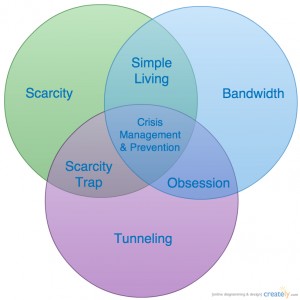
In the first circle on the left is Scarcity. It overlaps with the Bandwidth circle on the right and the Tunneling circle on the bottom. Scarcity overlaps with Tunneling, Scarcity overlaps with Bandwidth, Bandwidth overlaps with Tunneling. In the exact middle, the 3 areas overlap with each other. That makes 7 separate sections. Let’s look at each one.
Scarcity + Tunneling = Scarcity Trap
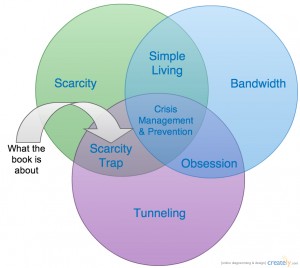 Illustrating this classic scarcity trap is the main point of the book. The authors outline this state of being between scarcity and tunneling. An example in the book is “payday loans” (the poor get a small, extremely short-term loan at ridiculously high interest. The interest plus fees on that small loan puts them into further debt, causing them to loan more to repay the original debt). The cash-strapped can’t think of anything else but paying the immediate bills in any way necessary. They can’t absorb the reality of debilitating interest rates when they have no bandwidth to think of such things.
When I began to think about it, though, I realized that Tunneling, Bandwidth and Scarcity interact in our lives and in our organizations in different ways. Here is where I begin to ad-lib off the concepts covered in the book. These concepts can be applied to both individuals and industry.
Bandwidth + Tunneling = Obsession
If a person has “too much time on one’s hands” –as the phrase goes– , she is focused intently on one activity, like a pro golfer would concentrate on golf. The pro golfer would exist in the convergence of Bandwidth and Tunneling. Pro golfers don’t spend their time thinking on things like bills or dinner or medical care. A single mother holding three part-time jobs has a lot more trade-off decisions to make than a pro golfer. What pro golfers do have is time to spend on golf. For lack of a better word, I’ve called this “obsession.” It could be called “passion” or “focus” but I’m thinking of how this state would look for us regular people. A teen in her parents’ basement playing WoW 50 hours a week would also fall into this area: a young adult with no bills, no obligations, and all-encompassing preoccupation with MMORPGs would be a more familiar example of someone existing in the obsession state.
A company can exist in this Obsession area if they have a lot resources allocated to a singular product or goal. The goal may never be attained because the lack of time or money isn’t felt (Scarcity). No motivation exists to complete the project and no other demands are being met. I’m thinking about my novel all the time. I read writing manuals. I meet with other writers. I don’t write enough words. A little scarcity might move me along.
Bandwidth + Scarcity = Simple Living Movement
We’ve all met these types of “bare bones” people. Perhaps they are Thoreau fans that don’t own TVs or live “off-grid.” Perhaps they are an elderly couple who live in a basic apartment with few possessions. Whether the scarcity is self-imposed or is economically created, a person who has a minimalist lifestyle would fall in the Simple Living area. They have the peace-of-mind to deal with the lack of things others deem essential. They accept that scarcity and move on.
Scarcity + Bandwidth + Tunneling = Crisis Management and Prevention
The Red Cross organization not only deals with immediate crises but also plan for and try to sidestep future disasters. Unpredictable events are in fact predictable in their inevitability, and the Red Cross squirrels away money for future use. (In fact, they are rightly criticized for withholding too much money and distributing too little to present-day disaster victims).
I suppose the authors would suggest that individuals and organizations aim for this stasis of Scarcity+Bandwidth+Tunneling. While we are appreciating scarcity of resources (knowing the value of a dollar as well as the worth of our time and moral norms), we have the energy to also look long and hard at savings for the future while concentrating steadily on day-to-day projects. With the right dose of Scarcity, Bandwidth can be loaned to one immediate project in the Tunnel. With the right dose of Bandwidth, Scarcity can be managed calmly in a very temporary Tunnel. With the right dose of Tunnel vision, Bandwidth can laser-focus on the issue of Scarcity.
#YOLO
“You Only Live Once” is a common mantra that’s taken a dangerous hold of young hip-hop culture. Instagram, Facebook, and Twitter are awash with #YOLO-tagged photos of young people engaging in risky behaviors. Economist and other academic researchers aren’t in the mood to party with them though; the increasing level of risk in young people’s decision-making can mean there is a compounding –and shared– feeling of hopelessness and malaise in that generation. By seemingly doing nothing but partying and posting on Facebook, young Millennials are living a dark minimalist life. With no jobs, no money and no hope, this new lost generation fills their lives with social risk, claiming there is only time now to do crazy things before they need to truly face the reality of a life of struggle or total ruin. This is that bad state of “having too much time on one’s hands”: loads of time, a dearth of hope, and total absence of focus. We need solutions to keep our youth engaged and invested while they wait for their turn on the world stage.
DSL, FiOS or Dial-Up?
The book tunnels in on how the poor get stuck in the Scarcity Trap, but lends no bandwidth to the questions “bandwidth” itself generates. My Venn model may break down a bit here too, because Bandwidth and Scarcity can come in many different forms. The typical ideas would be between time and money: Lots of time? No money; Lots of money? No time. But what kind of bandwidth do people need to deal with which kind of scarcity? What should we focus on, and when? Many more thought experiments are needed to test the strength of the Scarcity Venn, and a whole other book is needed to teach us how to deal with our varying states of living.
For now, I’ll try to bribe some friends into generating some hard deadlines for my novel.
Got Bandwidth to lend to this? Not many of my questions are rhetorical. Please comment.
UPDATE: September 23, 2013. I wrote to the author Sendhil Mullainathan via the app Goodreads, informing him of this review. This was his response (published here with permission from him) is below, in screenshot and typed text.

“Christine,
This is fascinating. I am looking at the venn diagrams now trying to wrap my head around it. Bandwidth + tunneling = obsession is interesting. You mentioned self-help and alas as you say it is in our nature. Recently I did write something very short that may help a tiny bit:
http://ideas.time.com/2013/09/09/the-…
I’m also writing a piece on getting to the gym regularly mainly because that’s the one thing I do well.
Sendhil”
Photo Credit: Book Cover and Venn Diagrams: Christine Cavalier