
≡ Menu

schoolkidswritingBack to School

I suck at trivia. I do OK on Jaywalking segment questions but I’m toast when it comes to Jeopardy or Trivial Pursuit. Facts I knew in 4th grade have completely disappeared from my mind. Thankfully: the Internet; Wikipedia; Reference publications.

The strange thing: I love crossword puzzles. For someone who stinks at recalling trivia, crosswords seem like the exact wrong hobby. But, thankfully: the Internet; Wikipedia; Reference publications! In short, I “cheat.” When I’m stumped, I use Internet apps: Goodreads for authors and novels; Merriam-Webster for definitions and the thesaurus; Wikipedia for lists or history. After that I’ll do a Web search on the subject. If *horrors!* even that doesn’t work, I’ll give up and search on the clue itself (hey, NYTimes crosswords are hard! Don’t judge). My research skills account for something, and anyway I love being reminded of facts I’ve forgotten and learn something new in the process. Doing crosswords helps keep my mind awake.

A friend of mine reminded me of another little skill we all learned in school that has helped me tremendously in my blogging and freelance writing. My friend is a librarian. Can you guess what skill she reminded me of?

Here’s your clue:

1A. Tool to navigate stacks (3 words): _ _ _ _ _ _ _ _ _ _ _ _ _ _ _ _ _ _

Got it?

It’s the Dewey Decimal System!

card catalog

Thankfully, this is all electronic nowadays.

Stay with me.

Content is King

The Web is filled with loads of advice about content marketing: When to post, how many “Top 5” lists you can safely get away with in a week, optimizing the use of colons in tweets for the most engagement. Talk about trivia! (It’s more like minutiae.)

The gurus say, “Content marketing is simple! It’s writing about your business.” They also say, “Content is king.” (Kings aren’t simple, usually, but I have to admit my sample size is pretty low). How many times have you seen blog posts from brands or writers that seem completely out of left field? Sometimes the subject of the post isn’t remotely related to the services they provide. One day the post is on target, the next it isn’t. We are all guilty of this, especially if we are in a daily-posting position.

You can use the Dewey Decimal System (DDS) to zero in on your subject area and find related topics. “What?” you may be thinking. “Go through those stale index cards at the library?” No. Remember? The Internet. Wikipedia. Reference Publications! Wikipedia has all the info on the DDS we need.

Where we keep the list

Go through the list of categories or “classes” of subjects over at Wikipedia’s DDS entry. Find the main class under which your brand, area of expertise, services or product falls. For example, if we were writing content for the brand Cheerios (cereal), we could find “food” on the list. That’s class 640: Home economics & family living. Now we have a main umbrella category to which our posts should relate. Next, look at the sub-classes under 640. Subjects like household utilities, homecare for the sick and household furnishing all congregate there. Plus, Wikipedia enables links to those particular subject articles.

Readers interested in reading about Cheerios are probably interested in aspects of life that surround the product. Now that I have a well-used list of related subjects, I, as a Cheerios content marketer, can write about Consumer Report’s safety ratings of high chairs or new energy efficient light bulbs. Personally, I’d write a fun post –with lots of photos– about how Cheerios look under different spectrum bulbs on various high chair surfaces. Creative, fun content. Just remember, though, being creative is great as long as your post isn’t crazily off-topic. Use the DDS classification system to keep you on track. Extra Credit: It also helps when you have no clue and are drawing a blank on what to write.
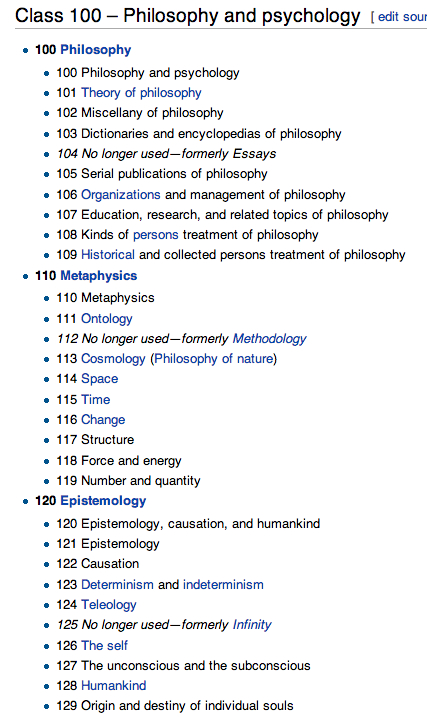
PhilList
To keep myself on topic for this blog, its classification lives on a sticky note on my laptop. If you’re curious, the class is 300: Social Sciences, Sociology, Anthropology/ 304: Factors affecting social behaviors. I write about how technology affects our lives; technology is the factor that affects how we behave. When I get stumped, I can expand to the 100 class: Philosophy and Psychology, or even 127: the unconscious and the subconscious. Extra Extra Credit: You can adopt any subject in the list, just relate it back to your blog’s main focus.

That wasn’t too painful, was it? Who knew Dewey would do us so good?

Photo Credits: kids in classroom: me (Christine Cavalier). Card catalog: Megan Amaral on Flickr


3 comments

lady with glasses pointing a finger in a corrective stanceThe Attack

No experience seems more common in social media practice than having one’s grammar corrected. The Grammar Bullies hide and then pounce on any typographical misstep or the your/you’re mix-up faster than you can click “submit.”

Reasons exist for such rude behavior. Slate attempted to explain the phenomenon, but if your gut instincts have told you some element of superiority is involved, your gut was right. Polite, secure people do not correct other people’s grammar. If they have the meaning of what one is saying in conversation, most listeners will overlook slight errors. Unfortunately, we don’t always talk with “most listeners.” Sometimes, in person, online, and against our better judgment, we talk with snooty, self-appointed, and insufferable grammar police.

What’s Really Happening

Behind all grammar corrections, back-handed compliments, and “it’s-only-a-joke” jibes lies hidden anger. When a Grammar Bully corrects your grammar (especially strangers online), you can rest assured that you are not the cause of his anger. Your word usage was simply the trigger of that anger. The Grammar Bully is in need of companionship, so publicly correcting you sends the homing beacon out to other Grammar Bullies. Grammar Bully is ringing in the friends with whom he can bond over mutual hate of the their/they’re misstep.

When we are angry or stressed, a bonding hormone called oxytocin is released, urging us to form social connections with other humans so as to better our chances for surviving the cause of the stress. A Grammar Bully is feeling insecure in some way, and the insecurity is driving her to gather up friends. Many observers may think the Grammar Bully is about belittling others, but really, the Grammar Bully is just looking to find other Grammar Bullies because she is feeling angry and/or stressed.

Anger can be subconscious and many times it is. We are discouraged from expressing anger when out and about in polite society, so we suppress it. Unfortunately, anger is one of those emotions that bubbles up to the surface. Grammar-correcting behavior is one of suppressed anger’s outlets.

So, now that we understand that insecurity and resentment are forms of anger that are being suppressed in the Grammar Bully, we can now learn how to behave in the event that we happen upon one of these lovely people.

Fight Back

Here are a few steps you can take:

  • Pat them on the head and say “That’s nice, Dear.”
  • Shout, “I WIN!” while jumping up and down and holding your fists in the air.
  • Immediately sign up the offender to every spam email list known to humanity.

Just kidding. That’s just our own anger at someone attempting to belittle us in public. We’re Zen. We’re secure. We aren’t thugs who call up other thugs to beat down others. A little serenity goes a long way, and in the end will gather you more friends the more you share it.

Be Gracious

Here’s what a secure and confident person can do when faced with Grammar Bullies:

ONLINE:

1. Correct your text. Now that you know the Grammar Bully’s main issue is deep-seated anger and not about you, you can just chill and make the change.

2. Delete the tweet or update and tweet it (or update) anew. This only takes a few seconds and strips the wind from the Grammar Bully’s sails.

3. Apologize and leave it. Life’s too short.

4. Ignore the comment altogether. This may mean the homing beacon will signal even more Grammar Bullies to congregate, but at times it is best to not engage a Grammar Bully at all. Use your best judgment.

4 pointer fingers in a young woman's distraught face

Don’t worry! It ain’t ’bout U.

IN PERSON:

1. Smile kindly and with compassion (if you can manage it). The Grammar Bully just gave you the signal that she feels inferior to you and others in the room, or perhaps to others in general. This is kind of like a compliment. Kind of.

2. Apologize light-heartedly. e.g. “Silly me! I fall into that trap too often than I’d like to admit!” (This will make you seem quite gracious to the other listeners).

3. Call attention to the correction, but in the kindest way possible. e.g., “I see you are a real fan of the English language. Do you know my writer friend? He is the same way.”

4. Suggest you table the argument for another day. “I don’t have my Elements of Style with me right now, but I’m assuming since we all got the gist of what I was saying, we can look it up later. For now I’d like to finish my story.”

Remember: We are chill. We are calm. And no matter what, we are not threatened by Grammar Bully’s rude behavior. The key thing to remember is that even though you may have made a mistake, the Grammar Bully is making an exponentially bigger one by revealing their insecurities in public via correcting you. Handle it graciously and you’ll come out on top.


Photo Credits: Rochelle Hartman on Flickr and Andrew Mager on Flickr

137 comments

More Bad Press for PayPal

Screen Shot 2013-08-15 at 4.09.48 PMMore and more stories are coming out about PayPal refusing to hand over ticket sales money or donations to event planners and start-ups. This freezes operations for the organizations that need the money. PayPal has reported that it is part of their anti-crime, anti-fraud practices, but to the watchers of all things Internet, it seems like no-one is at the wheel of the electronic payments goliath. Either that, or they have a very strange investment scheme happening that requires tying up their cash stores for months on end.

The latest complaint is chronicled on VentureBeat, and is sure to get quite a few hits. PayPal’s draconian (and perhaps illegal) methods are leaking out to the mainstream. This means people like me and less-savvy others will get the “PayPal is bad” message and avoid using it. PayPal already has a bad phishing email PR problem to overcome and it certainly doesn’t need the image that it won’t release funds.

See how Paypal is screwing up crowdfunding over at Venture Beat. Federal investigation, anyone?

6 comments


Screen Shot 2013-08-08 at 5.14.01 PM

A video over on Gizmodo talks about the emotional cast that orange and blues have on film. It’s a great beginning primer on the physics of light and color.

If you are new to the study of perception in Psychology and you’re a web designer, take a look at this video to learn how the different light frequencies happen. You can transfer some of these concepts to color choice in your web design, perhaps even do a bit of math in the Kelvin ranges to come up with colors not only in an aesthetic way but a quantitative way as well.

0 comments

Harassing Phone Scammer Pretends to Be DEA Agent

embroidered badge of the Drug Enforcement Agency

This guy most certainly doesn’t have one of these…

Today I was called at home by an aggressive phone scam criminal that goes by the name of “Mark Thomas” or something similar. Here’s how I got pulled into talking to this criminal, what clever engineering tricks he tried, and what to do if this happens to you.

Scammer’s First Contact

The first time the criminal called, our Verizon voice mail service (not the answering machine) took a message. When I played back the message, it seemed to be cut off. Caller has a deep male voice, is choppy but polite: “Yes. Hello. Good Afternoon. Christine. This is special agent Mark Thom–” (note the cut off message here. We’ll discuss that in a bit).

My Return Call

I identified the probable number in my phone’s history and dialed it. When the other end picked up, I heard talking and what sounded like to a telemarketing center in the background, so I quickly ended the call and figured I was done.

Scammer’s Second Contact

Mr. “Special Agent” calls my phone again. I see it is the same number so I pick up and say “Hello?” (I usually answer “This is Christine” when I see a business number I recognize to save the caller the formality of asking for me. This time, though, cautious, I just said Hello.) The criminal then asks, “Is Lisa home?” The conversation went as follows: {Key: Caller. Me. }

  • “Is Lisa home?”
  • “No, I think you have the wrong number.”
  • “Let me ask you then, why are you calling this number?” This was delivered in an increasingly intimidating voice.
  • “You called me first. I –”
  • (interrupting me) “Who is this?!”
  • “I don’t feel comfortable giving you that information. Is this Mark Thom-whomever? He called me.”
  • “Well who were we asking for when we called?! TELL ME WHO WERE WE ASKING FOR?”
  • “I don’t think you have the right number.”
  • “WHY DON’T YOU ANSWER THE QUESTION?! WHO WERE WE ASKING FOR?”

From then on it was just this man yelling at me, threatening that he would come and “serve [me] with due process” and that I shouldn’t worry because he was “going to find [me]”. He kept trying to discern my name, which I successfully kept secret. This just made him angrier. After about not even 30 seconds of sheer yelling and intimidation, I said, “OK You’re scaring me now. I’m going to hang up.” The man still kept yelling as I pulled the phone away from my ear and clicked the OFF button. He was still on the line yelling when I immediately attempted to dial 911. The jerk may have heard me dial 911 over his ranting.

Cut-Off Message & Earworms

I was a bit shaken up, to be truthful. I’m ashamed to admit I was scared, even for less than half a minute. I would’ve written the message off if it was a full message. The fact that it was only a partial message played a big role here. Also, my lack of experience with this particular scam and the typically human wiring of my brain made that little unfinished piece of business too hard to resist.

This particular criminal didn’t seem wise, so I doubt he socially engineered a purposefully incomplete message. But a cut-off message with a novelty approach (“Special Agent?” Clever!) and just enough information available to generate a callback is an evil-genius bit of social engineering. Let me explain.

Ever get an earworm? It’s a song that just plays over and over in your head, making you tune into any horrendous music station just to stop the song snippet from repeating ad infinitum in your mind. Only then you find as soon as the radio is turned off, the song just simply begins its rounds again, like some bizarro world “It’s a Small World” deranged carnival ride from the darkest depths of hell.

This “cognitive itch” or dissonance that we experience with earworms and other incomplete tasks has a name. It’s called the Zeigarnik Effect and it is defined thusly:

The Zeigarnik Effect is the tendency to experience intrusive thoughts about an objective that was once pursued and left incomplete (Baumeister & Bushman, 2008, pg. 122). The automatic system signals the conscious mind, which may be focused on new goals, that a previous activity was left incomplete. It seems to be human nature to finish what we start and, if it is not finished, we experience dissonance.

 The cut-off message, along with an uncommon moniker (“Special Agent”), whether designed by the criminal or not, sent my brain into a curious and “must-complete-this-task” state. I had to investigate. The quickest way to do that was to call back the number. Things went downhill from there. Checking the number online would’ve revealed a lot of pages dedicated to “Special Agent Mark Thomas” and the exact same phone number, but events escalated quickly and by the time it was over, I just wanted to file a report.

The Lesson

Fortunately, no harm nor foul came to me because I was careful to not reveal any personal information. Even during the criminal’s tirade, I kept my wits about me. My experience with government agents (although very little thankfully) helped me to realize this was a scam. No agent would be allowed to treat even the worst offenders in such a manner. This criminal puts on a movie version of a rogue DEA agent to get people to fall in line, and as the police officer told me, many people do, especially the elderly. The officer was quite understanding and calming actually. He said it was his second harassing phone incident today and he sees it all the time.

I wanted to share this with you so you can realize that those of us who work online daily and have years of experience with scammers can still be tripped up. If it happens to you, don’t be ashamed. Take action. Put an immediate hold on all of your accounts. Explain to the credit agencies and your banks that you suspect that you have been swindled. File a police report. Register all new credit cards and MAC cards. Yes, it’s a pain, but your credit and security are worth the effort.

Keep safe out there.

__________________________________

P.S.: The way to get rid of that earworm? Look up the lyrics online and sing the song through from beginning to end a few times, making an effort to notice the specific lyrics that you couldn’t remember before. Scientists think that an earworm is simply the brain trying to complete the missing lyrics. Go learn them and the earworm should disappear and leave you with peaceful silence.


PHOTO CREDIT: C Holmes on Flickr.
5 comments