≡ Menu
A night of philanthropy and search philosophy in Philadelphia at SEER

Come pray to the gods of SEO in the Search Church

If you were from ’round these parts, you’d know exactly where to go when someone mentioned “Search Church.” SEER Interactive, an SEO and analytics company headed up by my friend Wil Reynolds, works in an old church in Philadelphia. Wil and the gang worked hard to convert the church and turn it into a work/community space for all geeky souls that worship the ways of the World Wide Web.

Always innovating and thinking of ways to bring the Philly Search, Design and Tech communities together for a higher purpose, SEER Interactive is hosting a “Breaking Down Silos” night of charity where attendees can learn from hand-picked experts (including one from Google!) while contributing to the greater good: The entire $25.00 ticket price goes the American Cancer Society and two other charities. Major bargain, and lots of kudos to the speakers and SEER for donating their time and energy.

Hurry and sign up. The Search Church is big, but it can’t hold everybody.

Some Deets:
Thursday, May 16, 2013
3:00pm to 7:00pm

Register here.

0 comments

BarCampNewsInnovation Philly ReCap

[slideshow id=2]

Saturday, April 27 2013: I spent the day at BCNIPhilly (#bcni13). It was held at my graduate school alma mater, Temple University (see the photos above in my stream on Flickr and tag yourself and friends at the PurpleCar FB page… give it a Like while you’re there? kthx).

One of my most favorite days of the year and the culmination of Philly Tech Week, BCNIPhilly provides me with the best opportunities to connect with and learn from journalists, media makers, online gurus and more. This year, Content Camp Philly along with the News Hackathon happened in combination with BCNIPhilly.

This year was a bit different for me than previous years, and not just because I ditched handing out business cards in favor of temporary arm tattoos of QR codes of my websites. This year at BCNI was anomalous because I didn’t meet as many new faces as I normally do at this conference. Many of my long-time (and rarely seen) friends were in attendance, including (but not limited to) Lynette Young, Whitney Hoffman, Don Lafferty, Heather Chin, Jim MacMillan and of course the organizers Christopher WinkBrian James Kirk and Sean Blanda of Technically Media. Other troublemakers were there, like Ken Grant, Daniel Victor, Melody Kramer and members of Lynette’s Faucet Group John Langan and Chuck Hall. I saw Sondra Willhite from LadyHacks across the crowd, but we both missed each other. All day I recognized previous attendees but didn’t stop in between sessions to shake hands. I see  Albert Sun every year; we say hello but that’s the extent of our chats. (My blond hair this year may have thrown him off.)

I’m forgetting some folks! There was a very big crowd there this year. So big, in fact, lunch in the main room of the Annenberg Building was chaotic. Greg Linch took it upon himself to start a new serving line on the other side of the lunch table just to expedite things. I just slipped out to the 7-11 on campus for some gluten-free options (which I have to do every year. The conference is pretty “accessible” ticket-price-wise and is funded by sponsors, so I never expect a GF meal). I arrived back in time to hear a friend that I made at a past BCNI, Emily McManus of TED, give a talk about the outreach initiatives and a cool new search function at the non-profit’s site: Emotional graph search. Got 20 minutes and want to feel inspired? You’ll be able to click a button & the site will deliver you a quick media meal worth savoring!
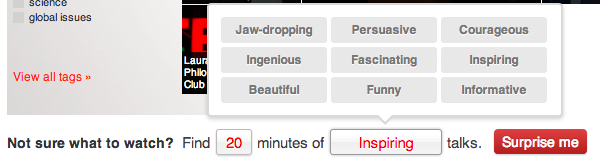
screenshot pic of TED search function

Just put in the time you’ve got, the emotion you want to feel, and click “surprise me”!


After the crowd dispersed a bit, I did get to meet a new local face, Karl Stark, who is the Health & Science Editor at the Philadelphia Inquirer. Like any smart editor, I think Karl was a bit suspicious and half-waiting for me to hand him my “please hire me as a stringer” portfolio. Instead, I gave him some story ideas for his work. (You guys know how I love to spout out ideas to people). Karl seemed to appreciate it, and took down some notes. I teased him about sending out one of his many journo minions after the stories. A minute later while we were perusing the board’s offerings for the next hour, I had the honor to introduce Karl to Jim MacMillan, my seasoned-newsman friend who worked at the Daily News forever and ever. Karl and Jim are in the same inner circles but had never met in person. As they talked, I felt a little heavy backstory there about their common work history, but I think any tension I was sensing was just typical “I used to work for the same company” stuff that would be immediately dispersed with a shared beer. So I hope they got to do that later at the Draught Horse.

At the after party at Draught Horse on Cecil B. Moore Ave, Emily and Heather, along with newcomer and fellow WITSphl13 attendee Rachael Hubbard (whose new Twitter bio pic was taken by me at the end of the day because I can’t have her be an egg!), asked me which session held the day’s highlight for me. I have to say 2 sessions were kickass. They didn’t shine because I learned something new; I didn’t learn anything new. Fortunately or unfortunately, I’ve gotten to a professional point in my writing-slash-creative strategy career where an unconference session probably won’t pop out any mind-blowing surprises. That kind of magical discovery stage has long, long past for me. The excitement for me in the sessions I mention was in the fact that someone else was standing up in the front of the room teaching the very strategies I use and the exact trends I see myself. It felt great not to feel crazy and too “out there.”

The first session of the day was given by my fellow township resident and marketer extraordinaire Michael Leis. He talked about the process through which his agency generates community for brands: They rely on building a voice via a character or a Shakespearean archetype. I’ve been cribbing this trick from the good ad agencies for years, but I add personality types from Psychology in the mix when I do consulting. It was so refreshing to see someone from a traditional agency setting talking about the tried-and-true Madison Ave secrets applied via Twitter and Facebook. As a fiction writer, I understand the construction of character and voice more than most people. Then I add my Psychology background as well as decades working and living in the tech world. So when Michael was even just touching on Shakespeare and archetypes and Twitter, I felt like I was at church listening to a choir sing my favorite spiritual. Michael’s slides and stories sang to me. I was so elated that I even asked him afterwards via a Twitter direct message to please look over my LinkedIn profile, as I explain in it the same concepts he discussed. If I were job-searching, I’d want to work in a house that gets it.

A sidenote-slash-related session was a roundtable called “Digital Strategist?” where we had a great conversation about how to use voice and build community online. Aram Zucker-Scharff (another BCNI regular) and I had a lot to say, especially in spewing advice toward the lovely and sharp Melissa Sachs. Another highlight of this session: meeting Penn employee  Kurtis Sensenig. Kurtis produces video for the Ivy League University of Pennsylvania and I’m hooking Kurtis up to advise my husband (a dean and lecturer at UPenn) on a remote course he’ll be teaching this summer. Kurtis reports that he’s been looking for a test case for his own theories on video for distance learning, so this serendipity is sure to result in some great collaboration. LOVE when that happens, don’t you? Finding my own work or consulting jobs at conferences is cool, but helping others to be more than the sum of their parts by connecting them together is one of life’s great joys. It’s why I’m such a “super connector” online and off.

The next session that held another “allelujah” moment for me was David Dylan Thomas‘s talk on the sharing economy. Ownership is over. Millennials and the future dwellers of the world who will live mostly in cities don’t want to buy your book, even if it is just in digital form. They want to borrow your book, and they want to borrow your car, your couch, your music, your camera, or anything else they just need for tiny bits of occasional time. Yes, yes and more yes. David put a crapton of future-view into a quick look bunch o’ slides, and said it better than I ever could. Again, I left feeling encouraged that the knowledge exists a lot more outside of my own sci-fi writing brain than I expect. It’s nice to feel you have “peeps” that see the world and the world upcoming like you do. (I’m not bragging here. Most days I feel barely sane, with all the things I see coming and no-one to tell them to. This is why I – and probably many others – write fiction… it eases the tension.)

There’s more I could write but let’s just cap it off here. The day was more of a trip down memory lane for me than other years but it was nice to see some of my “crazy” thoughts make the “mainstream.” Bouncing ideas around with like-minds at the after-party rocked too. Many of the attendees straddle the journalism, tech and online-behavior worlds like I do. For this lone creative worker, there’s not much better than a whole day surrounded by my rarified, mashedup-unique-talent, futurist people. That’s BCNI. Come see me there next year.


More recaps from other attendees:

Katie Sweeney

CPIJ’s Storify


8 comments

Women in Tech Summit 2013

[slideshow id=1]

This past Saturday April 20, 2013, I attended the 2nd annual Philly Women in Tech Summit 2013 (WITS13). My pics are above in a slideshow and also in the Flickr group.

Being in a big room with other female technologists gave me a feeling of belonging and in a way, safety. I felt like I was surrounded by “my people” and I had a posse of compadres that “get” me and my experiences. (Writers are also my peeps, but there’s no one conference for women-computer-scientists-who-are-also-writers… yet.)

One of the day’s highlights (there were many) was getting introduced to the Python programming language by my friend and neighbor Dana Bauer, a cartographer who uses Python in her data-map-making consultancy. Plugging my way through the CodeAcademy lessons in Python, I noticed CodeAcademy is touchy; I use my Terminal window on my MacbookPro to make sure my code would work in a less-strict environment. My 1st impression of Python: It  +  looks  +  like  +  this  +  with +  lots  +  of  +  spaces. Spaces? In programming languages? Not sure how I feel about that right now. We’ll see if my brain can pull away from the cold, hard efficiency of the Unix command line and adapt to the almost-font-centered/writerly environment of Python.

The LadyHackathon of several weeks ago had many of the same faces I saw at WITS13, but there were also quite a few new faces I haven’t encountered at any Philly tech events. Word-of-mouth goodness about this WITS conference will spread and it will need a larger space next year. Wharton hosted last year but the organizers ran into a snafu there and pushed it over to Philadelphia University. The DEC building at PhilaU was lovely. New and tech oriented. But the classrooms were small and some last-minute rearranging had to occur. Many of the rooms were packed to standing-room only capacity.

One of the great subtleties about the WITS13 was that almost 100% of the speakers were women. There was one or two incidents of male speakers, but women instructors held the majority. The panel at the end of the day was probably the most informative panel I’ve ever been lucky enough to attend.  The panel, moderated by tech powerhouse Sue Grinius-Hill, COO of ApprenNet, LLC, included these fantastic business leaders:

These women talked frankly about everything from finding mentors to job hopping to “leaning in” and coming to terms with the knowledge that we all knew enough technology to apply for the web dev jobs we see piling up. It made me realize that we don’t put enough stock in our ability to learn and learn quickly. The ability to adapt, synthesize. and apply new knowledge is truly what will get you a web development or any job in tech today. Men seem, on average, to have no issue applying for jobs that have requirements outside their current skillset. They tend to just show up and say, “Yeah, but I’ll learn it. No problem.” We tend to want to learn everything first, become an expert, then apply. We’re getting the order all wrong. We’ve learned enough to get by. Get a job first. Learn everything. Become an expert. Move on and up to the next job.

At the end of the session, the panel took questions. Jessica Ivins, a senior User Experience/Design Specialist at AWeber Communications, Inc., a WITS13 instructor and general Philly area UX promoter extraordinaire, stood up to address the audience. She encourage the women in the room to get into public speaking. Her own path to becoming the speaker she is today was at first met with reluctance, but now she is traveling to speak all over the country and outside the US’s borders. Public speaking, Ivins says, gets women “out there” and helps us to be seen as tech leaders. She said if she can learn to get up in front of an audience, we all can too.

This event was part of Philly Tech Week, which is going on now. Check out the schedule and come to at least one of the 80+ events. Philly has a vibrant tech/start-up/arts community and you should really get to know us.

Next event I’m definitely hitting up: BarCampNewsInnovation + Content Camp. See you there!


1 comment

WHEN TRAGEDY STRIKES: ONLINE REACTIONS

The Boston Marathon explosions caused death and destruction. Sandy Hook obliterated our hearts. We’ve all been under unusual strain lately for being citizens of a country that we feel is pretty much orderly and safe.

Since 2004, I’ve been watching online reactions to national tragedies. Many of the reactions can be loosely correlated with the famous “5 Stages of Grief” by Elisabeth Kübler-Ross: denial, anger, bargaining, depression, and acceptance. Online reactions usually reflect one or combine two or more of these stages.


WHAT TYPE OF ONLINE REACTIVE PERSON ARE YOU?

In light of the Boston Marathon tragedy, I’ll share with you the few trends  in behavior I see. Here are a few general profiles of reactions to grief or tragedy that I observe on Twitter and other social media sites:

  • Newsers (Denial): Retweeting the most recent news reports and keeping up with hashtag mentions and searches is the most immediate and comforting reaction for these users. I tend to fall into this group for a short amount of time. Knowledge about a disturbing thing helps people feel more in control of events that are beyond their purview.
  • Extreme Newsers (Denial + Bargaining): They keep on the subject for long periods of time, sometimes spanning days into weeks. They often think of themselves as what I call “curation journalists.” Curation Journalists don’t report or create their own news; they curate the best of the Web in real time. This may seem like “fake” journalism, but it isn’t. When tragedy strikes, it is very helpful to have a human sort through the mess of gossip vs. real reporting, quality vs. (perhaps libelous) quantity. Find yourself a friend who is great at this news-curation skill and follow them. It will save you a lot of time and energy, plus it will give you a sense of having a team of informants. Having enough information, as I said, is a human need for relief from stress.
  • Bots (Denial): These are the content creators that don’t turn off their automatic or prescheduled updates in light of tragedy. I’ve seen close friends that are big in the social media world fall under scrutiny because they were out-of-pocket or offline when tragedy struck, and an insensitive update (this one a joke about guns after Sandy Hook) can throw a career into a tailspin. It also can make you look like an insensitive ass.
  • Carry-on-ers (Denial or Acceptance): People who keep tweeting as they normally would without any or very little mention of the tragedy fit into this group. Although this may seem rude and insensitive to some, it’s OK if individuals would prefer to “talk their way through” a tragic course of events. Brands, however, should take a pause from selling. It’s just in bad taste. Here’s what McDonalds tweeted immediately and stayed silent at least 14 hours after the Boston Marathon explosions:
mcdonald's tweet that says they are pausing in light of the bombings in Boston

A good example for brands. Take a moment of silence and stick to it.

  • Side note: Realize that citizens of other nations don’t necessarily fall into this category. Foreigners may not have the same news sources or values. Foreigners may also fit into the next category, Back-Lashers.
  • Back-Lashers (Anger + Bargaining): Some people deal with tragedy by going straight for blame games. Assigning blame, invoking Karma rules, or suggesting extreme preventative measures (like martial law or restrictive legislation) are some of the ways Back-Lashers behave online after disasters and mass-murder crimes. These tweets, in my opinion feel cruel and insensitive. However true they may be (e.g., I saw a Middle Eastern man tweet about drone strikes), this type of self-relief goes beyond the realms of polite netiquette. I understand the angry reaction, though. It’s only human. Unfollow the icily cruel people, but try to stay patient with your connections that fit into this category. They may not realize how they sound.
  • Death Tourists (Denial + Depression): A “Death Tourist” is a person who is fascinated in a positive or negative way by the demise and suffering of other humans. There are actual travel tours offered to cater to this bunch; It’s a real thing. The tour visits the sites of mass or single murders, abuse, or other heinous crimes. Death Tourists on social media are a form of News-ers, but they focus on the graphic nature of the tragedy. They add compassionate touches like, “Oh my god, this is just heartbreaking to watch” but they spread horrifically graphic media via their social accounts. I’m not a big fan of this reaction either. Please see my post about “Eye Bleach” for my reasons why.
  • Mourners (Depression+ Acceptance): Some people are truly skilled at handling their emotions. Instead of gut reactions like anger or an obsession with absorbing all the graphic media available, the Mourners hop straight to the weeping, chest-tightening, and virtual clothes-rending tweets to express their sadness. This approach seems like a healthy reaction, as long as it doesn’t go beyond the limits of decorum, like Extreme Mourners. A compassionate mention and then a few hours or days of silence is the standard for sites like Twitter. (Facebook may have on-going asynchronous discussions under one update).
  • Extreme Mourners (Denial + Acceptance): These types are a bit like Death Tourists. Instead of absorbing media of the tragic event, they share their sadness and re-share others’ mournful comments, ad infinitum. This could be attention-getting behavior, but it can also be a sign of a panic attack brought on by the reminder that our lives can be in danger even at the most innocent of events.
  • Actioners (Acceptance + Bargaining): These are the philanthropic people with a passion to serve. This category can include people who retweet civil service calls (e.g. Donate Blood), or those who begin a charity or relief mission and are looking for volunteers. These compassionate go-getters give the rest of us hope and a feeling of control over our uncontrollable environment.

HAVE PATIENCE WITH YOUR FRIENDS ONLINE

We all experience tragedy in our own individual ways. We may bounce between the different kinds of online behavior when reacting to various horrific situations. Arguing with a connection online about their reaction is not helpful. Be patient. People need time to work out their anxieties, and cutting off ties over a social media update or two probably isn’t the best way to hold onto friendships.

Back in the old days, when there was no WWW or way to share your grief with millions or even just hundreds of people, therapists would suggest writing out a letter to your deceased loved one or the object of your anger. They’d also suggest keeping a journal of thoughts and emotions. Now, we just aren’t that private. We go to Facebook, Twitter, email, to publicly share our stages of grief. The rule used to be that one would write the letter, then burn it. Or they would write out the journal and then lock it away forever.

Locking our social media trail away forever isn’t yet possible. Even if you delete your updates, they still live on somewhere, in some random server grid. Take care to react politely and appropriately online. If you need to vent more, call a friend. Voices don’t carry; Type does.

How do you usually deal with massive national tragedy?


7 comments

blogtalkradio logoToday I was a guest on the featured BlogTalkRadio show “Views from The Top” hosted by Adrienne Graham (@talentdiva). The episode was entitled “Know Thy Customer”.

Ms. Graham and I gave a quick rundown of what seemed to happen with the short tenure of once-Apple employee Ron Johnson (the genius behind Apple Store’s Genius Bar). This Harvard Business Review article has a positive spin on what Mr. Johnson did right. Adrienne and I talked briefly (the show is 30 minutes) about the communication strategies that perhaps Mr. Johnson didn’t use.

My main point in the interview (which is made with the acknowledgment that we don’t fully understand all the details behind Mr. Johnson’s ousting) was that when a business must pivot to match a new economic situation, then the internal communication is as important if not more important than the external communication. Externally I felt Mr. Johnson did a great job. I saw innovative and daring ads, personal letters and valuable spending cash from him.

So why didn’t it work? Adrienne and I pondered if Mr. Johnson had considered the phenomenon of “loss aversion” within the staff and whether or not he dealt with it.

Loss aversion” is the rule, cited mostly in the study of Behavioral Economics, that people will stick to the status quo as long as possible. The loss of an established possession or process is 2 to 3 times more painful than the loss felt when not receiving a gain that was promised to you. In other words, losing 10 bucks from your pocket today feels way worse than not getting the 10 bucks your friend said was waiting for you at your desk.

JCPenney’s board seemed to want some major changes and innovation to turn the fate of the department store around. Ron Johnson seemed like the instigator extraordinaire for the job. If you have a half an hour, go take a listen to the conversation in iTunes.


I hope JCPenney survives the sad turn of events of this morning. If you’ve been following the story, let us know what you think. Do you think JCPenney gave Ron Johnson a chance?

5 comments