
≡ Menu
Yahoo's Mayer is bailing dead weight and ignoring sunk costs of the work-at-home policy

Yahoo’s Mayer is bailing dead weight and ignoring sunk costs of the work-at-home policy: Shape up or ship out.

Melissa Mayer of Yahoo had her HR lackey send out a memo that informed all employees that an end had come to an established and well-loved work-at-home policy at Yahoo. The Internet is up in arms about it, with arguments for both sides of the worth of work-at-home policies.


This really isn’t about working at home, collaboration, or anything else. This is about vetting dead weight at Yahoo without the mess of wrongful termination lawsuits.


I’ve worked in enough tech companies to recognize the schtick: Company has problems. Company needs a quick turnaround. A disdainful eye is turned on the employees. Employees are seen as expensive and unnecessary. Company decides to sell off entire divisions, lay off chunks of staff and replace them with contractors, or company makes sweeping, drastic changes in policy in hopes a bunch of people quit. The latter is probably the real reason behind the Yahoo move.


It’s a cowardly and crappy way to go, but the reality is it’s the most-efficient way to clear out “dead weight” (i.e. underperforming) employees via voluntarily separation. Voluntary separation usually means that wrongful termination lawsuits are not viable. In other words, if you quit a company, it’s more difficult to prove you were fired for unfair reasons.
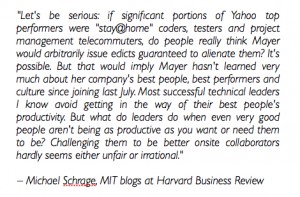
HBR.org quote by Michael Schrage

This MIT researcher says Yahoo knows who their top performers are. Click on the photo to see the article.


It looks like Mayer went through some creative strategy planning in order to make this policy change as annoying and as face-slapping as possible:

  • Sudden announcement
  • Announcement sent by the [always hated] HR department instead of the CEO
  • Sweeping and major policy change to the work habits of all employees
  • Threatening undertones
  • (The nursery for her child attached to Mayer’s office is another kick in the pants to new parents that may work at Yahoo.)


The more pain felt by the staff, the more likely it is that the underperformers will seek employment elsewhere. The “company men” at Yahoo won’t be the ones dusting off their résumés. They’re the “believers”, the hard workers, the ones who will probably applaud the loss of certain feet-dragging team members.


Behavioral Economics researchers like Dan Ariely have discovered that humans will do almost anything to maintain the status quo in any situation. The pain of loss, these researchers estimate, is 2 or 3 times more severe than the joy in gain. Yahoo management is hoping the loss of a comfortable work at home option plus the disrespectful tone and way the message was delivered will be powerful enough to help the “non-believers” move along without much protest.


In a litigious environment, Mayer’s latest move to disrupt the masses is standard practice and definitely a well-thought out creative strategy. My CEO-thinking self admires the move. My employee/parenting self is hoping Yahoo staff can find a way to get over the loss, trust their leadership and be happy and productive at work.

joke, twitter, vpn

Work-from-home geeks will get this joke.

 Boat photo credit: thefunklab on Flickr
0 comments
Matthew Klint's picture of his business class media screen

Pics on a Plane: Shoot & Get the Boot – Matthew Klint’s Offensive Shot

On top of all the controversy about the supposed threat that mobile telecommunications devices have on airline communications comes a bizarre story about United Airlines tossing a well-known travel blogger off one of a flight to Istanbul from Newark, NJ for snapping a photo of the screen in front of his seat.


From various reports, it sounds like one particular flight attendant (FA) lost her marbles. After asking Matthew Klint to cease and desist from capturing media, the FA went to the captain of the flight with stories of perceived threats. Mr. Klint then got kicked off the plane. No big arguments, no yelling. Mr. Klint has witnesses and corroboration from police investigations that he was nothing but calm and didn’t even argue. He reports that he simply put away his phone and tried to reach out to the FA to explain his simple action of taking a pic for his popular travel blog. Mr. Klint wasn’t trying to expose any wrongdoing by the airline. He was sitting in business class and was happy about it.


Mr. Klint wound up getting to Instanbul despite the problem, and United has yet to apologize for the incident but says they are investigating.


This is another case of the tech outrunning the culture. Police and governments are also having a hard time dealing with a media-enabled public. Grass-roots groups are popping up everywhere to inform the public of their First Amendment rights.


Mr. Klint was aboard a private vessel. The owners of that vessel are free to enact almost any terms of service they deem necessary. United has put forth a policy that informs customers that any use of media capture is unwelcome. (The FA in the Klint case is reported to have said that there are FAA regulations against the use of cameras, but probably was thinking of the rules banning wireless mobile use.)


Out and about, though, the First Amendment ensures a lot of freedoms to capture media. Those who are out in public give up a reasonable expectation of privacy and should be prepared to be recorded. If you want to move around incognito, there are spy techniques and technology hacks that can fool cameras/face-recognition software, but one word of advice: don’t start snapping shots of your surroundings. That still gets immediate unwanted attention.


If I were in charge of United’s creative direction, I’d embrace the tech. This would be more of a Virgin approach, but I’d think up ways that the flight attendants themselves and perhaps the planes/seats could be destinations to “check into” a la Foursquare or other social media apps. I could see sweepstakes, geo-caching-like gifts given from person-to-person (like wheresgeorge), and other games growing out of such efforts. Travelers will pick up the games, because they are social and they will pique their curiosity in a usually mind-numbing situation. United could hide QR codes in various places on the plane for the media savvy customers, offering coupons or simply fun videos as prizes.


Flying is such a pain. Having “famous” flight attendants to meet and planes and seats to occupy and share with like-minded travelers and friends would add a layer of social fun that could translate into more customer loyalty. Flight attendants should be posing for pics with customers instead of deplaning them. There are many creative opportunities for airlines to grow and maintain a new generation of customer base. They just have to wake up and smile for the camera.

0 comments

Steven Levitt and Stephen Dubner, the two wild-n-crazy economists behind the decision-making/navel-gazing Freakonomics books and podcast, have started a digital coin toss website where users ask the Tech Fates solve their dilemmas and commit to participating in a long-term research trial: Freakonomicsexperiments.com

freakonomics coin

One Way. Or Another.

This ongoing study is attempting to determine if people are happier flipping a coin to decide which path to choose or if they’d be happier mulling and chosing a decision for themselves.

Common wisdom shows a coin flip can be a very helpful and fair(ish) method when a decision is looming, but not helpful in the way the Steves are thinking. It’s helpful because in the few seconds it takes to flip the coin, one’s natural preference comes through. The Steves are thinking that some decisions are just too tough to responsible for all on one’s own. A person might be happier in life if she is told what to do by an emotionless (which assumes impartiality) computer algorithm as opposed to taking the on the onus of the choice herself. If it goes well, the decision-adopter can take credit. If it goes unwell, she can blame the coin toss. The Steves are betting the coin toss will help people be happier in the long run.

I went over to the site, thinking I’d ask a career question, namely, whether to pretty much give up on writing, consulting and/or look for another job, or, to redouble (and more) my efforts to make this work-independently-at-home thing better.

I paused at the “warning screen” the FE site gives you. The Steves very much want you to commit to the decision afforded by the toss. A pop-up warns that your solid commitment to adhere to the results of the coin toss is the only way they can get good data for the burgeoning behavioral-economics canon. It’s an “Are you sure?” page. I wasn’t sure. So I didn’t flip the coin. I opted to turn back not because I think I am the master of my own destiny. I am not, not by any means. My destiny is tied up with several others’ destiny.

Religious people give over their turns at the decision-making table to a higher power. Tech is my higher power; One would think I’d fully participate in the digital coin toss. At the end of the day, though, I’m the type of person who would rather have control over my career moves. I’d like to exert agency in areas where I can. I’m not the type to leave an important choice up to a coin toss, especially one put up by two untrustworthy economists (<-is that redundant?).

2753954235_706bbd47f1_n

Which Hedge Fun(d) to choose?

The Steves don’t go through the steps of Informed Consent at the site. “Informed Consent” is a process where a subject experiment agrees to the terms and conditions of the experiment. Informed Consent does not require that the study’s entire hypothesis be revealed at the start because the transparency may taint the results; participants are supposed to be “debriefed” at the end of their participation in the research trial. Offices called “Internal Review Boards” at research institutions ensure that each lab is following Informed Consent practices to the letter. I was once hired as a liaison to a university’s Internal Review Board (IRB) to help reinstate the lab’s good standing and ability to conduct human trials, because the lab had previously run afoul and was banned for not following correct procedures. Human participants in experiments need protections. It’s all quite a serious business.

Perhaps my background as a researcher precludes me from taking freakonomicsexperiments.com at face value. I either overthink it or underthink it. I’m not sure what it would take to convince me to participate, given my reservations. My guess is most of the 18,000+ people who have reportedly already flipped a coin aren’t going to take the research so seriously. They didn’t sign a piece of paper committing to the trial. They weren’t put through Informed Consent processes (which add weight to the seriousness of the research). The site looks like a fun web-based game, not a safe trustworthy human research trial. (We could talk at length about data gathering via surveys and how participants and experimenters are excused from Informed Consent in those cases, and how The Steves may be categorizing the FE site as a “survey” site, but I’ll table the research design debate for another post. Internet-based experiments are worth trying, despite the lack of an IRB or Informed Consent. The Steves will collect data. Whether or not the data will be more trustworthy than its collectors is yet to be seen.)


Have you ever decided something big, like which car to buy or your college major, with a coin toss? Will you try Freakonomicsexperiments for your next big choice? After all, it’s all in the name of science.


Photo credit: SkittleDog on Flickr.

More reading on this subject:
The Utility of the Coin Flip?
http://socscistout.blogspot.com/2013/01/the-utility-of-coin-flip.html
Of Black Swans and Tossed Coins: Is the Description-Experience Gap 
in Risky Choice Limited to Rare Events?:
http://www.plosone.org/article/info%3Adoi%2F10.1371%2Fjournal.pone.0020262


0 comments

This Reuters article mentions how Apple found some unwelcome code lurking in some of its user machines. “A site used by web developers” is secret talk meaning the programmers were looking up snippets of code so they could cut and paste it (which isn’t such a bad way to do it, really. Why rewrite everything by hand when someone else already did? Efficiency!).

Using code library sites like github or others to enable hacks is pretty darn ingenius. Usually the bad guys just hook up their infiltrating programs onto the underbelly of porn photos or movies.

What does this mean for normal people? It means that Apple products have enough market share to attract bad guys. This means we need to be careful with our laptops, ipads, iphones, etc. We need to install anti-virus software made specifically for Apple products. I’ve almost always had anti-virus software on all my Apple machines, but to be honest it was probably a bit overkill. Not anymore.

Another thing I do but don’t expect the rest of the world to deal with: I block java in Chrome. This means I must click a button to allow javascript to run. I can read/use most sites without enabling javascript, but sometimes when forms or videos or such need to be rendered, I have to click the “run javascript” button and reload the page. I don’t run the script if I don’t have to or if I don’t trust the site. This process is laborious and out of the purview of most end-users, though.

Install and run some anti-virus software. Go to your App store and click on Updates. Install any of those you see there. (I’ve seen some Apple machines that have over 100 updates for apps and system software waiting to be run. Yikes! Just do it, people!)

Be safe out there on dem Interwebz roadz.

0 comments
which door would you choose? Creepy or Rude?

Creep Monster or Rude Dude? Let’s choose wisely.

Suppose you’re given a choice between two doors. Behind each door is a customer-service worker you must speak with for a long time. One door is labeled “Creepy, Scary Person” and the other one is labeled “Invasive, Rude Person.” Which door would you choose?


Myself, I’d pick the latter. I’m guessing an invasive and rude person would be easier to deal with than a creepy and scary one. I’m pretty sure most people would make the same decision.


This is why we need to change our language when we speak about websites’ privacy-crushing data gathering of our personal behaviors. Oftentimes, the media and individuals will be shocked and “creeped out” by new features like Facebook’s Graph search. Words like “creepy” and “scary” are used to describe the shaken sense of security we feel when we realize just how much these sites know about us.


We need to get over this. Data tracking is here. It’s rampant. It isn’t any more creepy or scary than junk mail or an infestation of ants: annoyances that must be dealt with if we want to protect our family’s mental and physical well-being.


The longer we use words like “creepy,” the longer it will take for users to have control over their own data. The very language we use to describe the issue repels us from dealing with it. Everyday people are turned away from thinking and helping to solve the problem because of the misguided feelings the words evoke. In life, we tend to set aside “scary” things. We procrastinate unpleasant tasks. It’s natural.


“Rude” we face head-on. “Invasive” we fortify against. We feel armed and ready to mitigate any rude or invasive affronts on our peace of mind, because we’ve dealt with rude and invasive people and situations our entire lives.


Let’s all do our part to protect our individual freedoms. Let’s stop using words that make businesses’ hoarding and locking up of our behavioral data seem like anything more than an illegal and invasive affront on our wallets, our minds, and our lives.


Photo credit: Kevin McShane on Flickr.com
0 comments