≡ Menu

According to Symantec, “Porn” is a term most searched on the internet by children less than 7 years old.  This means many things, but one thing I’ve been thinking about is that an astoundingly awesome “good-karma” opportunity for Google and Symantec is fading away as we speak.

Symantec collects data on millions’ of users search habits. Their service, OnlineFamily.Norton, is a web monitoring service where parents can create profiles for each child and monitor their online activities. The company has mined data on millions of searches performed by the children who have Norton profiles. Symantec has amassed the data into a report. Symantec doesn’t reveal the number of children who have profiles, but the mere number of searches mined (over 14 million) lends us the information that Symantec must have many thousands of children’s profiles in their system (I trust these data and the sample. As a researcher, I think these data represent the general population fairly accurately).

For kids reported to Symantec as being under 7 years of age, the term “Porn” is #4 most popular on the list. Does this mean that children are hyper-sexualized? No. It means that kids are using the internet to look up definitions of words they hear. They don’t want an example of pornography; they want to know what the word means. They are afraid to ask in fear of “getting in trouble,” so they do what they know how to do: they stick the term into a search bar. Much research shows that although small children can be curious about sex and pornography, healthy young children tend to avoid interacting with adult x-rated media. Wake up and smell the opportunity, Google and Symantec!

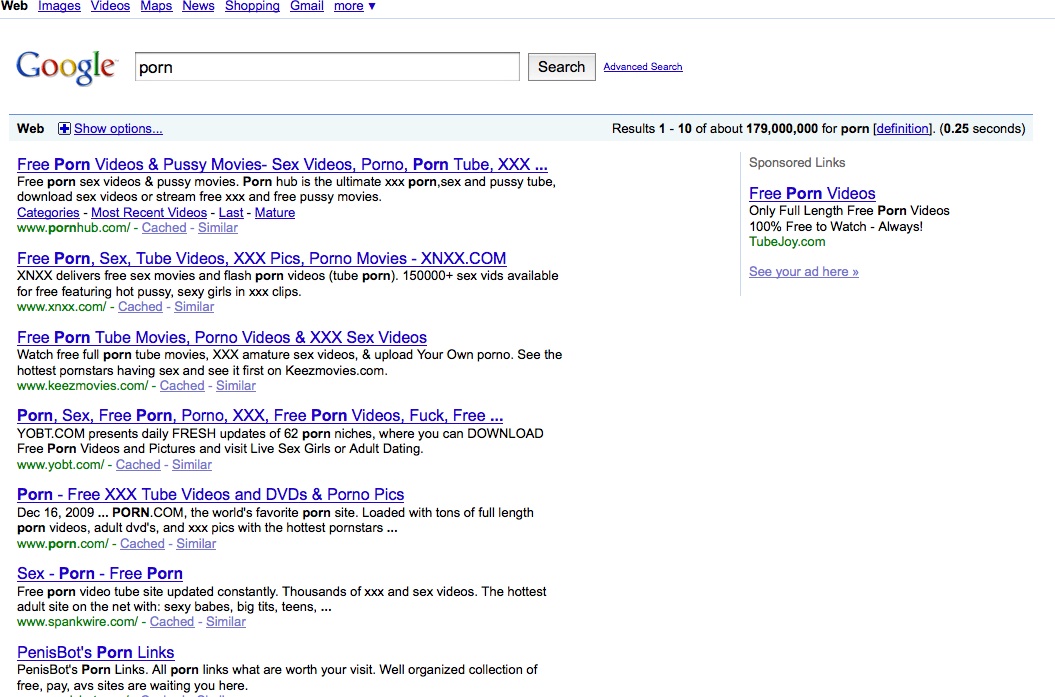
These are the results from today’s Google search on the term “porn.”

prngooglesearch

Notice the lack of plain definitions anywhere. Google, Symantec and perhaps Merriam-Webster are missing a golden opportunity to better the world and to get some great press. They should gather forces to ensure that the top search result for “porn” links to an informative but simple definition of the term. (I’d suggest linking to Wikipedia, but the entry for “Pornography” isn’t appropriate for young children. If Wikipedia could get the image off the entry and lock down any editing, the site may have a fighting chance to get in on this American PR Dream.) If they can throw in a few quotes about kids’ behavior from a psychologist or a prominent internet researcher like danah boyd, I’m sure Main Stream Media would pick up the story. Mothers everywhere would feel all warm and fuzzy inside, Google would boost its reputation as THE 1-stop family shop for searching, and Symantec would sell a bunch more products.

You may counter my idea with Google’s claimed practice of not manipulating search results. This is easy to fix: Google could sell or donate the “sponsored link” at the top of the search results page. Google could commit to selling or donating that particular sponsored link to only educational sites like Merriam-Webster or Carnegie-Mellon University. Merriam-Webster or Carnegie-Mellon could use the space to not only define the term but link to their other educational resources.

Do how about it, guys? When opportunity this great knocks, I’m surprised it’s taking so long to answer the door!

Let me know what you think in the comments.

4 comments

Interview: J.C. Hutchins

iProngJCcoverHop on over to iProng magazine to read my interview with podcaster and author of the popular 7th Son trilogy. J.C. Hutchins.

0 comments

The Fattening of America is written by economist Eric Finklestein. The book outlines the behaviors and policies behind obesity in America from an economist’s view. I personally wish he delved into the corn subsidies more deeply (it was almost as if he was afraid to broach the subject!), but it’s still a very well-referenced book with tons of information that may just change your perspective on healthcare, government and fat people. The author utilizes his obese “Uncle Al” as an example of a “ultility maximizing” person who is truly just making economical decisions that result in his obesity.

Sometimes my eyes dulled over at the sheer amount of info in this book, but mostly the author is funny, hip, engaging and insightful. The book is definitely germane to the current healthcare debate, and is a must-read for anyone who would like to argue both sides intelligently. The references are top-notch and most are searchable on the Internet. We all really need to know where the money is truly going. Take a look at this book and be amazed.fattening

4 comments

FTC Publishes New Guidelines for Bloggers.

See the original press statement here:  http://www.ftc.gov/opa/2009/10/endortest.shtm

For Release: 10/05/2009
FTC Publishes Final Guides Governing Endorsements, Testimonials
Changes Affect Testimonial Advertisements, Bloggers, Celebrity Endorsements

The Federal Trade Commission today announced that it has approved final revisions to the guidance it gives to advertisers on how to keep their endorsement and testimonial ads in line with the FTC Act.

The notice incorporates several changes to the FTC’s Guides Concerning the Use of Endorsements and Testimonials in Advertising, which address endorsements by consumers, experts, organizations, and celebrities, as well as the disclosure of important connections between advertisers and endorsers. The Guides were last updated in 1980.

Under the revised Guides, advertisements that feature a consumer and convey his or her experience with a product or service as typical when that is not the case will be required to clearly disclose the results that consumers can generally expect. In contrast to the 1980 version of the Guides – which allowed advertisers to describe unusual results in a testimonial as long as they included a disclaimer such as “results not typical” – the revised Guides no longer contain this safe harbor.

The revised Guides also add new examples to illustrate the long standing principle that “material connections” (sometimes payments or free products) between advertisers and endorsers – connections that consumers would not expect – must be disclosed. These examples address what constitutes an endorsement when the message is conveyed by bloggers or other “word-of-mouth” marketers. The revised Guides specify that while decisions will be reached on a case-by-case basis, the post of a blogger who receives cash or in-kind payment to review a product is considered an endorsement. Thus, bloggers who make an endorsement must disclose the material connections they share with the seller of the product or service. Likewise, if a company refers in an advertisement to the findings of a research organization that conducted research sponsored by the company, the advertisement must disclose the connection between the advertiser and the research organization. And a paid endorsement – like any other advertisement – is deceptive if it makes false or misleading claims.

Celebrity endorsers also are addressed in the revised Guides. While the 1980 Guides did not explicitly state that endorsers as well as advertisers could be liable under the FTC Act for statements they make in an endorsement, the revised Guides reflect Commission case law and clearly state that both advertisers and endorsers may be liable for false or unsubstantiated claims made in an endorsement – or for failure to disclose material connections between the advertiser and endorsers. The revised Guides also make it clear that celebrities have a duty to disclose their relationships with advertisers when making endorsements outside the context of traditional ads, such as on talk shows or in social media.

The Guides are administrative interpretations of the law intended to help advertisers comply with the Federal Trade Commission Act; they are not binding law themselves. In any law enforcement action challenging the allegedly deceptive use of testimonials or endorsements, the Commission would have the burden of proving that the challenged conduct violates the FTC Act.

The Commission vote approving issuance of the Federal Register notice detailing the changes was 4-0. The notice will be published in the Federal Register shortly, and is available now on the FTC’s Web site as a link to this press release. Copies also are available from the FTC’s Consumer Response Center, Room 130, 600 Pennsylvania Avenue, N.W., Washington, DC 20580.

The Federal Trade Commission works for consumers to prevent fraudulent, deceptive, and unfair business practices and to provide information to help spot, stop, and avoid them. To file a complaint in English or Spanish, visit the FTC’s online Complaint Assistant or call 1-877-FTC-HELP (1-877-382-4357). The FTC enters complaints into Consumer Sentinel, a secure, online database available to more than 1,700 civil and criminal law enforcement agencies in the U.S. and abroad. The FTC’s Web site provides free information on a variety of consumer topics.

MEDIA CONTACT:
Betsy Lordan
Office of Public Affairs
202-326-3707
STAFF CONTACT:
Richard Cleland
Bureau of Consumer Protection
202-326-3088

0 comments

Why I Won’t Write Reviews on Amazon Again

The RSS of alerts on my online content from FairShare usually stays pretty quiet. Even when another site uses my content and a new alert is generated, 99% of the time a link back to my blog accompanies the post.  Even then, the post isn’t a full copy but a summary and a link. I have no problem with this, as I license my content under a Creative Commons copyright.

For those of you who aren’t familiar, here’s a 3-step process on how a blogger can protect the words she writes from being plagiarized or stolen.

1st: a blogger visits the Creative Commons website and picks which type of copyright she wants. I’ve chosen the copyright that allows other people to re-post my content, as long as they link back to me or give me credit and they don’t use my work to make money.  They can’t sell my work or use it to sell other things, even if they do link back to me.

2nd: the blogger downloads the graphic and puts it on every page of her blog.  Mine looks like this:

CreativeCommonsshot

3rd: the blogger uses various web applications to send alerts via RSS or email whenever her content shows up somewhere on the Internet.  I use FairShare to look after all my content and Google alerts to look after various keywords, including my name and blog name.  When someone uses my content, those alerts will fire me an RSS update or an email, respectively.

That’s the basic way to keep track of where your work ends up online.

When I get an alert, I immediately investigate. If everything looks OK and within the terms of the Creative Commons copyright, I leave it be. About 99% of the alerts fall within what’s called “Fair Use.” In other words, the other site that borrows my content links back to my blog, giving me credit, and the site isn’t covered in ads or selling any products.

Today I started my RSS reader and found an alert from FairShare that was in that 1%.

FairShare

FairShare showed me the site New and Used Books, where my review of NurtureShock by Po Bronson and Ashley Merryman was listed under the ad for the book. I was not credited. The full review was posted, not a partial clip. There was no link back to the Amazon site where I had posted my review, there was no link back to my blog. No link at all. And they were using my review (albeit a non-favorable one) to sell the book.
This is when I send a “cease & desist” letter. Basically, a cease & desist is a letter that says, “Please link to me or remove this content immediately. You are violating my copyright.” In other words, somebody owes me money or credit, and if you don’t delete my content from your site, you must pay me.

NewandUsedbooks is still violating my copyright because they are using my words to sell a book, but even that I could let go if they just linked to me or to my Amazon review (which links to my blog).

Here is my email to Newandusedbooks.com. It is a typical cease & desist email that I write:

“You have used my content and are violating copyright. Please either remove my book review or give me the link credit to my blog. You have taken the online reviews from Amazon.com but have not linked to that either.  I will be forwarding a copy of this message to Amazon.com.
Here is the link to your page where you violate my copyright:
http://newandusedbooks.com/index.cfm?fuseaction=zmore&manu=Twelve&prodGroup=Book&item_ASIN=0446504122&author=Po%20Bronson&SubscriptionId=0JN0QHH0QAG4YVY4FY02
Here are the first few phrases of my review:
‘Conservative agenda by non-scientists.: (2009-09-20)
New York Magazine journalists Po Bronson and Ashley Merryman team up to add commentary and more information to their articles in this new book published by Twelve, a division of the Hachette Book Group.
The last page of the book has this blurb about Twelve:’
I expect this situation to be resolved by Wednesday, Sept. 30, 2009 by 2:00 p.m. Eastern Standard Time (GMT – 5).
Thank you.
Christine Cavalier
christine@purplecar.net”

Today is Sunday. I didn’t expect a quick response, but a few minutes later I received this email from newandusedbooks.com:

“Dear Ms. Cavalier,
New and Previously Owned Books is an Amazon affiliate.  We have not “copied” anything from Amazon rather as an Amazon affiliate and by contract with Amazon, we receive by automatic “download” the books, book covers, reviews, prices, availability, etc. directly from Amazon.  We do not select what reviews to post on any given book – they are downloaded from Amazon.  We cannot control what Amazon puts on their site and we cannot add to their descriptions and cannot add a link to your blog within their downloaded review.
I hope this explains where the information is coming from and alleviates your concerns.
Vickie Denney
www.ReaderToReader.com”

I wrote back immediately, but have yet to hear a response:

“Dear M. Denney,
Thank you for writing with a prompt reply.
Does your server refresh the pages often? If we remove our content from Amazon, can we conclude that it will then be removed from your site?
-Christine Cavalier
christine@purplecar.net”

Then I went and deleted all 4 of the reviews I posted to Amazon.com, despite the reviews’ good ratings and conversations they generated.

Newandusedbooks.com passed the buck to Amazon, saying that the catalog content they lease from Amazon isn’t controlled by them (or their seemingly parent company readertoreader.com). Does Amazon strip the links before they sell the content? Or does newandusedbooks.com strip the links when they post the Amazon catalog content to their site? The response I received didn’t answer these questions, and I don’t think my follow-up email will get much of a response, either.

I don’t need to pour over Amazon’s Terms of Service. I can already guess that Amazon has standard legalese that states they own the content of all reader reviews on their site. I proceeded to delete all my reviews and decided that the few links back to my profile or blog aren’t worth it. My stats never showed very many links back to my blog from Amazon, and I don’t need to spend time building up a “reputation” on Amazon as a good reviewer.

I know, I know. I’ve been blogging since 2004, I should’ve known better. I was thinking it was an even trade-off for the potential in new blog readership. I didn’t think Amazon would sell my content without at least a link back to the original content on its own site.

This is one of those situations that critics Andrew Keen, @AmandaChapel, et al., cite when they bemoan the current practice of online retailers using free content by amateurs. Readers write free reviews on Amazon and Amazon sells them along with their catalog content to book selling sites. The Publisher’s Weekly reviews are also on Amazon, but Amazon doesn’t lease out that content because Publisher’s Weekly tells Amazon they must pay for that work. The lone avid reader/blogger has no team of lawyers looking after them like that. Amazon and other sites take advantage of readers’ want for connection, or fame, or whatever misguided motivations and sell their very-marketable, worthy content for their own profit.

What do you think of this? Has this happened to you? Do you use copyright protection on your work? Let me know in the comments.

As for me, I say, “Bye-Bye, Amazon.” Now I’m going over to Goodreads.com to see if their revenue model is based on members’ free reviews.

UPDATE: 27 Sept 2009 4:39 pm: [continue reading…]

24 comments