Why I Won’t Write Reviews on Amazon Again
The RSS of alerts on my online content from FairShare usually stays pretty quiet. Even when another site uses my content and a new alert is generated, 99% of the time a link back to my blog accompanies the post. Even then, the post isn’t a full copy but a summary and a link. I have no problem with this, as I license my content under a Creative Commons copyright.
For those of you who aren’t familiar, here’s a 3-step process on how a blogger can protect the words she writes from being plagiarized or stolen.
1st: a blogger visits the Creative Commons website and picks which type of copyright she wants. I’ve chosen the copyright that allows other people to re-post my content, as long as they link back to me or give me credit and they don’t use my work to make money. They can’t sell my work or use it to sell other things, even if they do link back to me.
2nd: the blogger downloads the graphic and puts it on every page of her blog. Mine looks like this:
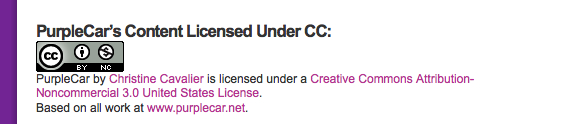
3rd: the blogger uses various web applications to send alerts via RSS or email whenever her content shows up somewhere on the Internet. I use FairShare to look after all my content and Google alerts to look after various keywords, including my name and blog name. When someone uses my content, those alerts will fire me an RSS update or an email, respectively.
That’s the basic way to keep track of where your work ends up online.
When I get an alert, I immediately investigate. If everything looks OK and within the terms of the Creative Commons copyright, I leave it be. About 99% of the alerts fall within what’s called “Fair Use.” In other words, the other site that borrows my content links back to my blog, giving me credit, and the site isn’t covered in ads or selling any products.
Today I started my RSS reader and found an alert from FairShare that was in that 1%.

FairShare showed me the site New and Used Books, where my review of NurtureShock by Po Bronson and Ashley Merryman was listed under the ad for the book. I was not credited. The full review was posted, not a partial clip. There was no link back to the Amazon site where I had posted my review, there was no link back to my blog. No link at all. And they were using my review (albeit a non-favorable one) to sell the book.
This is when I send a “cease & desist” letter. Basically, a cease & desist is a letter that says, “Please link to me or remove this content immediately. You are violating my copyright.” In other words, somebody owes me money or credit, and if you don’t delete my content from your site, you must pay me.
NewandUsedbooks is still violating my copyright because they are using my words to sell a book, but even that I could let go if they just linked to me or to my Amazon review (which links to my blog).
Here is my email to Newandusedbooks.com. It is a typical cease & desist email that I write:
“You have used my content and are violating copyright. Please either remove my book review or give me the link credit to my blog. You have taken the online reviews from Amazon.com but have not linked to that either. I will be forwarding a copy of this message to Amazon.com. Here is the link to your page where you violate my copyright: http://newandusedbooks.com/index.cfm?fuseaction=zmore&manu=Twelve&prodGroup=Book&item_ASIN=0446504122&author=Po%20Bronson&SubscriptionId=0JN0QHH0QAG4YVY4FY02 Here are the first few phrases of my review: ‘Conservative agenda by non-scientists.: (2009-09-20) New York Magazine journalists Po Bronson and Ashley Merryman team up to add commentary and more information to their articles in this new book published by Twelve, a division of the Hachette Book Group. The last page of the book has this blurb about Twelve:’ I expect this situation to be resolved by Wednesday, Sept. 30, 2009 by 2:00 p.m. Eastern Standard Time (GMT – 5). Thank you. Christine Cavalierchristine@purplecar.net”
Today is Sunday. I didn’t expect a quick response, but a few minutes later I received this email from newandusedbooks.com:
“Dear Ms. Cavalier, New and Previously Owned Books is an Amazon affiliate. We have not “copied” anything from Amazon rather as an Amazon affiliate and by contract with Amazon, we receive by automatic “download” the books, book covers, reviews, prices, availability, etc. directly from Amazon. We do not select what reviews to post on any given book – they are downloaded from Amazon. We cannot control what Amazon puts on their site and we cannot add to their descriptions and cannot add a link to your blog within their downloaded review. I hope this explains where the information is coming from and alleviates your concerns. Vickie Denneywww.ReaderToReader.com”
I wrote back immediately, but have yet to hear a response:
“Dear M. Denney, Thank you for writing with a prompt reply. Does your server refresh the pages often? If we remove our content from Amazon, can we conclude that it will then be removed from your site? -Christine Cavalierchristine@purplecar.net”
Then I went and deleted all 4 of the reviews I posted to Amazon.com, despite the reviews’ good ratings and conversations they generated.
Newandusedbooks.com passed the buck to Amazon, saying that the catalog content they lease from Amazon isn’t controlled by them (or their seemingly parent company readertoreader.com). Does Amazon strip the links before they sell the content? Or does newandusedbooks.com strip the links when they post the Amazon catalog content to their site? The response I received didn’t answer these questions, and I don’t think my follow-up email will get much of a response, either.
I don’t need to pour over Amazon’s Terms of Service. I can already guess that Amazon has standard legalese that states they own the content of all reader reviews on their site. I proceeded to delete all my reviews and decided that the few links back to my profile or blog aren’t worth it. My stats never showed very many links back to my blog from Amazon, and I don’t need to spend time building up a “reputation” on Amazon as a good reviewer.
I know, I know. I’ve been blogging since 2004, I should’ve known better. I was thinking it was an even trade-off for the potential in new blog readership. I didn’t think Amazon would sell my content without at least a link back to the original content on its own site.
This is one of those situations that critics Andrew Keen, @AmandaChapel, et al., cite when they bemoan the current practice of online retailers using free content by amateurs. Readers write free reviews on Amazon and Amazon sells them along with their catalog content to book selling sites. The Publisher’s Weekly reviews are also on Amazon, but Amazon doesn’t lease out that content because Publisher’s Weekly tells Amazon they must pay for that work. The lone avid reader/blogger has no team of lawyers looking after them like that. Amazon and other sites take advantage of readers’ want for connection, or fame, or whatever misguided motivations and sell their very-marketable, worthy content for their own profit.
What do you think of this? Has this happened to you? Do you use copyright protection on your work? Let me know in the comments.
As for me, I say, “Bye-Bye, Amazon.” Now I’m going over to Goodreads.com to see if their revenue model is based on members’ free reviews.
UPDATE: 27 Sept 2009 4:39 pm: [continue reading…]