≡ Menu

Comma Controversy

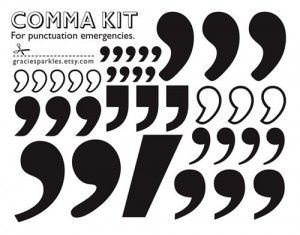
commasI recently received a comment about the lack of commas in my writing. This is just a quick post to say that my comma decisions are deliberately made. I choose a flowing style when I can; this means I forgo putting commas in common places.

In the 1700’s, commas were much more common.  Those writers dropped commas in places you didn’t realize existed.  Eventually, the pauses were dropped in favor of a smoother style.  We English writers will use fewer commas as time goes on.  My general rule is to first think of eliminating ambiguity, then concentrate on the flow of the piece (flow is a very close second, though).  Writing is meant to convey information and emotion.  If you’re sure you are impressing people with the unambiguous meaning of your words, then make sure the tone of the work leaves the right impression as well.  You want the reader to walk away with a feeling in their gut that comes from information in their head (and yes, I know I used “their” there, instead of “he” or “she.”  That’s another post topic I’ll approach someday).
Here are some different areas around the web I visited today that talk about comma usage.

Forum conversation

Blood Red Pencil articles on comma usage

Particularly helpful Blood Red Pencil article about Trask rules on commas

The New Yorker article looking into the book, Eats, Shoots & Leaves

Please weigh in with a comment about the comma controversy.  How, by chance, do you use commas?

Thanks!

(photo by graciesparkles on Flickr.com – buy her comma stickers on etsy!)
11 comments

Twables: Avoid it at all costs

A new 3rd-party Twitter.com application has interrupted our daily direct-messaging lives like an irritating neighbor kid who keeps knocking on the door.  Have you received a direct message (DM) that looks like this:Guess which one of my claims is a lie! http://www.twables.com/twotweetslie/guess/username”?  Annoying, isn’t it?

twablesTwables.com looks innocent enough, especially with its Twitter-bird design and Twitter color pallette, but it’s an evil little piece of crap that spams all your followers with a self-referencing DM link (a DM with a self-referencing link, i.e., a link back to your own site, is considered a big Twitter etiquette breach).  Twables asks for your Twitter credentials (i.e. username and password) and ends up sending the said annoying DM. Don’t give Twables your password and don’t play the game.

The DM is sent without specific informed consent, because Twables auto-checks the box which indicates the option to DM all of your followers. People are usually polite enough to leave the “DM /Send a @ to all your followers?” box unchecked. It’s not as easy and I don’t consider it informed consent if the application auto-checks the box for you and you must UNcheck it to keep the offending spam from being sent out. This is just bad design. A mistake like that can sink an application before it starts.

If you look on the Twables page, it seems like the Community: Public Groups and the Community: Private Groups could hold some potential: DM an entire specified-user group, or any group member can send a group DM. That would be helpful.  Unfortunately, because of Twables’ misstep with the uninformed consent to DM, I suggest that you don’t try these features. With all the auto direct messages, the site has a proven track record of being spam. Avoid it at all costs.

22 comments

Wacko Wednesdays: Fathers


***Wacko Wednesdays:  Each Wednesday, I’ll outline a human quirk or phenomenon in the study of Personality Psychology, or perhaps talk about a specific type of research into personality.  I’ll provide information, links, and my own experiences to help you along in your goals of writing memorable characters.***

Writers don’t write about mothers much.  I was at a writing conference where the speaker asked the audience to call out something they’d read that examined the mother-child relationship.   No-one spoke up.  The speaker had made her point.  The mother/child relationship is very complex and close to the heart.  Even Disney likes to kill off moms so they don’t have to deal with trying to navigate those murky-mommy-issues waters.  Fathers, on the other hand, abound in fiction. Father’s Day is this Sunday.  Because we know all psychosis comes from our parents (not!), for today’s Wacko Wednesdays, let’s talk about at writing about the father/child relationship, or writing a character as a father.

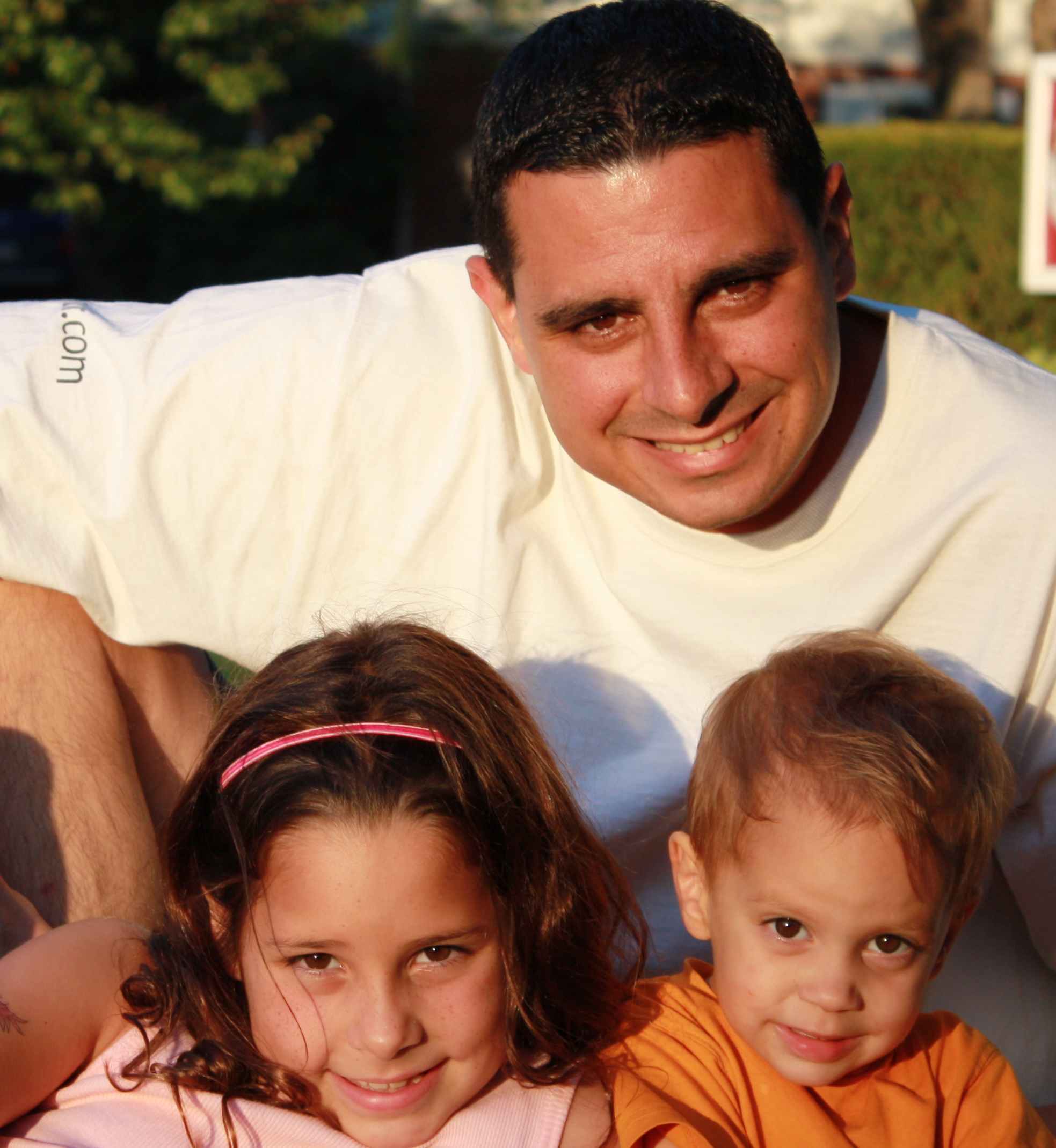
purplecarfam

For decades, psych research focused on the mother’s parenting as pathology for mental illness in children.  More and more, researchers are looking at the father’s influence (especially with the area of girls and eating disorders). The father’s attitudes and behaviors toward parenting would influence your main character (MC).  The father’s raising of your MC will probably all be backstory that happens offstage (i.e. not in the novel), but it is perhaps the most important character detail that fuels your MC’s current motivations. Let’s take a look at how some psych research examines how a father’s behaviors influence his children.

In the book, “The Role of the Father in Child Development” (.pdf of intro here), Editor Michael E. Lamb outlines the 3 areas that many researchers concentrate on when researching the father/child relationship: Engagement, Accessibility, and Responsibility.

“Whether and how much time fathers spend with their children are questions at the heart of much research conducted over the past three decades. In the mid-1970s a number of investigators sought to describe—often by detailed observation and sometimes also through detailed maternal and paternal reports—the extent of paternal interactions with children (Pleck & Masciadrelli, this volume; Lamb & Lewis, this volume). Many of these researchers have framed their research around the three types of paternal involvement (engagement, accessibility, responsibility) described by Lamb, Pleck, Charnov, and Levine (1987). As Pleck and Masciadrelli note, researchers have consistently shown that fathers spend much less time with their children than do mothers. In two-parent families in which mothers are unemployed, fathers spend about one-fourth as much time as mothers in direct interaction or engagement with their children, and about a third as much time being accessible to their children. Many fathers assume essentially no responsibility (as defined by participation in key decisions, availability at short notice, involvement in the care of sick children, management and selection of alternative child care, etc.) for their children’s care or rearing, however, and the small subgroup of fathers who assume high degrees of responsibility has not been studied extensively. Average levels of paternal responsibility have increased over time, albeit slowly, and there appear to be small but continuing increases over time in average levels of all types of paternal involvement.”

Engagement, Accessibility and Responsibility are the three things you can think about when forming your character.

Engagement:  How “hands-on” was your MC’s father when she was small?  Was he a good guy but had a job that took him away often?  Did he just seem like he was yelling everytime he spoke to his kids, but he was just trying to encourage them?

Accessibility:  Could your MC bring any question under the sun to her dad or was she relegated to communicating with him through his secretary?  Did he send the MC off to boarding school and say “See ya at Christmas?”  Was there always a DO NOT DISTURB sign on his door, but he was very attentive at dinner time?

Responsibility:  Did your MC’s father support his family well?  Was he a good earner but a fierce disciplinarian?  Was he a drinker but loved his family with all his heart?  Was he a drifter that constantly told his kids to reach for the stars?

Look for ways you can build in contradictions in each of these areas, then think about how a kid would reconcile those inconsistencies.  How we judge people is a lot of our character.  A father’s personality greatly influences our sense of judgment. In flat characterizations, fathers are either no-good bums or unsung heroes, drinking louses or quiet loyalists.  Usually a main character (MC) comes to acknowledge the father’s cheating ways or learns to appreciate the constant wisdom that they couldn’t recognize before.  It’s all so cheesy and cheap.  Try to go for some more depth.  What kind of roles does the father character in your book play?  What kind of parent is he?  Is he a stand-offish, everyone-has-to-learn-for-themselves kind of guy or is he a soccer dad that is with his kids every step of the way? How can he be both?  What generation is he in?  Is he a 70-year-old but a modern diaper-changing/sling-wearing dad?  Was he raised to think he’d let the kids grow up before he had any kind of relationship with them, even though he’s just 20 years old?

Take those three aspects of measuring fatherhood, Engagement, Accessibility and Responsibility, and mix and match good and bad characteristics of each.  Make the father character a conflicted, true-hearted, complicated being that marked your MC with distinctive world views. Happy Father’s Day, to all of those dads out there!


0 comments

Tinychat

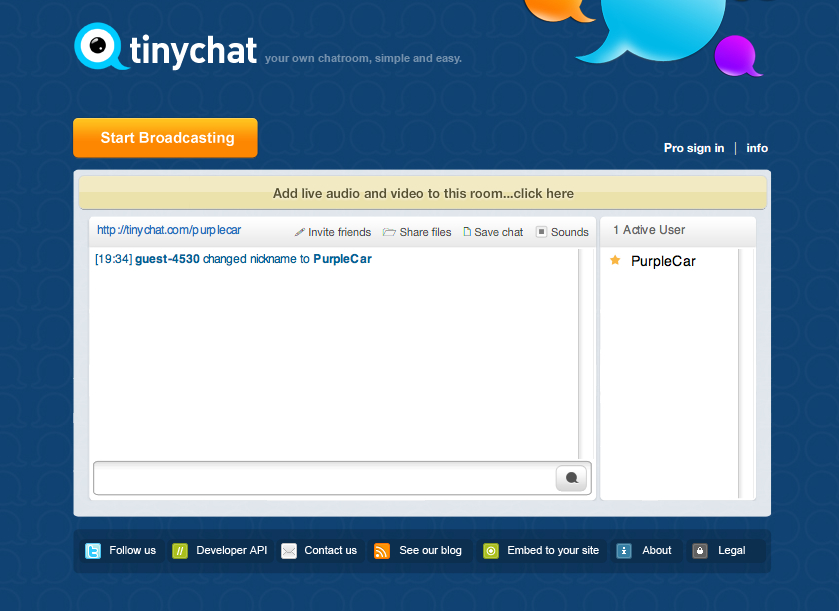
A new chatroom service is on the scene.  TinyChat claims to take the “ugh” out of bulky videoconferencing.

A quottinychate from the site:

“Tinychat delivers dead simple video conferences without the extraneous ad-ons and inconvenience, making video conferencing an accessible, uncomplicated experience.”

I tested it twice today, once with Steve Garfield in the morning, and once this evening with one of the TinyChat founders, Dan Blake. Dan had 12 of us video conferencing at once, including users like twitter.com/jowyang, twitter.com/chrissaad, twitter.com/theagent and others you might recognize.  There were a ton of people in the chatroom watching the 12 of us on video.

It’s a new app, so it obviously has kinks to work out. Here are some I noticed:

Echo: Everyone MUST wear earphones, or the echo is overwhelming.

Audio: Pretty good but tricky: I faded in and out in the big conversation and my Mac Book Pro’s built-in mic wouldn’t work. I had to attach an external USB Logitech mic.

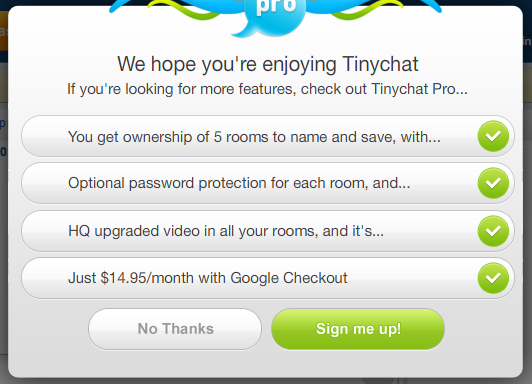
tinychat1Price: After a while, Tinychat sends a pop-up window promoting pro service. $14.95/month seems a bit high for the single user. I would never, ever pay that. I can see if a company may want to pay for it as that subscription rate gets you 5 video chatrooms, but I’m a single person and will only use 1. I need a cheaper option for that, even if they limit me to 5 chats a month or perhaps a limit of 6 people in the room instead of 12.

Policing: The owner of the room must be able to kick people out and mute others.

Conversation management:  Right now if you have a full 12 people in the room, it is difficult to see who is talking.  Someone mentioned programming some sort of visual signal on the person’s video stream, but I can’t imagine how that can be coded with the current tech.  If you have the owner click on a user, perhaps then, but the owner would have to keep clicking on each new speaker.   I say TinyChat just needs to give the owner of the room standard chatroom moderation powers.

Chatroom:  Standard chatroom, worked fine.  Need moderator powers there too.

Desktop sharing:  This was a fantastic and so-easy-it-is-revolutionary feature.  Any user (or “broadcaster”) in the video chat can share their desktop with the group.  And not just screen shots, actual moving, LIVE DESKTOP.  I showed a video, clicked around, etc.  This blew my mind in terms of the various ways tech support staff could help users.  Yes, there are many various remote-desktop sharing programs out there but they are bulky, stand-alone, not-end-user-friendly applications.  TinyChat integrates it into the service so well that even the STUPIDEST-I-forgot-to-plug-in-my-computer end-user could share their desktop.  It is truly brilliant.  I can see families getting together, solving mom’s computer problem, sharing videos, collaborating on vacations or choosing which pictures go in the scrapbook they are making for Grandma. That little add-on will be the killer app part of TinyChat.   It’s what separates it from the other video chatrooms (like yahoo live, etc.) that I’ve come across.

Way to go, TinyChat guys.  Fix yer bugs and you’ll be golden!  And please, offer a “semi-pro” plan for the little ol’ single users among us.  We’d like passwords to protect our chats too.

-PC

0 comments

Facebook.com/username

facebook.com/christinecavalier

If you haven’t already, make sure to go over to Facebook and make an account. Once you have an account, go to facebook.com/username to pick out a “vanity URL” for your Facebook profile.

A Vanity URL is a website application’s unique web address for your profile. Until now, Facebook’s URLs were a combination of odd symbols, numbers and letters that had nothing to do with your name. Now you can have a URL that is similar to your name or preferred username (if you get there in time OR if you have a very unique name).  My vanity Facebook URL is facebook.com/christine.cavalier .

Chris Brogan, a social media guy who is one of the area’s more prominent leaders, didn’t choose the URL facebook.com/chrisbrogan. In fact, he didn’t choose anything for several precious hours after the vanity url registration opened up, in which time someone else snapped up the name.  He was at odds with the effects of URLs, naming and applications have on his identity. As he says on his blog:

“It’s never about the sites and services. Never forget that. YOU add value to them, not the other way around. “

This is true, but I tend to think a name is the quickest way to find a person anywhere; Having the vanity URL as your name would be most prudent, especially since Facebook’s search engine is notorious for bringing up all sorts of flotsam when you are looking for friends. I oftentimes type a vanity URL in my browser’s address field, e.g. twitter.com/johnsmith, in the off chance I may just find the John Smith I want on Twitter.com with little effort. I want Facebook to work for me this way, too. I toyed with registering facebook.com/purplecar, but instead stuck with my name. I run the risk of someone else registering that vanity URL, because Facebook allows you only one. This was something I could live with, because eventually I will probably phase out “purplecar” altogether. I own my domain name, so perhaps I’ll move to that URL and make “purplecar” a quaint username I offer in chatrooms.

I digress.

Will life end because Chris Brogan’s vanity URL is facebook.com/dotchrisbrogan? No. Will your life end if you don’t rush over to facebook right now and sign up? No. But you will be online somewhere soon, and you will have to choose your tattoo like the rest of us. What will yours be?

-PC

5 comments