Wacko Wednesdays: Happiness
***After a long hiatus, Wacko Wednesdays are back! Each Wednesday, I’ll outline a human quirk or phenomenon in the study of Personality Psychology. I’ll provide information, links, and my own experiences to help you along in your goals of writing memorable characters.***
“We hold these Truths to be self-evident, that all Men are created equal, that they are endowed by their Creator with certain unalienable Rights, that among these are Life, Liberty and the pursuit of Happiness.” -United States Declaration of Independence, Philadelphia, Pennsylvania, July 4th 1776.
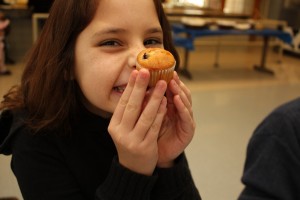
Happy Muffin!
Happiness research has taken the Psychology world by storm. If you search any book site for the word “Happiness,” you will see a plethora of books written on the subject. Lately I’ve been reading Stumbling on Happiness by Daniel Gilbert. It’s academic research and theory about attaining happiness and how our judgment about what will make us happy in the future is ridiculously skewed by our present thinking.
This book and the advent of other titles in the positive psychology area have inspired me to think about how we, as writers, paint the picture of our characters’ states of happiness. By looking at your MC and her goals in terms of her motivations and methods of attaining happiness, you can paint a deeper picture of what drives us all.
I’m sure you are familiar with the basic story arc: Main character (MC) starts out with a status quo, then challenges galore are thrown at the MC, lots of roadblocks stand in the way of achieving the new happiness goal, MC overcomes, is a changed person. The end. Today for Wacko Wednesdays I’ll run down two phenomena that researchers, namely David Myers, have identified as influencing a person’s happiness, namely Relative Deprivation and Adaptation.
Phenomenon #1: Relative Deprivation
“when we compare ourselves with those less fortunate, we can, however, increase our satisfaction. As comparing ourselves with those better-off creates envy, so comparing ourselves with those less well-off boosts contentment.” –David Myers
 Lately I’ve been reading A Tree Grows in Brooklyn, a classic piece of American literature that portrays a devastatingly poor family and their survival struggles in 1900’s New York. It’s actually making me feel quite good.
Yes I know that sounds bad. But here it is: My husband, my two kids and I live in the smallest house in our neighborhood. We live on my husband’s salary as I’m a full-time mom, but we truly have more than enough. Still, this suburban life and the American consumerism gets to everybody. We are inundated with ads to buy more stuff, we read stories of neighbors’ huge home improvements, we hear kids describing their African safari vacations. It’s an affluent area and it seems, at times, that we aren’t keeping up with the Joneses.
The unfortunate Nolan family portrayed in A Tree Grows in Brooklyn, truly has nothing. When they mention clothes, they mean one pair of pants and one shirt for a man and one dress for a woman. Can you imagine? I look at my closet full of plain, solid-colored Old Navy t-shirts and feel loaded (wealthy, not drunk). When the Nolan family mentions meals, they mean oatmeal with no milk or fruit. I open the freezer each morning and lazily wonder which hunk of meat I have to make that night. While they want for decent immune systems, we struggle to fight our ever-expanding waistlines. This book makes me feel so fortunate that I may start it all over again once I’m finished! This is Relative Deprivation at work. How rich you feel is totally dependent on who you are comparing yourself to. Compared to the Nolans (or many real people in this economy), my husband and I are doing great! Compared to our friends the doctors, with their big house and insanely lavish vacations, we’re struggling.

photo by Drawsome on Flickr
What do most good ol’ Amurrricanz do when they feel like they are poorer than everyone else? Apparently they buy lottery tickets. Recent research has shown the Relative Deprivation phenomenon in full-swing in lottery ticket buyers. If people are feeling deprived, they make the trip to the local bodega to pick up their Pick 6’s. If they feel better off than their neighbors, they don’t buy lottery tickets.
Here are the questions you can ask yourself about your MC’s Relative Deprivation feelings: Is she better or worse off than her neighbors, peers, family members? When does she feel better off and when does she feel worse? What makes her feel superior? What kinds of behaviors result from those feelings? How does she make herself feel better in the short term? Does she eat? Does she steal their watches? Does she retreat into her packed charity-ball schedule? How does her current state of feeling deprived influence her dreams for the future? Does she coast when she feels affluent or better off in some other way? Coasting is what most of us do once we achieve a certain goal or milestone. That brings us to Adaptation.
Phenomenon #2. Adaptation
“I’ll never get used to anything. Anybody that does, they might as well be dead.” ~Truman Capote, Breakfast at Tiffany’s, 1958, spoken by the character Holly Golightly
Adaptation is what happens when a person has hit a windfall, achieved a goal, or just plain got lucky when that Good Samaritan pulled him out of the path of that oncoming bus. We adapt to having an inheritance, being a college graduate, or being alive to wander into the bus lane again. The “new” becomes the “same old.” Lottery winners, on average, aren’t significantly happier than the rest of us when they are surveyed 5 years later. We dream about California living but apparently Californians register on the same levels in happiness scales as the rest of us. (See Daniel Gilbert’s book). We adapt to the new status quo.
When my husband and I moved from Center City to the house in the suburbs, we didn’t see it as the smallest one in the neighborhood. We saw it as huge and wondered how we’d ever fill it with furniture. We had just moved from a trinity on Naudain street, banging our heads each time we came down the skinny and treacherous spiral staircase. The kitchen in that all-stacked-on-top-of-each-other house was tiny and there was no room for the baby I was carrying. But that house on Naudain was a palace compared to our 3rd-floor walk-up at 18th and Pine. Now we are here in the suburbs for almost 10 years, we’ve lost our coveted and elusive guest bedroom to a second child, and we’d like to upgrade to a food processor and a breadmaker if we had the space in our now-tiny kitchen. We’ve adapted. I can read a thousand tragic poverty books (Angela’s Ashes is next), but try as I might, I can’t roll back my “want” clock to the days when we were two grad students living in a 1st-floor alley apartment. Since that hole-in-the-wall had no light, I simply dreamed of having a view of the street.
Here are some questions about Adaptation that you can ask yourself about your MC: Has she had a windfall of luck lately (e.g., landed that dream job, attracted a super-hero boyfriend, or inherited large sums from an obscure aunt)? What happens to her after? Does she adapt and want more? Does desire for more turn into a disease that will be her undoing? When is the exact point where she takes her new life for granted? Does she ever grow enough to notice? Does she freak out, donate her lottery winnings to a bald-cat nursing home and flee to the Himalayas to live a life of solitude? Or, like most of us, does she just treat herself to a 1-million-calorie Frappuccino that week?
In their very basic structure, all of the archetypes and character journeys center around some kind of resolution, some little bit of happiness. Characters are going after a goal; the pursuit and the accomplishment will, they think, make them happy in some way. The goal could be revenge, it could be love, it could be fifty-two cents. They achieve the goal. Everything is coming up roses and they are turning up noses. But then they adapt. Showing your character’s general state of happiness before, during and after the accomplishment of her main goal will help to give life to her and her story. In daily life, we may overlook details, but in general we are conscious to our own state of happiness. The pursuit of happiness drives us. It will drive your character, too. Show us her struggles to reach her personal happiness. Be brave and show us what life looks like for her after she gets all she (thought she) wanted. Be honest with yourself and your characters. As writers, we are obligated to speak the unspoken truth, especially in our fiction. Mix in a little rough Relative Deprivation and astonishing Adaptation, and your writing will come alive.
“Actual happiness always looks pretty squalid in comparison with the overcompensations for misery. And of course stability isn’t nearly so spectacular as instability. And being contented has none of the glamour of a good fight against misfortune, none of the picturesqueness of a struggle with temptation, or a fatal overthrow by passion or doubt. Happiness is never grand.” Aldous Huxley, Brave New World
Please comment and let me know your thoughts. -PC


