≡ Menu

Interview over at First Site Guide

Firstsiteguide homepageFirst Site Guide is a place where total web n00bs can get some beginner ebooks about building websites and blogs. All one has to do is hand over their email address. The site’s revenue model seems to be email advertising but I’m not quite sure, as I myself haven’t signed up for any mailings.

Why I’m posting about it: The site asked me last year to be a blogger interviewed for their personal experiences area. Sure, interviewing bloggers is a sneaky way to get backlinks, but it turns out there’s a good bit of advice happening in those interviews. It’s not the be-all, end-all resource for new website owners but the interviews can give you a good idea of how web people/bloggers work.

Firstsiteguide.com just redesigned all their pages, so go over and take a look. You can find my interview here.

0 comments

Tiny house? Nope.

Biz Author Ann Handley's Writing Shed

Biz Author Ann Handley’s Writing Shed

Back to life

Backlash reality articles are finally critiquing the Internet’s-darling “tiny house” craze. Like everyone else, I was fascinated by the trend. As kids, we all dreamed of an awesome clubhouse or treehouse of our own.

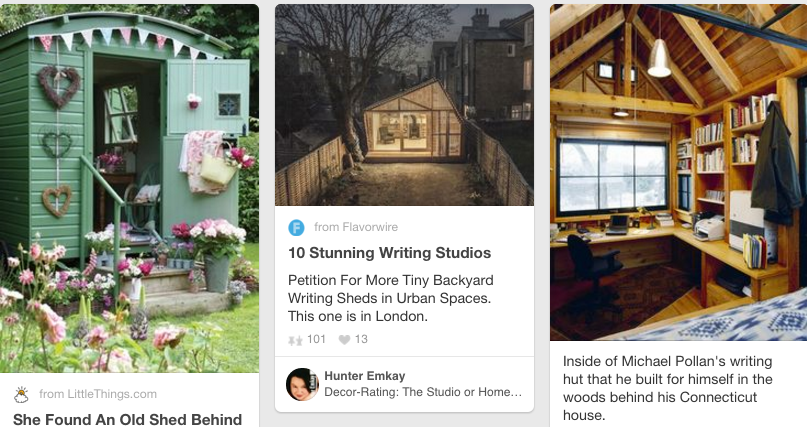
I mused over building a tiny house in the backyard. The kids could have sleepovers in it, we could put guests out there or even AirBnB it. It could double as a writing shed, like the one my friend Ann Handley (author of Everybody Writes) has. (links below)

Despite all the hype, something about the tiny house movement struck me as iffy. I credited my suspicion to the knowledge of my township’s ban on too-small living structures (tiny house advocates scream foul when it comes to such “oppressive” zoning). Honestly, though, after my initial fascination, I didn’t lend it much thought. Turns out, my suspicion wasn’t about zoning. It was about feasibility.

Back to reality

I like simple living. Right now I’m all about The KonMari Method of simplifying and streamlining. I’m decluttering the house, room by room, following along a calendar of assignments on a home storage website. Having grown up in a very messy, very cluttered apartment and then house, and having a hoarder grandmother whose house was a death trap, I regularly revisit the amount of things I own. I keep a tidy house, but I often fall short of my “simple living” goals (Hello, craft supplies).

When I’d read about tiny houses and their owners, I would notice a few things:

  1. Most tiny house owners were white, single or coupled people, no kids.
  2. Their hobbies were outdoor-related, if any hobbies were mentioned at all.
  3. They were looking to save money and/or simplify and/or live off the grid/in nature.
  4. They worked outside the home.
  5. They had no pets or just one pet (generally small).

Early adopters of the movement abandon their tiny houses when one of the above criteria changes. Pregnancy and babies. Enforcement of local ordinances against housing less than a certain square footage. Loss of Internet access or other utilities. etc.

Some people just run out of the energy it takes to live in such a cramped space, especially with another person.

Minimum space requirements are a thing. Zoning laws exist for a reason (many reasons, actually). I hate to admit to schadenfreude, but I found a huge sense of relief when I finally found some articles talking about these issues.


Pinterestsearchwritingshed

Writing sheds on Pinterest

Back from a fantasy

Living space, privacy, and community are inextricably linked to physical health and happiness. Most people need connection with many other humans. A tiny house out in the woods, far from everyone and everything may sound great, but for the overwhelming majority of people, living so isolated wouldn’t be a long-term solution. (Some of the articles below demonstrate this).

Having very little privacy and space of my own growing up was hard, to say the least. Cramped living isn’t good for anyone long term. It’s a form of poverty those of us who’ve lived it constantly strive to escape.

-PC


Tiny House, Big Lie (awesome article that says it all)

365 Days of Decluttering

KonMari Method

Ann Handley’s Writing Shed

Writing Shed Search on Pinterest

Tiny Houses abandoned and why on Tech Insider

Soul II Soul Lyrics

Everybody Writes by Ann Handley (I’m thanked in the credits!)
Affiliate link (not that I ever earn anything from these):

0 comments
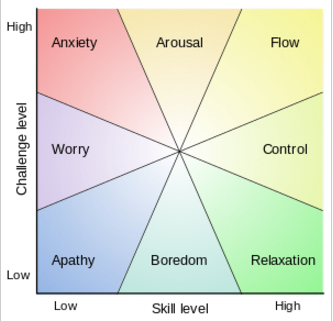
Y axis= Challenge Level, X Axis=Skill Level. Axes cross at "low" and range to "high". High challenge level + high skill level is opposite of Y&X axes cross, and that is the state of "Flow"

GO WITH THE FLOW

This chart is a favorite of mine. The concept of “Flow” (Csikszentmihalyi) or “Being in the zone” (Michael Jordan) is that state of balance between the perceived difficulty of the task at hand the the perceived potential of one’s own abilities. When “flow” happens, a person is using all of their skills at their fullest potential on a task that is almost beyond their reach. People describe losing hours of time to a “rhythm” or “groove” when they are in this state. Religious people may describe it as engaging in one’s destiny, or communing with one’s spirit.

Research coming out of the Positive Psychology camp tends to be total crap. It’s not replicable. The sampling is pathetic. The methods are just plain bad. But I hope the concept of “Flow” keeps getting some hard inquiry. Despite my fear of corporate America twisting it to enslave as many workers as possible, I look forward to more insights into the study of purpose and mastery in one’s work. (Daniel Pink proposes we need 3 elements to fuel strong motivation: Purpose, Mastery and Autonomy. More on that in a minute.)

HOW DO YOU RELAX?

The chart above works for me with my many hobbies, like knitting or crafts projects. Knitting patterns with simple, repetitive stitches are my tv-watching companion. Simple knitting, which is low challenge for me, puts me in the “Relaxation” corner of the chart (High skill, Low challenge). If I need to concentrate more on the pattern, that brings me into the “control” area, and I may have to pause the TV until I get past a particularly tricky bit.

I have to say, though, I don’t think I reach a state of “Flow” when I’m knitting. Maybe once or twice I hit my stride but knitting patterns change stitches quite often, so I get halted in the movement. Long stretches of tricky stitches definitely can be a flow-inducing thing but I don’t knit too many of those kinds of patterns. Maybe I should.

Crossword puzzles, for me, were addictive. Hours a day were wasted on NYT Crossword puzzle app. Perhaps if my skills were a bit better, I’d get out of “Control” and into “Flow” when I was doing the puzzles. But as it was, I spent too much time on them. Reading, writing, doing photography or other crafts were more worthy of my efforts and had a better chance at keeping me in either “Relaxation” or “Flow.”

WHAT IS ANXIETY, EXACTLY?

The most informative part of this chart is the upper left corner: Anxiety. Anxiety is the result of a huge challenge being met with low skills. Anxiety builds up when we think we don’t have what it takes to overcome whatever is coming at us.

So how to lessen anxiety and calm-the-F-down? Break the problem down into smaller steps, so you can attack one hurdle at a time. Also: take a more realistic/optimistic look at your own skills and resources. You probably have a friend you can talk to, or can find a library book having to do with that challenge (This is why the “For Dummies” books are so popular. They break down challenging subjects into small, manageable-by-anyone steps).

The “mindfulness” movement also encourages us to break moments down to this very one, and asking the question: what must you do right now? (Most of the time the answer is: just breathe. And sometimes breathing and staying present is enough of a challenge in itself). The next question to ask: what small step can I take now? Baby steps on the bus, people! Slow and steady can win a race. This is the approach I’m taking to the novel. Sometimes my days are so busy I write in 5 minutes here and there. It’s better than nothing.

AUTONOMY, MASTERY, PURPOSE

Author Dan Pink talks about the best ways to motivate employees in his book Drive (Linked below is my podcast interview with Mr. Pink about the book). Mr. Pink says 3 elements have to be present for any worker to find that sweet spot of flow at one’s job. First, the employee must have the most amount of autonomy as possible. Choosing one’s own tasks and methods is a key requirement for loving one’s job. Next, the skills for those tasks must be acquired in a way that is possible for almost total mastery to be achieved by the worker. Finally, one’s work must have meaning over and above the salary earned. Pink found that salary alone is a very poor motivator, no matter what the level of salary is. Flow in one’s work is achieved by a high moral sense of meaning in the results of the work and the ability to sit right on the edge of mastery, always learning new skills while completing each task well.

In the “Flow” chart above, Autonomy is in the choosing of the task, so you don’t see it on the chart.

“Mastery” (ranging from total newbie to elite pro) would be placed at “Skill level”

“Purpose” (ranging from No fucks given to One’s Whole Reason for Living) would sit at the “Challenge Level:”

FlowplusPink


So if you aren’t feeling motivated right now, ask yourself where you are on the chart. What’s your skill level? Can you gain more skill? What’s the challenge level? Can you break it down into smaller steps? Take a different look at it. You may eek out some motivation yet!


My Interview with Dan Pink about DRIVE

Y axis= Challenge Level, X Axis=Skill Level. Axes cross at "low" and range to "high". High challenge level + high skill level is opposite of Y&X axes cross, and that is the state of "Flow" 0 comments

Snowy Philly

Snowy Philadelphia

Technical.ly has a great drone video of Philadelphia-O’-Snow, after the 4th largest snow storm in recorded history here. The amount doesn’t look that bad from a hundred feet up… but let me assure you, it was a shitton of snow. We spent the entire weekend clearing it. Fisticuffs are undoubtedly happening in South Philly over saved shoveled-out parking spots.

Drones are awesome. Amateurs can now make crazy overhead videos like this.

Snowy Philadelphia by Matt Satell

0 comments

App removal is a life choice

Many of you know I don’t have Facebook on my phone. In fact, I have a dedicated browser for Facebook on my machine, and I only access the site (and nothing else) on this machine using that browser. Limiting Facebook’s tracking practices gives me an illusion of privacy.

More people in my life seem to use the Facebook messenger service in lieu of texting. So far I haven’t run into too much inconvenience not having FB on my phone. Close friends have my cell number, and they haven’t yet complained about the extra step of having to use SMS/text to get to me. Voicing suspicion about Facebook is socially acceptable at this point, and hence I get no pushback on my FB ban.

A few days ago, I removed Twitter from my iPad and iPhone. I was spending too much time on Twitter in the mornings “with my coffee.” I’d tell myself that I’d only peruse Twitter for the time it took to finish my first 10 oz of coffee, but … that cup of coffee started taking over an hour to finish. That time suck just crept up on me until it was over an hour, sometimes two. It doesn’t matter how early you get up, that kind of puttering around the Internet puts a drag on your day.

So, it’s gone. I’ve replaced the action with Instagram, SnapChat and Flipboard, but I exhaust all of those apps in 5 minutes. Then I know it’s time to get up and move. I was out at the mall today, sitting and waiting, pleasantly, for other people. I would’ve sat on Twitter, and I definitely missed having it, but I spent more time talking with actual humans. In fact, my daughter and I saved a family some real heartache because we were awake and aware.

A little girl, maybe 2 years old, wandered away from her older sister (maybe 4 yrs old) and her grandmother. The grandmother was distracted by something (don’t know if it was a phone) and the tiny tot ran away, towards us and some kiddie rides. We watched as the grandmother realized the tot had escaped. We had been keeping an eye on the little girl, who was fine – she was happily climbing on the structures – so we waved the woman down and yelled that the little one was in front of us.

Before you condemn the grandmother, this little girl was speedy gonzales. She was gone in a matter of a few seconds. And it happens. Everything was fine. I’ve witnessed – and helped out in  – this type of situation countless times (I tend to be hyperaware), but I wonder if not having Twitter on my phone helped. I was sitting down, waiting, passing the time. It was a perfectly acceptable situation to check my phone. And honestly, nowadays it is a bit uncomfortable simply sitting and watching people and things happening. One can come off like a creeper, I’d suppose. We’re so used to people having their heads down. But today I’m glad I had my head up, and this week I’ve definitely started the day a lot sooner than usual.

So, very limited Twitter for me, until I can totally control the habit. What about you?

0 comments