≡ Menu

Coloring characters

picture of a yellow cap for Quiky grapefruit and lemon soda

Is your favorite color yellow?

Fiction and non-fiction writing always contains some sort of character. Pretend people have to seem as real people, and real people have to seem larger than life (or at least extraordinary in some way).

Writers have their own ways to dig in deep into characters. One thing I like to do is use color and the conventional, western cultural implications of those colors (yes, color meaning differs by culture. Red is passion or anger here. In China, it means luck and prosperity. Many examples of this abound. Another one: white wedding gowns are downright creepy to whole swaths of Asians).

I play with Web Fate to gather information on a character’s favorite color. The other day I was looking up words for “yellow,” after which I looked up meanings for yellow.

Here’s what a color psychology site I found said about yellow:

YellowThe text reads “Choosing yellow as your favorite means you have a deep need for logical order in your everyday life and to be able to express your individuality by using your logical mind to inspire and create new ideas.”

I’m not convinced anyone actually “chooses” a favorite color. Purple has always been my favorite. I was born that way.

OK, maybe I wasn’t but I surely don’t remember any other but purple being the key hue for me. Here’s what that site said about purple:

purple


The text reads: “If purple or violet is your favorite color, you have a deep need for emotional security and to create order and perfection in all areas of your life, including your spiritual life. You also have a deep need to initiate and participate in humanitarian projects, helping others in need.”

I might have to change to YellowCar.

____________________________

LINKS

Color Psychology site, the source of this ridiculousness

PHOTO CREDIT

Christine Cavalier (me). See it and others on Flickr.

picture of a yellow cap for Quiky grapefruit and lemon soda 0 comments

Core Values: Do you assess yours every year?

Hearing “Core Values” at business meeting turns my stomach. Unless the company has them plastered up on the wall and trains every new recruit in them, they shouldn’t be tossing around the term. It’s the worst square on a buzzword bingo card.

Mars, Inc. has its core values on its website. AND all over everything. I worked there over 10 years ago and I still remember them. Click on the image to get more info on the 5 Principles.

Mars, Inc. has its core values on its website. AND all over everything. I worked there over 10 years ago and I still remember them. Click on the image to get more info on the 5 Principles.

Personally, though, a “core value” review might help us to live a better life. My friend Brian Rendel has a post on LinkedIn where he talks about training crisis line staffers to identify then talk about a person’s core values. Brian says when we’re aware of our personal core values and we live by them, we uncover our best self.

“…we  find the energy and the resources to reach our potential. When we pay too little attention to our values, our energy fades, our life darkens, and we lose our way. Re-connecting to our values can ignite us with motivation to head for our dreams, and give us the energy to make it happen. “

Brian’s article is a short one. I’ve added a link below to it, as well as a link to a site I found that helps you assess your own core values. I’m hoping to come up with 3 solid ones for myself in the next few weeks. I’ll work with them for the upcoming months, maybe all 2016. We can rotate core values, as life changes and concentration is needed in different areas. Your general world view will probably stay the same. Others online have a similar yearly review practice called “3 words” – you choose 3 terms that will define your work or personal life for the year. You change them (probably) each January 1. I’m a little late but better late than never! I’ll update you on my core values once I decide what they are this year.

Please share your thoughts in the comments. Do you have core values or a “3 word” practice?

LINKS

Brian Rendell’s discussion on core values

Core values assessment tool


0 comments

This: article on White Privilege

This could've been a pic of my parents, who lived in trailer together in the Poconos with 3 kids. I was the 3rd. We moved into an apartment when I was 6 months old.

This could’ve been a pic of my parents, who lived in trailer together in the Poconos with 3 kids. I was the 3rd. We moved into an apartment when I was 6 months old.

Except for the extreme poverty outlined in this article, my life mirrors what this writer experienced. I’m hyper-aware of “class” and the different types of privilege there are in society. Economic opportunity and culture differ between groups, and these differences are major and not exactly “racism” per se. The economic differences exist because of racism but they are in and of themselves different things.

This writer explains it well.

Explaining White Privilege To A Broke White Person…

0 comments

Derakhshan in the Guardian
Hussein Derakhshan was imprisoned by the Iranian government for… wait for it… blogging. He was sentenced to 20 years but in 2014, he was released after 6 years. In The Guardian, Mr. Derakhshan details the changes in blogging and the Web while he was in prison.

Go ahead and read the article. Then come back. I’ll wait.

Facebook, Instagram & Twitter are killing the Web

Mr. Derakshan ends with this:

“Sometimes I think maybe I’m becoming too strict as I age. Maybe this is all a natural evolution of a technology. But I can’t close my eyes to what’s happening: a loss of intellectual power and diversity. In the past, the web was powerful and serious enough to land me in jail. Today it feels like little more than entertainment. So much that even Iran doesn’t take some – Instagram, for instance – serious enough to block.

I miss when people took time to be exposed to opinions other than their own, and bothered to read more than a paragraph or 140 characters. I miss the days when I could write something on my own blog, publish on my own domain, without taking an equal time to promote it on numerous social networks; when nobody cared about likes and reshares, and best time to post.

That’s the web I remember before jail. That’s the web we have to save.”

I respect this man and marvel at his endurance and sanity. I also want to point out that technically, he is correct. Apps use the INTERNET, not the WEB. The Internet is the roads, the Web is the cars. What apps do is essentially use public roads to chauffeur you to gated neighborhoods. Once you are inside the gates, that neighborhood really discourages you (sometimes even prevents you) from leaving it. In the case of Facebook, the gated neighborhood tries to provide you with your every need within Facebook, so you won’t have to leave.

Many apps do not have corresponding Web availability. In other words, the only way you can get into the gated community is to use one of their cars, instead of one of Firefox’s, Safari’s or Chrome’s. They are sidestepping the web browser – and the Web – entirely.

Is that “killing the Web?” I don’t know. I started blogging in 2004. Links and “backlinks” were immediately gamed. Black hat SEO became almost necessary to win views and just merely exist online. (Btw, I never did any of that. I had a blogroll, back in the day, but that was not black hat SEO and it wasn’t anything more than common courtesy and convenience).

We don’t know what’s going to happen. Web/web browsers are still quite useful. Not everything should be an app. But Hussein Derakhshan, a modern-day Rip Van Winkle, has given me a lot to think about. Mainly: How do we preserve the best things about the Internet AND the Web without sacrificing them to “game the system” capitalists? What is the education needed? What is the culture we want to embody? Personally I’m not sad to see any smarmy backlink peddler go the way of the dinosaurs, but we’ve thrown the baby out with the bathwater, I guess.

0 comments

Stacks of Business Cards

I never toss other people’s business cards.

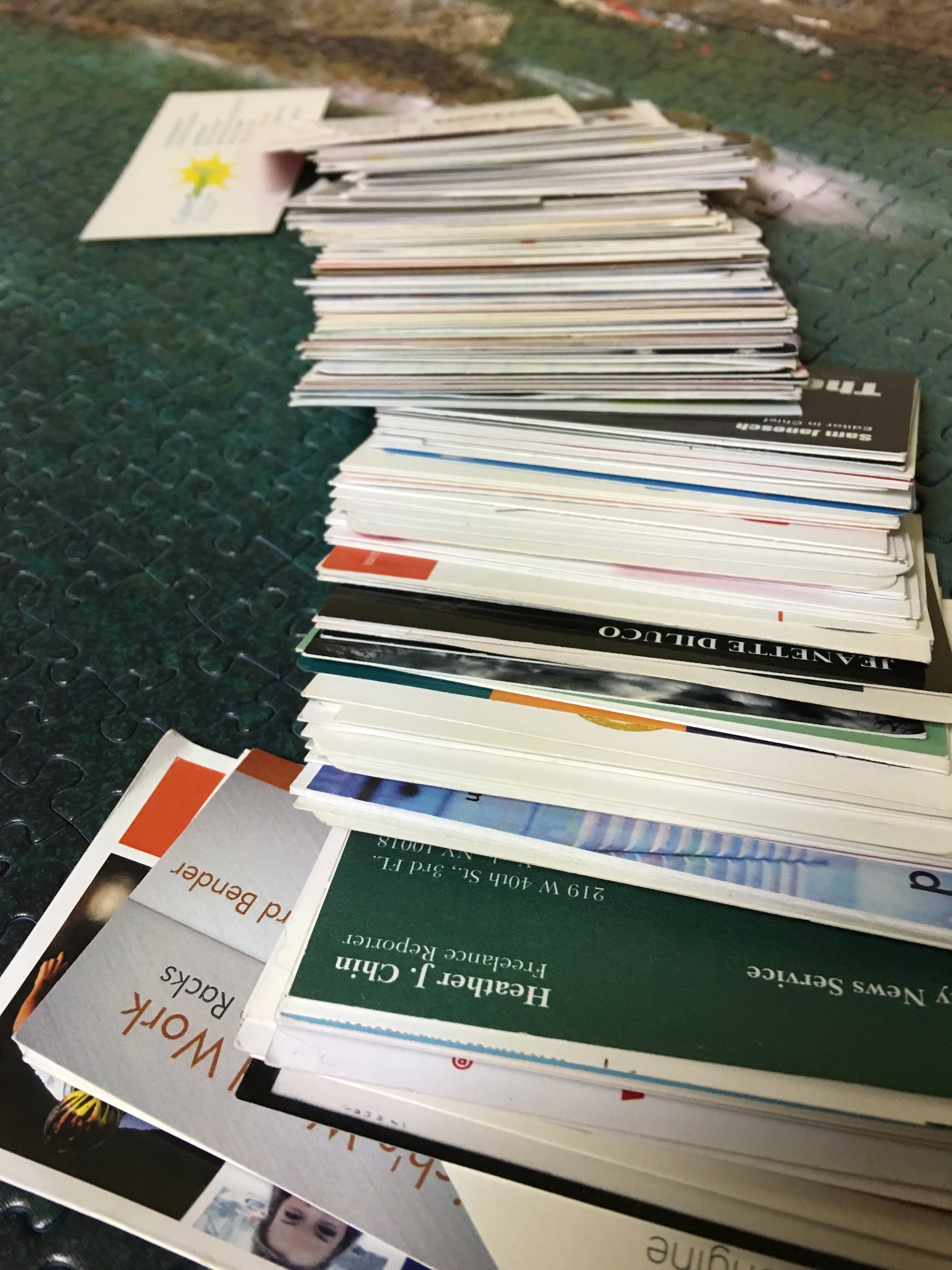
Well, I shouldn’t say never. I shred duplicates. But I have stacks and stacks of them. They look like this:

business cards

That is just 1 stack of the many hundreds of business cards I’ve collected over the years. (You know, I just realized: When someone asks me if I collect things, I shouldn’t answer “No.”)

I feel guilty tossing these little rectangles of cardboard out (I’d shred them first if I did), but I don’t do anything with them either. The cards are usually handed to me at a tech or journalism/writing event with a vague implication on how and when to use it. Hence, I don’t use it at all.

This has led me in my own practice to almost vehemently refuse to give out my own physical paper business card. Instead, I offer to send a vcf (which had some technical difficulties at WordCampUS this year, but I digress) so my information can go straight into someone address book. Guess what, though? They never use the digital info either, just like I don’t use the printed stuff.

Since I’m resolving to write more this year, including blogging, I was thinking it would make a fun project to call every single one of these people and ask them what’s up in life. Once I think about it, though, that would be a major undertaking.

What do you do with business cards?


1 comment