≡ Menu

Senior Citizens: Learn to Text

My friend’s father was complaining that his 21-year-old grandson (my friend’s nephew) would not answer his emails. The grandson (like many young adults now) is experiencing some job woes and his grandfather wanted to keep a caring watch over him. Communication between them had stopped when the emails went dead.

A co-worker of my husband was lamenting that his 30-something son won’t make time for a lunch date. My husband asked how he was trying to contact his son. The co-worker said phone calls and emails.

Our advice for both of these ex-email-communicado senior citizens? Learn how to send text messages. My husband’s colleague took the advice, texted his son and a lunch date was arranged within minutes; he was amazed. The man went from feeling distressed over his son’s “cold shoulder” to extreme relief that it was a medium problem not a personal one that kept his son from making time for him.

The grandfather I talked to was still skeptical. His wife said, “Well, I just don’t think I’m going to learn how to do it.” I spent some more time with the grandfather, showing him some shopping and coupon apps on my phone, the navigation features, and how to text.

I’ll teach a course to older users this fall in my township. One of the more important things we will be going over is texting. Worlds will open up to these grandparents when they see their grandchildren’s words immediately in response to theirs. This is a simple thing that does a lot of good for the relationship, but the idea of smart phone texting just seems so foreign and intimidating to older people.

We each need to take some time to sit with some senior citizens and show them how we use our devices. What is basic to you is new to them, and they need the information. Elderly people especially tend to become more and more isolated. Our households are rarely multi-generational now, which means grandchildren are growing up without the exposure to the wisdom of grandparents, and grandparents are living without the revitalizing energy that comes with being around children and young adults. Texting can help facilitate communication between the generations and lead to more face-to-face meetings.

“Ever seen an iPhone?” is an easy question to ask the elderly person on the train next to you, or at the coffee hour after church. These older people are very curious about smart phones but they are self-conscious about asking. I’ve always been bombarded with questions about tech by older citizens when we are in a quiet conversation. They want to know. They are afraid to ask.

Open up a door for a person who doesn’t yet have the keys.

Let me know in the comments what approaches you take. Also, if you were teaching my “Tech for Boomers (and above)” class, what would you include?

0 comments
cheesesteaks wid

We’re more than just cheesesteaks!

What Silicon Valley Had and We Did, Too


The “burgeoning” tech scene in Philadelphia is following the same historical footsteps of California’s Silicon Valley. Technology isn’t new here, and it wasn’t something that simply dropped down on Palo Alto, California one Monday morning in 1977.


California’s San Francisco valley area grew quickly. Palo Alto, the suburb with 7000 businesses that hire 98,000 people, was only incorporated in 1894*. Industry around electricity, gas, radio and television grew in the next century. Stanford University grew along with Palo Alto, providing educated workers and research facilities to the nascent industries.


Philadelphia goes much farther back, of course. This can be a good thing or a bad thing, which we’ll get to in a minute. But let’s remember that we, too, have a long history of industry and research in many areas, including radio and computers. ENIAC, the world’s first electronic general purpose computer, was invented at the University of Pennsylvania in 1946. But going back further, you can see Philadelphia was a pioneer industrial city, in health care and trading routes, then later in textiles, railroads, naval engineering and radio manufacturing. We have plenty of research facilities to back up the industries here. Industry and scholarship grew hand-in-hand in Palo Alto, and Philadelphia has always had a strong presence in both areas.

Here’s what one paper from MIT, quoting a Stanford University scholar, said about the early elements Silicon Valley needed to continue to its current success as an electronics and software hub:


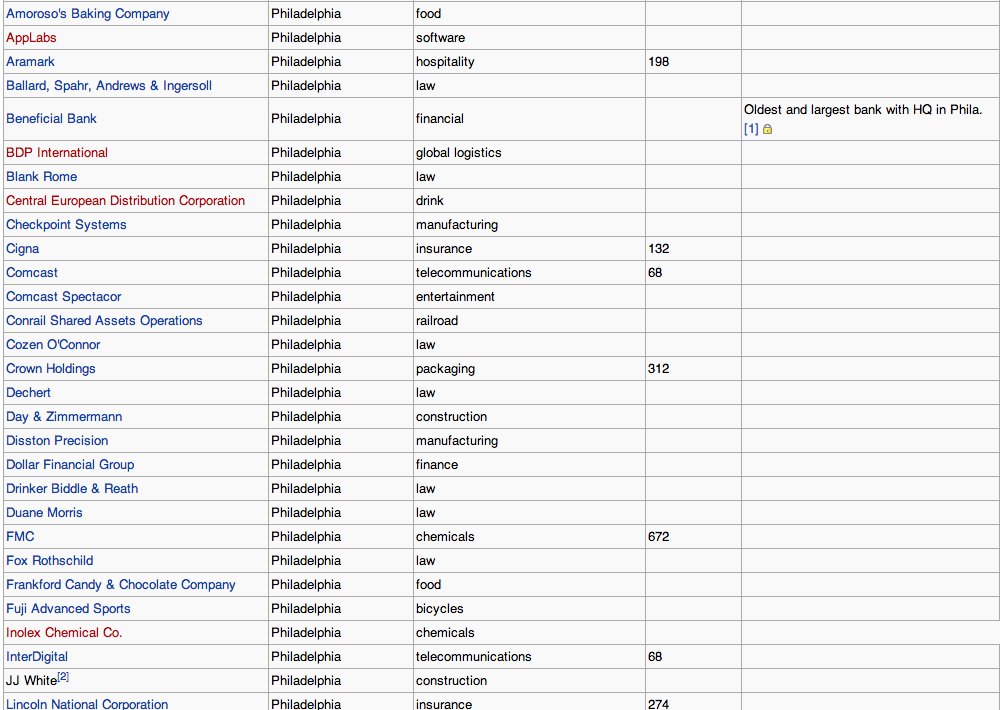
list of philly companies from wikipedia.org

List of companies in the city of Philadelphia

“A leading role for local venture capital,

…a product mix with a focus on electronic components, production equipment, advanced communications, instrumentation, and military electronics

…[and] a tolerance for spin-offs”


We may have missed the early train to the consumer technology boom, but we in the Philadelphia area definitely can show up to this meeting. We have superstar-level venture capitalists (I swear, every event I attend in the city has a “6 Degrees from Josh Kopelman” conversation going on by the bar). We have Comcast, Boeing, Lockheed Martin and lots of incubator support for startups. We tolerate “weird spinoffs,” especially in the arts (Fringe Fest, Mural Arts Program).

What Silicon Valley Had, and We Didn’t:

Our long-standing tradition of bad politics and broken status quo holds us back. The MIT article states that the Silicon Valley also had:


“…a keen awareness of the region as existing largely outside the purview of the large, ponderous, bureaucratic electronics firms and financial institutions of the East Coast;

…a close relationship between local industry and the major research universities of the area;

an unusually high level of inter-firm cooperation”


companies in the philadelphia area #2 from wikipedia

More companies in Philadelphia

Other local experts can pipe up here, but I’m thinking perhaps our nubile tech companies cannot wrench themselves free of the phenomenon of “East Coast” banking (whatever that is) or the ubiquity of “Philadelphia Lawyers.” (I don’t know what “inter-firm cooperation” is. I grew up in the Commonwealth, I went to college here, I’ve lived in Philly since 1993; I’ve never even heard the term.) This tethering to the “same old, same old” may hold our most creative talent down.


So perhaps those are the areas we can work on, to open up some of the doors that the Silicon Valley had opened for it early on. We can always improve upon the relationship between local industry and the universities. Sure, there are programs, outreach and support, but judging by the laments of “brain drain” by the city government, Temple, Drexel and Penn surely aren’t encouraging their students to take jobs at a Philly start-up, or heck, in one of the many Fortune 500 industries we have in the city and surrounding areas.


Philly always seems to be in an eternal identity crisis. We love kvetching about what we are and what we aren’t, as a city, as a people. Despite all the noise and hands we throw up in frustration, the start-up industry is taking hold here, no matter what. We should embrace it and nurture it.

Let’s Discuss

What are some areas of concern for you? What do you see as the most helpful move we could make to get start-up entrepreneurs to come and stay in Philadelphia?


_________________

references:

*http://en.wikipedia.org/wiki/Palo_Alto,_California

https://en.wikipedia.org/wiki/List_of_companies_based_in_the_Philadelphia_area

http://web.mit.edu/ipc/publications/pdf/00-014.pdf

1 comment

Guest Post At ThatDamnRedHead

I wrote a guest post for my friend Stacy Lukasavitch, Social Media Coordinator Extraordinaire. She knows things you don’t. So check out her site after you check out my “Behavioral Books for Marketers” post.

go head, cliiiiiiiiick iiiiiiiit. you know you want to.

0 comments
Playing in the Sandbox

Even tiny tots have their own ideas. Give kids and your employees the space to make their own decisions.

What is “agency”?

You have it. Your kids have it as soon as they’re born.  Even your employees have it (don’t worry, it isn’t their local recruiting office).


“Agency” is a short yet fancy word for “decision-implementing capability.” An individual has agency if she has the power to change her mind or take action. Even the tiniest of human babies have some rudimentary level of agency.


In academia, agency is a touchy subject. Questions about consciousness and when actions are intended or made from instinct are typical areas of study for some Developmental, Evolutionary or Behavioral Psychologists. These scholars concentrate on an individual’s agency and how it emerges in the human life cycle. Philosophers of the “I think therefore I am” Descartes variety debate the very existence of agency in humans and animals.


Different beliefs about agency are also evident in parenting styles. Some parents are strong authoritarians who believe small children do not have the knowledge needed to make good choices. In contrast, permissive parents give their children’s budding motivations the utmost importance. Employers can fall into these extremes, too, swaying between micro-managing and a leaderless, hands-off approach.


Neither extreme works well. Too much authority can rob people of motivation. Too little leadership may cause people to lose focus. A happy balance between the two extremes can make your workplace or your home life run a bit more smoothly.


In his book, Drive: the Surprising Truth about What Motivates Us, Daniel Pink puts forth a theory that people need autonomy, mastery and purpose in any endeavor in order to stay motivated and achieve goals. Autonomy, mastery, and purpose fall under an individual’s agency. In the workplace, this translates into managers giving employees the tools they need to 1. work individually in an environment of trust (autonomy), 2. be able to constantly improve their skills (mastery) and 3. function as a part of a larger system for the greater good (purpose). Take away any of these aspects, and you’ll see your employee morale go down and your turnover rates increase.


Agency definition from Merriam-Webster

Official Definition from M-W.com

Parenting is similar. We strive to give our children the tools they need to become adults, but along the way many children aren’t given the space and time to master those tools. Paul Tough’s book How Children Succeed, a look at how to get lower-income, underserved kids to success by inculcating good character traits, has elicited a loud rallying cry from many middle-class and elite educators who claim parents are failing by not allowing their kids to suffer the consequences of poor decisions. Over-protective “helicopter parents” jump in to solve all their child’s problems and erase any growth opportunity for the child. (Here’s an egregious example: At a nearby high school, parents have been known to bring lawyers along to teacher’s conferences to dispute their child’s grades!) This overzealous protection results in dependent, confidence-lacking young adults that fail to launch.


At work and at home, you can strike a healthy balance between overbearing leadership and reckless free reign. Determine just how much agency your charges (i.e., your children or employees) have in relation to their tasks. When assigning a new responsibility, ask yourself 3 preliminary questions:

  1. Do others in this situation accomplish this task? (compare your charge to her peers)
  2. Does this person have the tools to accomplish this task? (check her resources and talents)
  3. What will happen if this person fails at this task? Is the danger perceived or real?


If you are comfortable with the answers, make a plan and implement it. Give your people room to grow by giving them the tools to exercise their own agency in a productive way. Your children or your employees will always have their own agency, because there are as many opinions as there are people in the world. You want to provide an environment where everyone understands the goals and are motivated to use their agency, i.e. make decisions, that help achieve those goals.


Have you ever heard the term agency before? What words do you use to describe this phenomenon of personal motivation? Let’s discuss.

0 comments

Book Review: How Children Succeed by Paul Tough

Sister Bernadette was having none of my hijinks. Her face was as old and gray as her patience, and time was running out on both. Usually when my first grade self got a bit “bold” (Sister’s favorite word for me), a swift and decisive reaction from her was enough to get me in my seat. This day, though, I was on a roll. I had the class in stitches, and like any good comedian I wanted to ride it out. I was incorrigible.

Sister Bernadette, in a rare gutsy move I hadn’t seen before or since, made me stand in front of her desk facing the class in a waste paper basket. The message: “You’re garbage.” Sister was betting on my ability to be embarrassed.

This old school nun was not a good gambler. She made two fatal mistakes: 1. She overestimated my moral sense. 2. She underestimated my ingenuity. She had me stand with my back to her and my face to the crowd. Immediately I was miming and moving my hands, continuing to make the class laugh. She told me to stand straight with my arms locked at my sides. I stood perfectly still. Except for my face. I started contorting my mouth, nose and eyes in all sorts of crazy shapes. More laughs!

The basket was then moved to the side of her desk where I could face her. That’s when pure boredom set in. Still, I wasn’t absorbing the lesson, until my older brother came in the classroom with a message from his 4th grade teacher. In hindsight, Sister must have, without my notice, summoned my brother down on a messenger ruse. This was a devastatingly clever strategic move on her part, because the thought of my mother knowing about this incident terrified me to the point of pure panic. Instant, hysterical tears came pouring out of me and I lost my breath. The beating that awaited me when I returned home would be so severe I wouldn’t be able to sit for a week. Sister Bernadette finally seemed satisfied and I was permitted to go back to my seat. Lesson learned. I never acted up that much again in her classroom.

In his new book, How Children Succeed: Grit, Curiosity and the Hidden Power of Character, New York Times journalist Paul Tough presents research about the importance of traits like resilience, optimism, self-control, and conscientiousness to long term success. These characteristics appear to be more important than early-intervention academic support for long term success in children growing up under the poverty line. Tough, an education reform reporter and author of the poverty-reform call-to-arms book Whatever It Takes, cites studies that give a different view on what schools, parents and the government can do to break the poverty cycle through education; success, these studies say, lies not in early intervention and implementation of traditional cognitive skills (reading, math) but by teaching the “non-cognitive” skills that noteworthy people appear to have in abundance since toddlerhood.

This “strong character” argument in education is nothing new. Parochial schools and many elite private schools use “building character” as a selling point as much today as they did 200 years ago. Tough reports that the current education system’s shift away from inculcating character traits toward teaching to standardized testing (the

quantitative measurement of basic academic skills) only took hold in the 20th century. This skill-measuring approach was solidified by the most recent testing-on-steroids No Child Left Behind program. And, Tough notes, it is just easier to test skills like reading, addition and subtraction. “Soft-skills” are harder to quantify. How does one judge a child’s self-control? How do you measure curiosity? What defines “grit” in a first grader?

Enter the Marshmallow test. It turns out there are ways to measure character traits. This famous test, conducted by researcher Walter Mischel in 1972 at Stanford University, put one large, yummy marshmallow in front of a 4-year-old, then instructed the child to wait to eat the treat. If she could wait for 10 short minutes, the researcher said, she would have two marshmallows, but only if she waited the whole time. If she couldn’t wait, she could ring a bell and the researcher would come back and the preschooler could eat the one marshmallow.

Some preschoolers made it through the ten minutes, some didn’t. There were varying lengths of tolerance, of course. None of this is very interesting. The mind-blowing part of this study was what Mischel and others learned years later. It turns out that the length of time the 4-year-old waited directly correlated to her level of achievement decades later. The kids who could wait were more likely to graduate from high school, avoid teen pregnancy, and dodge other pitfalls, then go on to college and eventually earn more. The researchers studied the tapes and discovered the successful delayers had creative ways to distract themselves from the tempting treat. Some sang songs, some turned their backs to the marshmallow, others played with their hands. One kid even napped. The kids who couldn’t hold off for even just a little bit tended to fall into the nightmares that poverty can bring, dropping out, drugs, crime, and early sexual intercourse. The message was clear: the early character skill of being able to delay gratification was essential to accomplish long-term goals.

Tough cites some similar thought-provoking examples of this character research that ended up delivering the question of measurable traits to neuroscientists. Neuroscientists love their EEG’s, PET scans, CAT scans and functional MRI’s, and they employed the tech to discover if any brain variations were happening between the successful kids and the “at-risk” youth the education system tries so desperately to help. The tech showed some disturbing results: brain anatomy is altered, yes, physically altered, by stress. Repeated stress introduced into early lives can prevent the construction of the pathways children need in order to develop good character traits and solid cognitive skills.

This isn’t to say that those pathways can’t be generated later. If lower-income parents, Tough posits, can learn some theories and practices adopted from the attachment parenting movement, the children’s brains can recover and the kids can thrive and succeed even whilst living in poverty. There is some evidence to support this, and Tough gives some real world examples of what an “attachment to build character” program looks like. He also spends quite a large chunk of the book studying unique and wildly successful inner-city chess clubs as well as some pathway-to-college programs in Chicago’s poverty-ridden districts.

How Children Succeed is pretty compelling. Tough is a seasoned writer. He frames the dry research with rich profiles of educators and academics. His stories of students affected by these programs pull at your heartstrings.

Personally, the book brought me back to fundamental questions that come with being a parent in an affluent suburb of Philadelphia. No child I know is struggling with poverty. The kids here attend very well-ranked public and private schools. Despite their secure middle-class lives, these children’s bad behavior frustrates me almost daily. Not only would the majority of these kids not be able to wait 5 seconds for the marshmallow, they would not be able to keep their hands off the bag as the researcher opened it. I couch my complaints to my husband as “lack of discipline” but Tough’s book peels that onion back a bit more and reminds me these children lack fundamental character traits. And indeed, Tough mentions how this dearth can affect more affluent children, especially those born to classic “helicopter” parents (attachment parents gone astray). I worry for the preschool children who torture their infant siblings, I am concerned for the kids who can’t sit in a restaurant, or those who simply cannot allow their parent two quiet minutes for an important phone call. These parents, in a misguided effort to shield their children from suffering, are creating self-control-free mini-tyrants. We all worry for the future of our country when we’re standing in line behind these little monsters at Whole Foods. A little character-trait training could do us all some good.

That fateful day in the beginning of my first grade year, I rode the bus home in fearful silence. I dragged my feet when my two older brothers got off the bus with the dozen (wild!) public school kids that also lived in the dilapidated apartment complex across from an equally dilapidated US Army depot. It was still September, my first month at the small club that was Monsignor McHugh Elementary school and here I was, already labeled garbage. My brothers were home probably for a full minute before I got to the door. I expected one of my mother’s famous full-on, thick-leather-70’s-belt blitzes, but all I got was the typical (and contradictory) “I-miss-my-baby-all-day” smothering. My brother didn’t rat me out. He let me dodge a bullet, and I always respected him for it. I learned loyalty and compassion from him that day.

My parents divorced when I was in 4th grade. We stayed in that apartment complex, my brothers and I sharing a room, until I was 12-years-old. Life was stressful, but my brother had just enough rare moments of precocious wisdom to carry me through to adulthood. I chafed every single teacher at Msgr. McHugh and at my catholic high school, but there were a few strong, trustworthy folks there who provided me with some solid footing. And early in my life, my bond with my mother was good enough to create the brain I needed for success.

My neighbors weren’t so lucky. By the time I was in second grade, I could feel myself pulling away from my playmates by leaps and bounds. They would spend any loose change immediately on candy; I would save it. They would play pranks and steal little things here and there, and I would walk by myself in the woods. I would read; they would watch hours upon hours of TV. By the time we left the complex when I was 12, I was college bound and they were running with crowds that would lead them down tragic paths. The discrepancy was painfully apparent. An old neighbor stopped my mother in the grocery store, years later, to ask how she managed to get me off to college when her granddaughter, my childhood friend, was pregnant by the time she turned 16. My mother couldn’t do anything but shake her head. She often had the same question.

In How Children Succeed, Paul Tough may have just offered the answer.

0 comments