≡ Menu
Plagiarism doesn’t seem to be a concern when it occurs outside our own area of expertise. Internet culture gets bogged down in arguments over who gets credit.

Credit Crunch

A different kind of credit crunch is happening online. The question of who gets credit for which work has crushed some social Internet spaces.

Word for word wiki-p

Twitter users demand to be credited for their original tweets, even if the tweet is nothing more than a link to another person’s work. Flickr photographers staged protests until the service found a way to attribute licensing. Pinterest die-hards won’t pin any photos that don’t link to the original photographer’s website. Etsy crafters are crazed with other sellers knocking off their designs.

Being concerned about getting your proper amount of retweet credit is what one would call a first-world problem. Credit for curating links is not as worthy as constructing the content behind the link. Good curating has a place in a world of information, but not as valuable a place as users think. Linking back to the original photo on Pinterest is a matter of etiquette but not required (In fact, searching for original websites may prove inhibiting to using the service). Etsy crafters are in it for the money as well as the craft; a knock-off design isn’t a compliment but a direct hit on a seller’s bottom line.

The Fight

Since the onset of the Internet, factions have fought fiercely over who gets credit for what and when. The fight covers written work as well as ideas, design, photos or any type of online product. Today I’ll focus on written work.

The design of the Internet at times makes attributing sources difficult (e.g., 140 character limit on Twitter, forum threading). Alas, even the very definition of what constitutes plagiarism is elusive. Esteemed website Salon.com has a recent panel piece discussing plagiarism, and while the panelists bring up interesting points, they all fail to define plagiarism in this age of digital and social media. Why do the experts avoid defining plagiarism? Because it’s nearly impossible to detect and trace, even with the most exacting of standards. The wikipedia entry for “plagiarism” is littered with citations, as if more citations make the concept simpler to grasp.

As a life-long writer, photographer and crafter, the issue of plagiarism has been relevant for me since childhood. I started struggling with the concept in elementary school. Essays were generally expected to be little more than a re-write of the subject entry in the World Book Encyclopedia. I knew, as a 9-year-old, I couldn’t possibly gather information about dinosaurs myself. So, I surmised, everything I’d write would be plagiarism, despite the fact I followed the instruction to “write it in your own words” (a favorite phrase of all teachers on Earth).
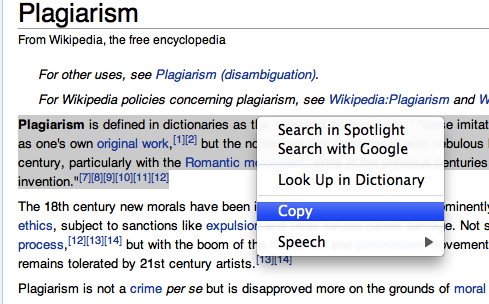
Copy and Paste

I always write everything in my own words; I’ve got plenty of my own words. Anyone who follows me on Twitter knows I don’t often find myself word-free. This doesn’t mean I’m plagiarism-free. In this world of big data, our unconscious minds synthesize and then spit out gobs of knowledge without remembering the source. We’re only human.

Another challenge that keeps us all from toeing the original-attribution line is the discussion of what qualifies as plagiarism. The definitions of intellectual property, copyright and fair use in the U.S. are so clouded up with legalese and popular opinion you can’t breathe let alone blog without violating the law or some random rule of etiquette. Twitter users violate laws daily. Bloggers are notorious for “stealing” ideas. Flickr photographers mimic. Even back-fence conversations with neighbors violate copyright each time a person tells a joke.

Forever Valued

The written word is the bearer of wondrous mystique. Sound vanishes. It’s heard in time and then it disappears. One cannot revisit a concert hall and expect to hear the sounds made the night before. Even if recorded, the live experience is gone. Written words, though, can last forever. I can visit a blog post and expect to see the words written the night before. In fact, if all goes well, I can visit the same blog post in 100 years and expect to see the same words posted there. Words are easily captured and kept online.

The written word has a powerful past. Historically, writing was an esoteric skill reserved for only the most elite. The written word was considered threatening to monarchies. Indeed, the written word can free slaves, start wars, end wars, birth nations and break hearts. Understandably, people tend to get a little crazed when a writer’s work is used without credit. We have to wonder, though, if the written word, especially in the form of a link or other curated object, is still as valuable as the rare and powerful words of the past.

A blog post is not of equal value to the Constitution of the United States. It isn’t more valuable than the daily banter at the corner barbershop. But once someone blogs Sweeney Todd’s daily orations, the words seem to gather more weight than necessary. People – especially those of a certain age – place banter into a different category once it’s posted; The value of online “print” is many steps above the value of the uttered phrase. Written words are a commitment, a treatise of sorts, a somewhat drastic move that we are taught to avoid unless necessary. We need to rethink this high value assessment.

People should be allowed to post their thoughts without the threat of repercussions or being accused of plagiarism. If we all followed the old adages “Never put anything in writing,” and “Always cite your sources,” there would be no Internet. Social networks, websites, and everything Internet-related (even YouTube) are all driven by text. Should we stop interacting online because we can’t remember, like humans often can’t, where we first heard or saw something interesting? Of course not. The old laws and traditional values placed on written words haven’t caught up to Internet culture and our current lives.

Governments are formed on written words. In documentation and legal areas the value of the written word remains, but not all words are of equal value. We must keep our contracts to keep our way of life, but to assign a blog post the same weight as the Constitution is a miscarriage of justice and a sure-fire way to sink our society. Instead let’s broaden our ideas of online communications and encourage innovation and creativity in groups and individuals.

Extractors, Exponents, and Experiencers

To put it simply, there are three types of people in this argument about plagiarism: Extractors, Exponents and Experiencers.

Extractors

Extractors are the criminals. They are the writers of software bots that steal and post blog entries with no linking credit. They are the writers of term papers from wikipedia articles. These people are crooks and no-one would disagree that what they do is stealing. We’re not talking about these types today.

Exponents

The Exponents will be sticklers for the perceived law or morality around plagiarism. Lawyers are at the extreme end of this spectrum and elementary school teachers are on the other end. I find many people in the start-up and early-adopter worlds fall under this category. Their tempers flare when patents or some anomalous idea is in play.

a pinterest "rule"

The start-up world, they argue, is based on ideas, and any infringement on intellectual property is considered stealing. Exponents can be found in all walks of life, not just in lawyerly circles. The non-techie users on popular inspiration-board website Pinterest.com post pointedly-typeset banners that declare pinners should always credit the source of the photos on their boards.

To Exponents, credit should always be given where credit is due, no exceptions. If you can’t remember the source, don’t relay the data. The Exponents are more individually-focused; they want to see the person or the organization get kudos for their original work.

Experiencers

The Experiencers are more concerned with moving ideas forward and less concerned with identifying the originator. Early adopters, tourists, and op-ed columnists sit on the agreeable end of the spectrum and the copycat businessmen lurk on the other.

Experiencers want ideas to “contribute to the canon” so to say. Experiencers want technology, thought and perhaps mankind as a whole to evolve. Individual work isn’t as important as entire movements that can effect change for the better. Experiencers would say a bucket needs many drops of water to get filled. Once one drop is next to another, we can’t tell which drop came first. Experiencers believe that ideas are like water – en masse and bonded to one another. Ideas are free, but the implementation is not. Experiencers ultimately admire not the idea generation but the application, the hard-work process of bringing the idea to life. The Experiencers would tell start-up entrepreneurs to concern themselves not with keeping their idea secret but with getting to market first and dominating the market best. The guy with the first filled bucket wins.

On The Range

Most of the time we all waiver between Exponents and Experiencers. We tend to be the stickler Exponents in our own field, widening the definition of plagiarism to the point where competitors are eliminated. We harbor fantasies of being untouchable in the market. We think any piece or concept surrounding our idea should be protected so we can have the time to fully develop it ourselves.

When it comes to areas of expertise outside our career paths, we tend to think like Experiencers and are more lenient on what constitutes plagiarism. We can see more clearly the “big picture” of ideas and think of their origins as more generally than individually based.

This jumping between views is all terribly convenient, of course, but that’s what it is to be human. It’s also a common practice in a crappy economy. We’re all worried about our livelihoods. When hard times hit, humans align themselves with allies. Tribes tighten their circles and work though famine times together. Since 9/11and the coincidental ubiquity of Internet access, many pundits have observed that people are searching out their like-minded cohorts online instead of listening to diverse voices (so much for the democratization of the Internet). Again, this is a human trait that has helped us survive for eons.

But we must fight any tendency, be it fueled by instinct or learned skill, to over- or under-play the importance of attributing credit. Too much stickling for the rules results in censorship. Too little attribution discourages creativity. Either extreme fosters fascism. If you believe in democracy, then you believe in discourse. Let’s encourage mature discussions as much as we can.

Copy These Tips

Here are some tips and techniques to consider when you’re passing on your knowledge.

Don’t Plagiarize

The University of Pennsylvania’s writing program has a helpful website for its students called “Tips for Avoiding Plagiarism.” Here’s the gist:

  1. Don’t procrastinate. Plagiarism happens most often when writers are pressed for time.
  2. Make a habit of taking notes and keeping records. (You can do this on Twitter, say, with the Retweet or Favorites functions. On Pinterest you can use the “Like” or “RePin” button. On Google + the +1 or Share button. Facebook has Likes and Shares also.)
  3. Don’t rely heavily on direct quotes. Use quotes only for effect, when necessary, and always keep them brief.
  4. Cite when you aren’t sure if it’s required. Err on the side of caution.

If you aren’t writing formally, perhaps just a blog post or a tweet, link to original ideas when you can but don’t let it stop you from publishing a thought. Here are some phrases you can use to avoid seeming like you are pirating ideas:

I heard this recently…
This topic came up…
I saw this on Twitter -speak up if you were the original post author-…
Have you heard about…
Why does it seem like everyone is talking about…
I’ve often wondered…
The idea that’s bouncing around the Internet…
I would modify this idea with…

Encourage Discourse

Here are some highlights from the article “Techniques for Group Discussion” from The Community Toolbox.

  1. Be aware of your biases.
  2. Don’t “beat a dead horse” – outline your points and then let someone else talk.
  3. Remember you aren’t the be-all, end-all expert in a topic.
  4. Monitor comments and follow-up.

Discuss

Anything to add? Comments commence.

-Christine Cavalier

0 comments

Book Review: The Psychology of the Girl with The Dragon Tattoo

Lisbeth Salander is one of the most intriguing literary characters of all time. A new book, The Psychology of the Girl with the Dragon Tattoo, examines Lisbeth’s character in depth. The book’s publishers, SmartPop (BenBella Books, Texas), recently sent me a copy for review.

Edited by a clinical psychologist and written by various PhDs in Psychology, The Psychology of the Girl with The Dragon Tattoo gets inside Lisbeth’s head in a more thorough and professional way than any fan or blogger could. The essays look at Lisbeth’s personality, decisions, and growth, e.g. her Goth appearance, the tattoos and body piercings, the silent stance, and even the significance of Lisbeth’s breast implants toward the end of the third Millennium Trilogy novel.

The Psychology of the Girl with The Dragon Tattoo not only looks into Lisbeth’s reasons behind her behavior, but places those behaviors in a larger society as a whole, giving us a broadened perspective on the beautiful logic and justice of Lisbeth’s joie d’ vive. In dissecting the hero of Lisbeth, the academics build up her character to the superhero proportions it deserves.

Lisbeth is truly the newest Titan of our day. Superman would want to whisk Lisbeth away to his bed but Lisbeth would geolocate the Fortress of Solitude within seconds and broadcast its GPS co-ordinates on the Internet. Spiderman would want to web her up but Lisbeth would nail his feet to the floor, then empty his accounts and publish his identity on Facebook. X-Men’s Storm would make Lisbeth laugh (then maybe Lisbeth would seduce her). James Bond 007 could learn quite a number of tricks from Salander, like international hacking techniques, disguises, videotaping, money laundering, weapons handling, and hand-to-hand combat theories. The Terminator would give Lisbeth pause but she’d find a way to either sleep with it or erase and reprogram its harddrive. Or both, in reverse order. Lisbeth is supremely capable and cannot be stopped.

How did Lisbeth get this way? What age-old mythology supports Lisbeth’s super-humanness? Why do people tattoo and pierce themselves? Why are we so uncomfortable when someone like Lisbeth doesn’t fit into one feminine or masculine profile? By the way, WTF is up with Sweden? What’s with the extreme sexism and the gnarly dudes in the books? What if Lisbeth Salander were real? What would happen then? Where would she have come from?

The Psychology of the Girl with The Dragon Tattoo answers all of these questions and more. Just take a gander at the book’s essay titles:

Part 1: The Girl with the Armored Façade
  1. Lisbeth Salander and the “Truth” About Goths
  2. The Body Speaks Louder than Words: What Is Lisbeth Salander Saying?
  3. Lisbeth Salander as Gender Outlaw
  4. What to Say When the Patient Doesn’t Talk: Lisbeth Salander and the Problem of Silence
  5. Mistrustful: Salander’s Struggle with Intimacy
Part 2: The Girl with the Tornado Inside
  1. Sadistic Pigs, Perverts and Rapists: Sexism in Sweden
  2. Broken: How the Combination of Genes and A Rough Childhood Contribute to Violence
  3. Men Who Hate Women But Hide It Well: Successful Psychopathy in the Millennium Trilogy
  4. If Lisbeth Salander Were Real
  5. Confidential: Forensic Psychological Report: Lisbeth Salander
Part 3: The Girl Who Couldn’t Be Stopped
  1. The Magnetic Polarizing Woman
  2. Resilience with a Dragon Tattoo
  3. Lisbeth Salander, Hacker
  4. Salander as Superhero 
  5. The Cost of Justice

These titles alone are enough to start active fan forum threads. Plus, the writing isn’t at all dry or academic – it’s accessible and flows, but is not in the least condescending to the normal reader. I do wish that some of the essays would’ve steered away from the typical pitfalls, e.g., the first essay on Goth cites statistics that affirm the stereotype of Goths but doesn’t fully examine how those stats are deceiving. Sometimes the analyses can be a bit off. Also, if you’ve read my reviews of the book, I don’t see Blomkvist as such a great guy; In this book he’s referred to as a good influence on Lisbeth (perhaps so, but Blomkvist is no prize himself). Another thing I had an issue with was the promulgation of the word “Girl” to describe Lisbeth. I understand the book is just riffing off the American title but as responsible citizens and members of the Psychology profession, I would have hoped for a bit more accuracy. (There’s a great essay about gender in the book, though, and it’s worthy of study by any top Women’s Studies university-level classes).

I did enjoy the book and will keep it as a reference for my own character studies in my writing. Enjoy the American version of the movie, which releases on December 21, 2011 and then pick up a copy of this book for the fan, the literary writer, the psychologist in you or your family. It’ll add depth to your knowledge and understanding of our most favorite modern-day hero, Lisbeth Salander.

-Christine Cavalier

 FROM THE PUBLISHER:

Book Details:

Title: The Psychology of the Girl with the Dragon Tattoo

Editors: Robin S. Rosenberg, PhD, and Shannon O’Neill

Publisher: Smart Pop, an Imprint of BenBella Books, distributed by Perseus Distribution

Publication: December 2011, $14.95 (CAN $18.95), Paper, ISBN: 9781936661343

Psychology, 256 pages, 5 1/2 x 8 1/4

4 comments

Huge Pile of Paperclips+Design=Carpety Goodness!

Big data is pretty useless by itself. So is a building-sized pile of paperclips, or an endless amount of pictures of your cat. A small few of those paperclips could save a school secretary some headaches with dead-tree records and maybe a dozen of those photos of Mr. KittyPants are worth enlarging for that montage you have planned for the bathroom, but thousands of entries in a category need one thing to become useful: a filter.

Tech companies are constantly tweaking algorithms to sort through the huge dumps of data that come out of places like Facebook, Twitter, MMORPG’s, or the whole of the Interwebz. Too much data exists for humans to handle, even if we hired entire continents of people to do it. It’s like a trip to another galaxy: we’d have to plan for multiple generations to be made during the trip, and it would still take eleventy billion years to get there.

But big data manipulators do have one advantage: humans populate the Internet. And what do humans do really, really well, even before they can speak? They love to categorize. Big sticks, little sticks, hard rocks, flaky rocks, young mates, old people, what have you. Our brains are programmed to filter.

Human behavior on the Internet is the same as human behavior in the caves of yore. We sort. We categorize. If we cannot sort of categorize, then the whole is disregarded. The modern office supply shopper will walk past a display of “fill your own box” bin of unsorted paperclips to go over to the nicely separated or packaged ones, even if they have to pay more. The enthusiastic home photographer may be smart enough to back up their massive photo file but they rarely take the effort to re-label and sort their work. How many attachments have you received with some title like IMG_7869.jpg? Exactly.

So, what’s a non-psychology-non-sociology-trained engineer to do? Look for the human filtering, that’s what!

Incorporate into your design some of the following algorithm-ready human filtering that are already present online:

  1. Twitter lists. Users filter followers/followees into lists. They spend human hours sorting people, according to their own opinion of those people, into categories. For the most part, lists on twitter are also named pretty aptly, like “philosophers” or “funny people” (we can also assume that those two categories are mutually exclusive). Your algorithm can compare the results of these human hours and then build results again. Perhaps you are looking for who’s famous in the paperclip community? Compare a bunch of Twitter lists, then find the most-mentioned person. Twitter’s API has a great amount of human filtering, you just need to know where to look. Language use is pretty common amongst cultures, certain terminology, etc. etc. Facebook groups will work in the same way (once the API is open).
  2. Tagging and Grouping on Photo Sites. Flickr is a great example of a community that puts in a lot of human filtering hours. They tag and group photos to within inches of their lives. Flickr users also have a low tolerance level for bullshit. They call out sneaky photoshopping, they gripe about mis-tagged photos. Many of them also share their exif data (fancy photo tech terms) of each photo. If a company needs to process photographic evidence that may come in droves, then a Flickr group is a perfect way to get humans to tell your algorithm whether or not the photos are legit. In Flickr’s design, human filtering is a key element. Also with Pinterest and other curation sites. Figure out a way to use that culture of filtering to your advantage. Then go pay Flickr lots o’ start-up cash for use of the API.
  3. Networks: The measurement and tracking of human networks online dominates the design thinking in every new website and app. It drives me crazy. The credibility measurement algorithms of Klout, Kred, PeerIndex, etc., all take number of Twitter followers into consideration. This is ludicrous and about as useful as our pile of perplexed paperclips. Followers can be bought and gamed, as is evidenced by #teamfollowback. Facebook networks are almost equally as useless, as users add total strangers to their Friends lists. What is useful, if anything, about follower numbers is the ratios that surround them. We can assume, say, that a user who is followed 5 times more than they follow and has no history of mentioning the terms “follow” “back” and “me” together and has built lists of people who also have similar high ratios, is a different sort of person who has mentioned those terms and does not build lists of users. This is not about the numbers in networks, it’s about the human behavior of users.

This are just a few beginning thoughts on how to harness the power of human behavior in your algorithm. Hire a Psychologist or Sociologist, or me, for that matter, to find you more easily-tapped, custom-fitted examples of online (and offline!) human filters that you can use in your website, application or algorithm design.

Anything to add? Let me know in the comments.


-Christine Cavalier

1 comment

Book Review: The Rare Find by George Anders

Book Review The Rare Find: Spotting Exceptional Talent Before Everyone Else by George Anders

Skip this book. In summary, here are the author’s 5 basic lessons for hiring talent:

  1. Don’t overlook people with “jagged” resumés. Look instead at the person’s career choices and skills they have learned and instincts they inherently have.
  2. Search for people who demonstrate resilience and creativity as well as the traditional skills like work ethic and reliability.
  3. Don’t assume management skills in one area translate to skills in another. Just because a person is a successful manager at a tech company doesn’t mean she will be great at managing a food manufacturer. Companies have different cultures.
  4. Analyze your current hiring methods and overhaul the ones that have led you to build ineffective work forces in the past. Your cutesy questions of “What is wind?” or “What is education?” may be bringing in the worst candidates.
  5. Nurture talent and foster a sense of purpose and belonging at the company.

Anders’ writing style is more on the academic rambling tradition than the quick, short, case studies of most pop-business books. The first few chapters were written in an introductory manner that jumps from example to example without as much as a conclusion or major question addressed. I kept turning back the pages to see if I was reading an elongated introduction or actual chapters.

Anders would have served us and the subject better if he had concentrated on just a few great examples per chapter and then followed it with an in-depth analysis of the concept he was trying to teach. Reading this book was like seeing a bunch of movie trailers that were cut down to 15 seconds each – you could see the common themes but the staccato barrage of information is disturbing and ineffective.

One more thing about the cases used in the book: I’d prefer it if Anders didn’t fall into the tired and very annoying cliché of sports analogies, especially when using sport team examples goes against one of his main tenets. Anders cites many sporting examples in the book, but one of the main lessons he purports to convey is that experience from one situation doesn’t necessarily translate into success in another. The spattering of sports examples, the overwhelming use of men’s examples and male-dominated industry cases also turned me off as a reader.

I feel like this book could’ve been great and exceedingly popular amongst very diverse markets if Anders just had a good editor. It seemed like Anders, being Mr. Bigtime Business Writer, intimidated the editor into entertaining his ADHD-like rants.

Anders’ points are valid and I appreciate his message. I wish he’d take this book off the market and sit down and re-write it for a more general audience. The thought of this may turn his stomach, but simplicity would have been the best policy for this subject matter. I fear the rambling quality of the book obscures the worthy lessons therein. It’s such a shame and a staggering disappointment. No change will be brought about by this book, because not enough people will read it and those who do read it will give it up by the third chapter. Sad.

Next time, maybe the publishers will adopt the lessons of the book and instead look to an underdog writer with a diverse background and evidence of passion and insight to write the book instead of a old white guy business writer with lots of New York Times best-seller juice.

They can always call me, of course. 🙂


Did you read The Rare Find? Let me know what you think in the comments.

4 comments

Why You’re Addicted to the Internet

Business Insider has a great post about human behavior that we all should read, 47 Mind-Blowing Psychology-Proven Facts You Should Know About Yourself. I’m not sure about the strength of that “facts” claim, but it seems like most of the research cited has been time-tested and repeated often. #8 is a fantastic explanation of how and why we are addicted to Twitter, Facebook, text messaging, email and Google search (from WhatMakesThemClick.net, author of the original 100 list, @thebrainlady on Twitter). [I’ve posted about the power of the intermittent reward system before; it is the dark side of The Force and it shan’t be ignored.]

Take a look through this run-down and try to shut down the laptop, put down the phone sometimes.

#8 — Dopamine Makes You Addicted To Seeking Information

#8 — Dopamine Makes You Addicted To Seeking Information

Image: xorsyst

Do you ever feel like you are addicted to email or twitter or texting? Do you find it impossible to ignore your email if you see that there are messages in your inbox? Have you ever gone to Google to look up some information and 30 minutes later you realize that you’ve been reading and linking, and searching around for a long time, and you are now searching for something totally different than before? These are all examples of your dopamine system at work.

Enter dopamine – Neuro scientists have been studying what they call the dopamine system for a while. Dopamine was “discovered” in 1958 by Arvid Carlsson and Nils-Ake Hillarp at the National Heart Institute of Sweden. Dopamine is created in various parts of the brain and is critical in all sorts of brain functions, including thinking, moving, sleeping, mood, attention, and motivation, seeking and reward.

The myth — You may have heard that dopamine controls the “pleasure” systems of the brain: that dopamine makes you feel enjoyment, pleasure, and therefore motivates you to seek out certain behaviors, such as food, sex, and drugs.

It’s all about seeking — The latest research, though is changing this view. Instead of dopamine causing us to experience pleasure, the latest research shows that dopamine causes seeking behavior. Dopamine causes us to want, desire, seek out, and search. It increases our general level of arousal and our goal-directed behavior. (From an evolutionary stand-point this is critical. The dopamine seeking system keeps us motivated to move through our world, learn, and survive). It’s not just about physical needs such as food, or sex, but also about abstract concepts. Dopamine makes us curious about ideas and fuels our searching for information. The latest research shows that it is the opoid system (separate from dopamine) that makes us feel pleasure.

Wanting vs. liking – According to Kent Berridge, these two systems, the “wanting” (dopamine) and the “liking” (opoid) are complementary. The wanting system propels us to action and the liking system makes us feel satisfied and therefore pause our seeking. If our seeking isn’t turned off at least for a little while, then we start to run in an endless loop. The latest research shows that the dopamine system is stronger than the opoid system. We seek more than we are satisfied (back to evolution… seeking is more likely to keep us alive than sitting around in a satisfied stupor).

A dopamine induced loop – With the internet, twitter, and texting we now have almost instant gratification of our desire to seek. Want to talk to someone right away? Send a text and they respond in a few seconds. Want to look up some information? Just type it into google. What to see what your friends are up to? Go to twitter or facebook. We get into a dopamine induced loop… dopamine starts us seeking, then we get rewarded for the seeking which makes us seek more. It becomes harder and harder to stop looking at email, stop texting, stop checking our cell phones to see if we have a message or a new text.

Anticipation is better than getting — Brain scan research shows that our brains show more stimulation and activity when we ANTICIPATE a reward than when we get one. Research on rats shows that if you destroy dopamine neurons, rats can walk, chew, and swallow, but will starve to death even when food is right next to them. They have lost the desire to go get the food.

More, more, more – Although wanting and liking are related, research also shows that the dopamine system doesn’t have satiety built in. It is possible for the dopamine system to keep saying “more more more”,  seeking even when we have found the information. During that google exploration we know that we have the answer to the question we originally asked, and yet we find ourselves looking for more information and more and more.

Unpredictable is the key — Dopamine is also stimulated by unpredictability. When something happens that is not exactly predictable, that stimulates the dopamine system. Think about these electronic gadgets and devices. Our emails and twitters and texts show up, but we don’t know exactly when they will or who they will be from. It’s unpredictable. This is exactly what stimulates the dopamine system. It’s the same system at work for gambling and slot machines. (For those of you reading this who are “old school” psychologists, you may remember “variable reinforcement schedules”. Dopamine is involved in variable reinforcement schedules. This is why these are so powerful).

When you hear the “ding” that you have a text – The dopamine system is especially sensitive to “cues” that a reward is coming. If there is a small, specific cue that signifies that something is going to happen, that sets off our dopamine system. So when there is a sound when a text message or email arrives, or a visual cue, that enhances the addictive effect (for the psychologists out there: remember Pavlov).

140 characters is even more addictive – And the dopamine system is most powerfully stimulated when the information coming in is small so that it doesn’t full satisfy. A short text or twitter (can only be 140 characters!) is ideally suited to send our dopamine system raging.

Not without costs — This constant stimulation of the dopamine system can be exhausting. We are getting caught in an endless dopamine loop.

Write a comment and share whether you get caught in these dopamine loops and whether you think we should use what we know about these systems to create devices and websites that stimulate them.

And for those of you who like research:

Kent C. Berridge and Terry E. Robinson, What is the role of dopamine in reward: hedonic impact, reward
learning, or incentive salience?: Brain Research Reviews 28 1998. 309–369.

Originally published on WhatMakesThemClick.net.

Read more: http://www.businessinsider.com/100-things-you-should-know-about-people-2010-11?op=1#ixzz1ceHpSNzo

4 comments