
Ideas spread like pollen

Many, many implications for our lives as data, our own personal memories, and what it means to learn.
 The earthquake and resulting tsunami in Japan and surrounding Pacific areas are the major news stories today. The footage is difficult to view. The devastation is severe.
Twitter users are linking to videos and news stories faster than any one person could consume them. The ubiquitous linking is typical behavior for Twitter users, who like to experience world events as a group. The tweets in my stream fell into two general camps today: 1. Serious grief and/or fascination with Japan’s tragedy. 2. Typical subject matter. These are two conflicting uses of a social networking application, and tensions arise between users. What’s happening here? How are we supposed to act online when tragic events take over the world? I think this conflict has some unique aspects. We will use the accepted grief stages to give us insight into what is really happening for users online.
As many of you know, famous psychologist Elisabeth Kubler-Ross outlined 5 stages in the personal grieving process: 1.Denial and Isolation, 2. Anger, 3. Bargaining, 4. Depression, and 5. Acceptance. These stages don’t have to occur in order, but even out of order, they don’t really apply to the social networking experience of tragic world events. Here are my updated stages for the online social network user:
1. Denial and Consolation: Denial is the shock and disbelief of that first link you see. Is it a joke? Is this legit? You click on the link, then the next one, then the next one, until you are satisfied that the tragic world event did indeed occur. Isolation turns into consolation, when users look to share information and opinions with others. At some point, the user becomes saturated with information and opinions and her desire to commiserate lessens.
2. Annoyance: Users express their frustration with others online who are not respecting or responding in the same manner. I saw more than one comment from users who were feeling the disconnection between the mundane and the major. Take these tweets from today, both of which have been retweeted:

It says: “The events in Japan are really a wake up call. Fashion, celebrity, everyday minutiae isn’t important. Family, friends, prayer & love are.” Tweet from user @bexmarie.

It says: “Natural disasters with such global impact as what #Japan & #Hawaii are facing really do put the minutiae of some tweets into focus, huh?” Tweet from user @msbruschetta.

It says: “Bitch said since japan had an earthquake ain’t no more sushi gon be made. WTF” Tweet from user @Marcshellafresh.
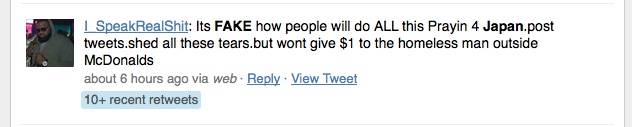
It says: “Its FAKE how people will do ALL this Prayin 4 Japan.post tweet.shed all these tears.but wont give $1 to the homeless man outside McDonalds” Tweet from user I_SpeakRealShit.
3. Engagement: Users may discuss their opinions on subjects surrounding the tragedy (e.g., survival rates, clean-up efforts, international aid money) with others, backing up their opinions with links, blog posts and other media. Some users feel the need to help, and begin to “donate” their updates by retweeting international organization tweets, like those of the Red Cross. Popular links are to grass-roots-type bulletin boards used for family and friends location and communications.
4. Depression or Internal Conflict: Users profoundly moved by the tragic event settle into a feeling of loss. They may stop tweeting for a bit, especially if they feel they’ve “done all they can” with their online social networking updates to help the victims of the tragedy. Others users, meanwhile, desire the return of the typical functionality of their online networks, but know they may be seen as superficial or trivial by other users. These conflicted users wonder what to do: Isn’t Twitter meant for trivial things? Why do I look like a jerk if I link to this Funny-or-Die video right now?
5. Normalization: Eventually almost all users will return to their typical tweeting behavior.
So, how do we all get along? Should there be a general rule during tragic events that no-one should tweet trivially? Is the grief experienced by the tragic event tweeter to be dismissed as surface and opportunist?
Before we answer these questions definitively, let’s consider another phenomenon called “compassion fatigue.” Compassion fatigue is the description for feeling burnt out from intense caregiving to victims of a tragedy or from being asked to apply deep feeling to a situation. While online users don’t usually come close to a clinical diagnosis of compassion fatigue or its symptoms of stress, depression, hopelessness, and negativity, I think we all experience a version of this fatigue when we are exposed to impossible amounts of information about a tragic event. At some point we move past feeling informed to feeling overwhelmed. In fact, I’d argue that online social network users are in a constant state of compassion fatigue, in amounts directly proportional with the time a user spends online. The general information/compassion fatigue is related to what the traditional news media producer feels daily: a total over-saturation of the human condition. A general cynicism and protective barrier around the more sensitive parts of one’s personality are needed to be able to weather the daily onslaught of bad news. In other words, being online all day isn’t for the weak.
So keep this constant basal state of compassion fatigue in mind when you see tweets of any nature. It’s difficult, but we need to respect each other’s usage. If a user wants to link like crazy to CNN updates that you don’t want to see, unfollow them for a bit or use a third party application to “mute” them for a few days. If you want to link to FAIL BLOG videos, feel free. Your affected followers may be disappointed to unfollow you or mute you, but that’s what they may need to do if I truly feel the gravity of the emergency situation. Tweet and let tweet, follow and let unfollow, of course. Online use involves a certain amount of hardened resolve, but we must not let our tolerance of others wane in the process.

Need a bigger bubble. Photo by Christine Cavalier
Three recent incidents, yesterday’s being the most shocking, have ripped a hole in my cozy tech bubble. They were painful, but they were good for me.
I consider myself an educator. Educating Internet users about human behavior, media psychology and sociology is the purpose behind this blog and the main focus of my social media consulting work for marketing departments and other business leaders.
Probably just like you, I spend most of my time connected. Like a lawyer navigating the legal system, I’m a techie that adapts tech to fit my life. A lawyer isn’t afraid of getting sued; I’m not afraid of new technologies. I can see past the user interface and into the design model (and sometimes get quite annoyed with it). I was practically born into tech; I speak the language. Natural acumen combined with constant application makes (most of) my tech-enabled time online and off go smoothly.
This is great, but the downside is that I forget what life is like for the majority of people. (This is not so great if I consider myself an educator.) So you can imagine the shock when I’m out and about in the world and I interact with natives who don’t speak the language. Read on to see what happened, what I learned, and why I want you to burst your own bubble every once in a while, too.
The first “Say what?!” shock came a few weeks ago when a fellow grade-school mom and I were chatting about cell phones for kids. She had asked me what model phone we bought my 10 year old. I told her, and I directed her also to my article in the Philadelphia Inquirer about kids and cell phones. As we were chatting about the perils of Internet access on devices used by grade-schoolers, this mother, who is a first grade teacher herself and the same age as I am, tells me that her phone has Internet access but no data plan. As I was looking over her phone, she shows me a button on the screen that connects the phone to the Internet. The button is in a convenient spot, obviously, which means it gets hit by mistake often. Each time the Internet gets activated, US$2.00 in data charges go on her bill. She gets charged the 2 bucks even if she shuts down the mobile browser immediately. The design of her phone would encourage, nay, force, accidental or intentional hitting of this button.
I asked her if she called the provider and asked if this phone could be blocked from data access. She said that when they bought the phones and the plan, the provider made it seem like that all phones on the plan needed to have the data access. Her husband needs the data access for work, so she didn’t “make any waves” with the provider. Now that a few months have gone by and she’s seen the ridiculousness on her bill, she started thinking she needed to buy a new phone, one without data access.

Tech Basics. Photo by Christine Cavalier
This is when I started getting really annoyed. This is great for the phone company, right? They get to collect at least $20/month in data charges from this woman for her innocent mistakes and the (probably intentional) bad design of the phone. And now she thinks she has to spend more money to save on the charges. I told her the provider’s attitude and charges were totally wrong, to call and demand the phone be blocked from data access immediately, and tell them to forgive the other mistake charges (which are easily identified by the numbers: 0 seconds access time and 0 sites visited). I was so pissed that this provider would take advantage of their own customer like that. It’s ridiculous to tell (or even hint to) customers that your mobile service infrastructure can’t block certain phone numbers/phones from data access. This (major, national band) provider just wanted to get that extra money out of the pockets of the under-educated. I can’t tell you how much that pissed me off. I haven’t followed up with her yet but I hope she did call the provider and “gave them a piece of her mind” (as my mother used to say).
The next small incident is kind of typical, but still just as shocking. I was with another fellow grade school parent in my town. This person is starting a small business and needed online marketing advice. I usually have the wisdom to stay away from these quagmires, but this started out as a friendly request. We worked out an agreement and I started working on a few things. First thing we did was do a Google search on the company name. My client was shocked that his company name wasn’t at the top of “the list” (read: search results). He had paid for an online Yellow Book listing and assumed that meant he would come up in a Google search. I asked him to give me the URL of the Yellow Book [continue reading…]
 The pics from this event are up on Flickr. I have to say, though, I didn’t do so well with my new lens. I have to find a way to focus that thing in low light. Also, the color balance is all red, red, red. I’ll try to fix this later in post-production. Still, enjoy the pics, and it was nice meeting (almost) all of you tonight in Wayne, PA at Christopher’s. Thanks to Philly Marketing Labs for arranging.