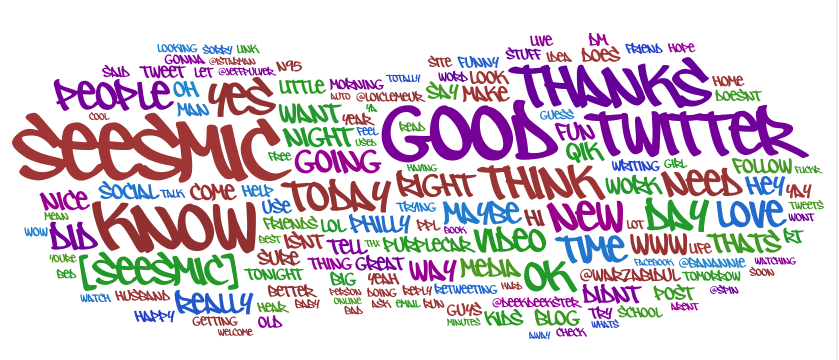
Recently, Twitter user @soluzioni asked me the following question:
“Hi Christine! Since u seem to use Twitter lots, what are ur insights on the in-effectiveness of visualising threaded discussions? ..-)”
Although I love a good academic chat about Twitter, I didn’t understand this question at all. @soluzioni isn’t a native English speaker, and at times foreign users adopt too many buzzwords or odd habits. My first impression was, “What is ineffective about thinking of improving how we look at threading?” My second thought was, “Either threads are there or they aren’t.”
I ran this question and @soluzioni’s next one (“‘Nothing too clever’: a couple of connections / pivot points to who+what to facilitate context.” [-I think he’s trying to dumb it down for me]) past my rhetoric-busting husband. He suggested that perhaps @soluzioni, whose bio has references to mind mapping, was trying to create a way to represent visually the links between posts in a threaded discussion.
I can understand that. The “ineffective” part threw me off. Anyway, I’m going to work with the premise that @soluzioni is unhappy with the status quo of conversation mapping on the web.
Basically, a forum thread looks like this:
Main question
—>reply
—>reply
—->reply to a reply
—>reply
—->reply to a reply
—–>reply to the reply to a reply.
The first “main question” post is either at the top or the bottom of the page. Then replies are off-set under the main post. Replies to replies are offset even more. Many times, a user will click the “reply” button under the main question but continue on with a point brought up in one of the already existing replies. This means that if you want to follow the discussion, you have to spend the time viewing every single reply entry embedded under the “main question,” no matter what level of offset they are.
This type of chronological map is the simplest way to “follow” a conversation on-line. Unfortunately, the 140 character limit of Twitter makes it impossible to classify your conversation over multiple users and instances. At times people use hashtags (a # symbol followed by a term that reflects the conversation, e.g., #eaglesfootball) but hashtags still take up space and may not reflect all of the relevant topics in a conversation.
Some 3rd party Twitter API apps have attempted to thread Twitter conversations, and they do a decent job of capturing and offsetting immediate replies. But the more people you “have in your room” the more fragments will occur. Without hashtags (which people forget to add anyway), it’s impossible to capture all of the ideas that swarm during a Twitter conversation.
For businesses or people trying to gather ideas via social-media crowd sourcing, this is devastating. Even 1,000 Google alerts honed in on Twitter won’t bring you the little gem of an idea offered by a small-crowd Twitter user. I propose a different method.
I’d like to see a 3rd party app that can build keyword clouds from Twitter entries. I’d like this app to be highly customizable. I want to be able to mark the first “main topic” Twitter entry (a.k.a. “tweet”), then I’d like to modify the user span from which the app will draw keywords, then I’d like to put a time limit on it.
Here’s an example of using this fantasy application:
I put this entry into Twitter:
“Your company wants to start using Twitter as a business tool. How do you advise the use of social media to them?”
I then fire up my fantasy app. I link to my original entry.
I click the option of “all conversation” (as opposed to “only @replies”).
I put a time limit on it by clicking “in the next hour.”
The app first uses a Twitter search to see replies to me (@PurpleCar).
But, and this is where it gets innovative, the app also takes a catalog of all my followers and all THEIR followers, and makes a keyword cloud out of EVERYTHING they ALL tweet in the next hour. If one of your follower’s followers (3 tiers away from you) has more followers than say, 95% of all Twitter users, then that user’s tweets can be pulled into the keyword cloud (this would address “reach” — like a 6 degrees of separation concept — how far do your ideas reach around the Twitter community). The app, after an hour, would give you a reach score and a keyword cloud based on your choices. If your main topic’s keywords show growth (easier if they are very unique words), you can assume that you’ve started a conversation.
This keyword cloud along with some well planned Google blog search and keyword search over the next few days could lend a pretty reliable picture of what people in your community are talking about.
We are a LONG way away from this fantasy app. For the app to be effective, it would have to automatically abbreviate your words (e.g. “business” to “biz” or “bus”), have serious drive abilities (I have over 2,000 people in my room, most of whom are online when I am, and a lot of my followers have more than a few hundred followers themselves), and have total access to the Twitter API. None of those things is possible right now. It’s almost on the verge of artificial intelligence AND NASA-fast CPU’s AND server health and security at Twitter (the last of which is the most impossible option of all).
But, keyword clouds, twitter search and Google alerts exist, so with a bit of work you can fashion your own keyword cloud for a certain group of users over a certain amount of time. You’d have to work on a very small scale, but sometimes big ideas come from just one small voice. You just need to find a way to hear that tiny peep in the darkness.
I hope @soluzioni wasn’t too insulted, and I hope this answers his question about my insights into the threaded (or lack of threaded) conversations on Twitter.
UPDATE: 19 January 2009:
Erich from the comments reminded me via Twitter of tweetstats.com and wordle.net. I made a nice “wordle” of my Tweets – it’s a keyword cloud of the most used terms by me. You can see it here. It is for ALL of my Tweets since I started with the app in 2007.